

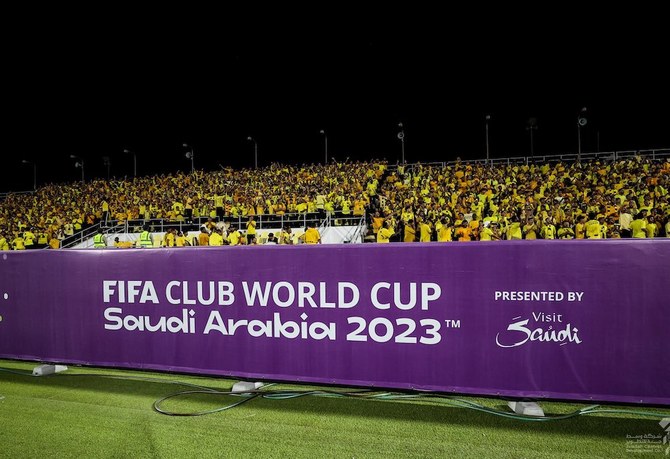

RIYADH: Saudi Arabian teams have a good record in the FIFA Club World Cup but for the first time it will take place on home soil. That gives Al-Ittihad extra support, incentive as well as pressure.
The first Saudi team to participate was Al-Nassr who went to Brazil for the old FIFA Club World Championship. In a tough group, the Riyadh team finished third, losing to Real Madrid, beating Raja Casablanca, and then going down to local team Corinthians.
Al-Ittihad played at the first tournament in its current format in 2005 as they went to Japan as Asian champions.
It started with a 1-0 win over Al-Ahly (the Egyptians lay in wait on Friday, assuming Al-Ittihad beat Auckland City on Tuesday). On a cold Japanese evening, talismanic midfielder Mohammed Noor got the only goal of the game with 12 minutes remaining, getting to a cross before goalkeeper Essam El-Hadary and then belting the loose ball home from close range.
That was enough to book a semi-final against Sao Paulo. It was always going to be difficult against the South American champions and in front of more than 30,000 fans in Tokyo, Al-Ittihad gave it a real good go. Most of the crowd were there to support the Brazilians but the Saudis got a standing ovation at the end.
It was 1-1 at the break as Amoroso put Sao Paulo ahead before Noor equalized. Amoroso and then Rogerio Ceni, the highest-scoring goalkeeper in the history of football, netted from the penalty spot.
Asian player of the year Hamad Al-Montashari made it 3-2 midway through the second half to set up an exciting finish but Al-Ittihad just could not get the equalizer and then went on to lose to Costa Rica’s Saprissa in the third and fourth place play-off by the same 3-2 margin.
Saudi Arabia then had to wait until 2019 for their next appearance as Al-Hilal ended the drought in the Asian Champions League by defeating Urawa Reds of Japan. In many ways for Saudi Arabia, the 2019 FIFA Club World Cup was a mirror of what happened in 2005, though it took place in Qatar and not Japan.
It started with a 1-0 win over the African champions, this time Esperance de Tunis. Bafetimbi Gomis got the all-important goal. That earned a semi-final against a giant from Brazil. Salem Al-Dawsari put the Blues ahead to send thousands of fans in Doha wild with delight. But it was not to last as Flamengo hit back to win 3-1. The Riyadh giants outshot the South Americans but just could not get the goal needed.
That meant a match for third place with Monterrey. After the game ended 2-2, with Carlos Eduardo and Gomis scoring, it went to penalties with the Mexican team winning 4-3. Eduardo and Mohammed Kanno failed to convert.
It once again demonstrated that Saudi Arabian teams could compete on the global stage and Al-Hilal had another chance in 2021 in a tournament.
That started with a 6-1 thrashing of hosts Al-Jazira of the UAE. There was plenty of attacking talent on display on that day in Abu Dhabi with Odion Ighalo, Matheus Pereira, Kanno, Al-Dawsari, Moussa Marega, and Andre Carrillo all getting on the scoresheet.
Instead of South American semi-final opposition, the Blues of Riyadh faced the Blues of London. Chelsea ended up winning 1-0 but it was a fine performance from Al-Hilal who more than matched the European champions. Romelu Lukaku scored just after the half-hour.
If that was impressive, the match for third place was a disaster and it ended in a 4-0 loss to Al-Ahly. By the half-hour mark, Al-Hilal were two goals down and two men down as Pereira and Kanno were dismissed. Also dismissed soon after was head coach Leonardo Jardim. It was a low point but under his replacement Ramon Diaz, the team then went on a winning spree at home and won an unlikely league title.
Al-Hilal were back for the 2022 edition held in 2023, to deliver a truly memorable performance.
In February, it started with a tricky game against African champions Wydad Casablanca, in front of 44,000 fans in Rabat. It was a fighting display. Going a goal behind early in the second half, Al-Hilal looked to be on their way out. Yet, with seconds remaining Kanno scored to take the game into extra time and almost as soon as it started, the midfielder was sent off.
Despite that, the Saudi Arabians took the game to penalties when young midfielder Musab Al-Juwayr scored the decisive penalty.
Then came the usual semi-final against Brazilian royalty but this time the result was anything but usual. Al-Hilal won 3-2 against Flamengo. Al-Dawsari scored twice from the spot in the first half, a brace that sandwiched a Pedro goal. Luciano Vietto then extended the Asian champions’ lead with 20 minutes remaining and they held out for a famous 3-2 win.
That earned a first Saudi Arabian final against Real Madrid when Al-Hilal gave as good as they got, losing 5-3 in a wildly entertaining game against the mighty European champions.
It meant that Al-Hilal returned home with their heads held high –though it came at a cost in terms of fatigue in their later domestic form.
Just three months after Saudi Arabia’s World Cup win over Argentina, it showed once more that the country was a football force. There has been more attention since with all the big-name signings and headlines.
It means that Al-Ittihad, playing on home soil, have much to live up to in terms of Saudi Arabian history in the tournament as well as global expectations.


