

Al-Ittihad look to Al-Hilal’s example at FIFA Club World Cup

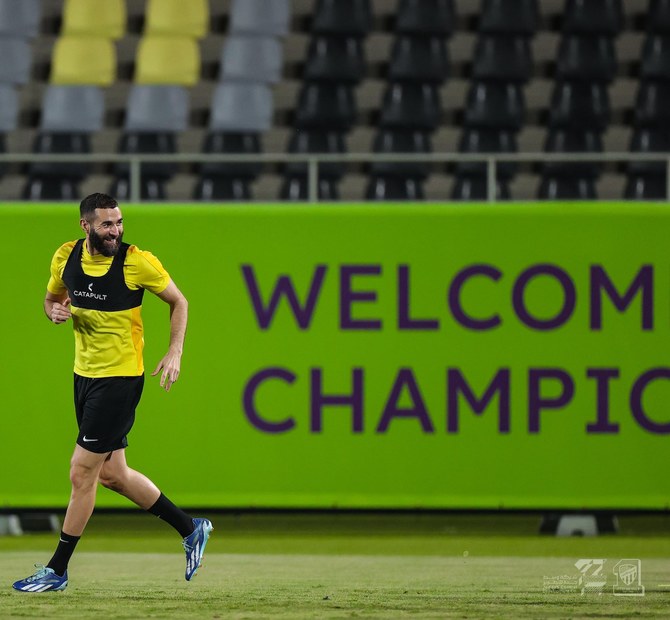
Karim Benzema will lead Al-Ittihad at the FIFA Club World Cup 2023. (@ittihad)
Short Url
Updated 11 December 2023
Follow

Al-Ittihad look to Al-Hilal’s example at FIFA Club World Cup

  • Reigning Saudi champions can take heart from fierce rivals’ march to last year’s final as they look to put poor form behind them

RIYADH: If Al-Ittihad are looking for a positive spin on their patchy form heading into the FIFA Club World Cup, which kicks off in Jeddah this week, they need look no further than their fierce Saudi rivals, Al-Hilal.

It was only earlier this year that the Riyadh giants embarked on their own Club World Cup campaign, and they did so on the back of a run of form domestically that saw them win only three of their seven matches before the tournament began, and included a shock loss to Al-Fayha in their penultimate match before jetting off for Morocco.

But wins over Wydad Casablanca and Flamengo saw them become only the third Asian club to make it through to the final, where they put in an impressive showing in a 5-3 defeat to Real Madrid.

On the scoresheet that night for the Spanish giants was a certain Karim Benzema, who will headline the star names for Al-Ittihad as they open their campaign against Oceania champions Auckland City on Tuesday.

That will give comfort to Marcelo Gallardo after his side suffered a shock 3-1 defeat at the hands of mid-table Damac over the weekend, a loss that has seen them fall 16 points behind Al-Hilal and drop to fifth place in the Roshn Saudi League.

Having won four of their previous five after parting ways with last season’s title-winning coach Nuno Espirito Santo, it is a loss that might also have shaken some of the confidence in the Ittihad side as they come to terms with life under Argentine Gallardo.

Despite the apparent gulf between the two sides, Gallardo knows there is no room for any complacency against the New Zealand side, who are no strangers to this stage, this being their 11th appearance.

They have also proved to be giant-killers in the past as well, finishing third at the 2014 tournament in Morocco.

“Any game in the Club World Cup is always very tough,” Gallardo is quoted as saying on the FIFA website.

“The first game always has the nervousness factor too. It’s one game only, a knockout match, you need to win to stay alive in the competition. We know Auckland will be tough to beat.”

Goalkeeper Marcelo Grohe also chooses to toe the party line, while saying the side are taking it one game at a time, but does admit: “It costs nothing to dream.”

With the talent they now have at their disposal — the likes of Benzema, N’Golo Kante, Fabinho, Igor Coronado, and Romarinho to name just a few — there is no reason Al-Ittihad should not be dreaming big and looking to match what Al-Hilal did last year.

But they enter the tournament carrying a far heavier burden than their Riyadh rivals did earlier this year.

Such has been the transformation in Saudi football over the past 12 months, it is no stretch to say Al-Ittihad are carrying the entire reputation of Saudi football on their shoulders.

While the investment is about far more than just results at the Club World Cup, it offers the first opportunity for Saudi football to show its wares on the international stage, and a good performance will go a long way to showing that Saudi football is indeed heading in the right direction.

A poor performance, however, and the critics will very quickly, and only too happily, rush to judge the Saudi splurge as an expensive flop.

While Al-Ittihad will attract most of the attention over the first week, it is worth remembering they come to the tournament merely as hosts rather than Asian champions.

That title belongs to Japan’s Urawa Red Diamonds, making their third appearance at the Club World Cup after third (2007) and fifth-placed (2017) performances previously.

Like Al-Ittihad, they arrive in Jeddah on the back of a run of poor form that saw them not only slip from the top three on the final day of the J. League season, but also crash out of the AFC Champions League in the group stage after a shock defeat to Vietnam’s Hanoi FC last week.

Then there is the rather peculiar situation with the position of head coach.

Poland’s Maciej Skorza has already announced his departure after just one season in Japan, with Norwegian Per-Mathias Hogmo announced last week as his replacement.

Skorza will still take the reins in Jeddah, however, despite the fact he has already tendered his resignation and his successor has been appointed.

Should either Al-Ittihad or Urawa make the final, they will become the fourth team from Asia to do so in the last eight years — a nice feather in the cap for football in this region, in what is the last tournament to be played under the existing seven-team format.

By the time the next Club World Cup rolls around, to be played in the US in 2025 with 32 teams, we could see multiple Saudi clubs competing. It is just Al-Ittihad this time, but the whole world will still be watching.


Rocky 2025 for Green Falcons leaves Saudi fans anxious ahead of 2026 World Cup

Updated 29 December 2025
Follow

Rocky 2025 for Green Falcons leaves Saudi fans anxious ahead of 2026 World Cup

  • Herve Renard’s team secured a seventh qualification for the Kingdom, but the year ended in disappointment after the semifinal exit at the Arab Cup


RIYADH: Just over three years ago, the Saudi men’s national team did the unthinkable, defeating eventual world champions Argentina in their opening match at the 2022 FIFA World Cup.

As the 2026 World Cup approaches, with just under six months until the Green Falcons kick off against Uruguay, the contrast in sentiment surrounding the national team could hardly be starker.

The road since 2022 has been anything but smooth. While Herve Renard was head coach during Saudi Arabia’s memorable 2022 campaign, this is now his second tenure in the Kingdom. A brief spell under Roberto Mancini, one many Saudi fans would rather forget, saw progress stall on the road to 2026.

Despite significant excitement surrounding Renard’s in October 2024, the second chapter so far has failed to inspire.

A draw against Australia and a loss to Indonesia marked the beginning of Renard’s return, followed by an underwhelming campaign at the 26th Gulf Cup. Saudi Arabia did make it through to the semifinals, but for a nation that has not lifted a trophy since early 2004, supporters were desperate for silverware, even at the regional level.

There were signs of improvement at the start of 2025. Wins against China and Bahrain, alongside a draw in Japan, left the Greens one victory away from direct World Cup qualification — albeit requiring a favorable swing in goal difference after Australia’s last-minute win over Japan.

However, defeat to Australia, followed by another disappointing campaign, this time at the 2025 Gold Cup in the US, saw fans’ pessimism creep back in ahead of the fourth round of World Cup qualification.

A narrow win over Indonesia, coupled with a draw against Iraq, meant Saudi Arabia ultimately secured World Cup qualification for the seventh time. With the 2025 Arab Cup on the horizon, the Greens found themselves at a crossroads: Win the Arab Cup, and momentum heading into 2026 would be sky-high. Lose, and uncomfortable questions would resurface.

Saudi Arabia did reach the knockout stages, but once again, doubts remained. Renard’s trip to the US for the World Cup draw meant he missed out on the Comoros group stage clash, and that did little to ease concerns. Still, the Greens were three matches away from their first title in 21 years.

Palestine proved stern opposition in the quarterfinals, but Mohammed Kanno’s late intervention sent Saudi Arabia through to face Jordan, the 2023 Asian Cup finalists.

Jordan’s rise has increasingly unsettled the Saudi fanbase. Between 1970 and 2018, Saudi Arabia had lost to their neighbors just three times in 11 meetings. That has all changed since 2019, with Jordan triumphing in three of their last four outings against the Greens.

They would ultimately make it four from five, as a solitary second-half goal was enough to launch Jordan to their first-ever final, and disappointment once again took over the Saudi camp.

That result intensified calls for Renard to be sacked ahead of the World Cup. Rumors suggested his departure was imminent, but the Saudi Arabian Football Federation swiftly denied anything of the sort.

It is worth noting that Renard himself has already made history, becoming the first coach to lead Saudi Arabia to World Cup qualification in 2022 and remaining in the role for the start of the tournament. Should he remain in charge for 2026, he would also become the first to manage the team at two consecutive World Cups.

Yet while SAFF and Renard turn their attention to their next challenge, Saudi fans remain anxious.

Speaking to Arab News, local fan Ahmed Al-Bawardi said the issue extends beyond results. “It’s not so much about the results, but the national team’s identity,” he said.

“We don’t look like a well-oiled team on the pitch, and we don’t feel the same excitement as we did in 2022.”

Asked whether he would like Renard to stay, Al-Bawardi added: “Sacking Renard might solve some problems, but what we’re seeing is deeper than just bad tactics.”

Renard himself has repeatedly pointed to the limited game time afforded to domestic players in the Roshn Saudi League. Al-Bawardi responded with a sentiment shared by many Saudi fans: “The Premier League is the best in the world. How many domestic players start there?”

According to TransferMarkt data for the 2025/26 season, the Premier League has 544 players registered, 388 of whom are foreign — a staggering 71 percent. The Roshn Saudi League, by comparison, is still some way off — only 37.5 percent of the league’s players are foreign.

Balancing the national team’s development alongside the league’s rapid expansion was never going to be easy. Nor was switching managerial philosophies, only to return to one whose previous work was partially undone.

As Saudi Arabia looks ahead to 2026, unease remains among the fanbase. With a World Cup group that includes former world champions Spain and Uruguay, the road to the US, Mexico and Canada may still prove to be rocky.