

Gaza war having ‘catastrophic’ health impact: WHO chief

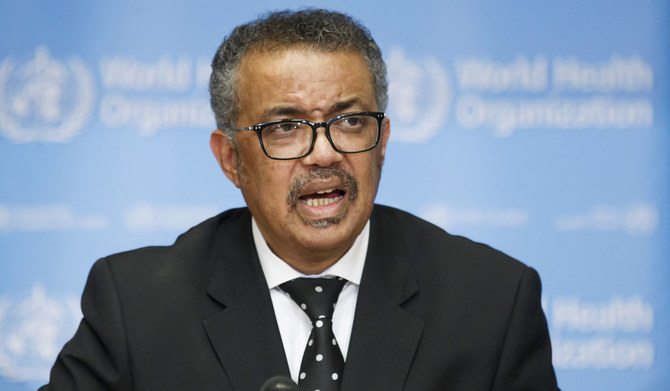
Tedros Adhanom Ghebreyesus, Director General of the World Health Organization (WHO). (AP)
Short Url
Updated 11 December 2023
Follow

Gaza war having ‘catastrophic’ health impact: WHO chief

  • There is no health without peace and no peace without health, Tedros Adhanom Ghebreyesus tells special session

GENEVA: The war between Israel and Hamas is having a catastrophic impact on health in Gaza, the WHO chief warned on Sunday, with medics facing an “impossible” job in unimaginable conditions.

Tedros Adhanom Ghebreyesus told a special session of the World Health Organization’s executive board that the Palestinian territory’s health system was in free fall.
“The impact of the conflict on health is catastrophic,” Tedros told the Geneva meeting.
“As more and more people move to a smaller and smaller area, overcrowding, combined with the lack of adequate food, water, shelter and sanitation, are creating the ideal conditions for disease to spread,” he said.
The UN health agency’s chief said there were worrying signs of epidemic diseases — and the risk was expected to worsen with the situation deteriorating and winter conditions approaching.
“Gaza’s health system is on its knees and collapsing,” Tedros said, with only 14 out of 36 hospitals functioning with any capacity at all, and, only two of those in the north of the coastal territory.
Only 1,400 hospital beds out of an original 3,500 are still available, while the two major hospitals in southern Gaza are operating at three times their bed capacity, Tedros added.
Tedros said that since Oct. 7, the WHO had verified more than 449 attacks on healthcare in Gaza and the occupied West Bank, and 60 on healthcare in Israel.
“The work of the health workers is impossible, and they are directly in the firing line,” he said, with medics who are “physically and mentally exhausted and are doing their best in unimaginable conditions.”
“There is no health without peace and no peace without health,” Tedros concluded.
The special session was called by 17 of the 34 countries on the executive board, which normally meets twice a year. Its main job is to advise the World Health Assembly, the WHO’s decision-making body, and then implement its decisions.
A draft resolution proposed by Afghanistan, Morocco, Qatar and Yemen calls for the immediate, sustained and unimpeded passage of humanitarian relief into the Gaza Strip and the granting of exit permits for patients.
It seeks the supply and replenishment of medicine and medical equipment to the civilian population and for all persons deprived of their liberty to be given access to medical treatment.
It voices “grave concern” at the humanitarian situation, laments the “widespread destruction,” and urges protection for all civilians.
Palestinian Health Minister Mai Al-Kaila, speaking via video link from Ramallah, called for the immediate cessation of the “brutal war in Gaza” and the immediate, unconditional flow of fuel, water, aid, and medical supplies into the territory.
“The daily horrors we all witness defy international law and shatter the essence of our shared humanity,” she said.
“Now is the time for decisive action. The world cannot stand neutral while innocent lives are lost, and the basic rights of the Palestinian people are compromised.”
Meirav Eilon Shahar, Israel’s ambassador in Geneva, said that on Oct. 6, “there was a ceasefire with Hamas. On Oct. 7, we woke up to a new reality.”
She said Israel’s military operation “is directed toward Hamas. It has never been against the Palestinian people. And I recognize the suffering in Gaza.
“Let there be no mistake, however: Hamas is responsible for this suffering.
“The reality is, if we stop now, Hamas will carry out another Oct. 7.”


Lebanon PM publishes long-awaited banking law draft

Updated 4 sec ago
Follow

Lebanon PM publishes long-awaited banking law draft

  • The law stipulates that each of the state, the central bank, commercial banks and depositors will share the losses accrued as a result of the financial crisis.
  • Depositors with a limit of $100,000, over the course of four years

BEIRUT: Lebanese Prime Minister Nawaf Salam published on Friday a long-awaited banking draft bill, which distributes losses from the 2019 economic crisis between banks and the state.
The draft law is a key demand from the international community, which has conditioned economic aid to Lebanon on financial reforms.
In a televised speech, Salam said “this draft law constitutes a roadmap to getting out of the crisis” that still grips Lebanon.
The draft will be discussed by the Lebanese cabinet on Monday before being sent to parliament, where it could be blocked.
The law stipulates that each of the state, the central bank, commercial banks and depositors will share the losses accrued as a result of the financial crisis.
Depositors, who lost access to their funds after the crisis, will be able to retrieve their money, with a limit of $100,000, over the course of four years.
Salam said that 85 percent of depositors had less than $100,000 in their accounts.
The wealthiest depositors will see the remainder of their money compensated by asset-backed securities.
“I know that many of you are listening today with hearts full of anger, anger at a state that abandoned you,” Salam said.
“This bill may not be perfect... but it is a realistic and fair step toward restoring rights, halting the collapse.”

- ‘Banks are angry’ -

The International Monetary Fund, which closely monitored the drafting of the bill, had previously insisted on the need to “restore the viability of the banking sector consistent with international standards” and protect small depositors.
The Associations of Banks in Lebanon criticized the draft law on Monday, saying in a statement that it contains “serious shortcomings” and harms commercial banks.
“Banks are angry because the law opens the door to them sharing any part of the losses,” said Sami Zougheib, researcher at The Policy Initiative, a Beirut-based think tank.
He told AFP that banks would have preferred that the state bear full responsibility.
The text provides for the recapitalization of failing banks, while the government’s debt to the Central Bank will be converted into bonds.
Salam said that the bill aims to “revive the banking sector” which had collapsed, giving free rein to a parallel economy based on cash transactions, which facilitate money laundering and illicit trade.
According to government estimates, the losses resulting from the financial crisis amounted to about $70 billion, a figure that is expected to have increased over the six years that the crisis was left unaddressed.
Since assuming power, Salam and President Joseph Aoun have pledged to implement the necessary reforms and legislation.
In April, Lebanon’s parliament adopted a bank restructuring law, as the previous legislation was believed to have allowed a flight of capital at the outbreak of the 2019 crisis.
The new bill stipulates that politically exposed persons and major shareholders who transferred significant capital outside the country from 2019 onwards — while ordinary depositors were deprived of their savings — must return them within three months or face fines.
The draft law could still be blocked by parliament even if the cabinet approves it.
“Many lawmakers are directly exposed as large depositors or bank shareholders, politically allied with bank owners, and unwilling to pass a law that either angers banks or angers depositors,” Zougheib said.
Politicians and banking officials have repeatedly obstructed the reforms required by the international community for Lebanon to receive financial support.