

Israel aims to expel Palestinians from Gaza, Jordan says

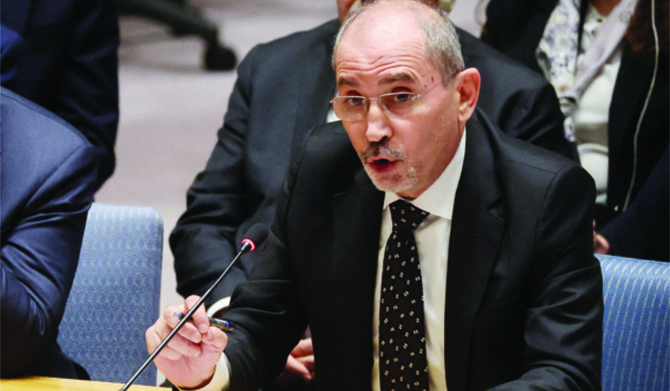
Jordanian Foreign Minister Ayman Safadi speaks at the forum. (AFP)
Short Url
Updated 11 December 2023
Follow

Israel aims to expel Palestinians from Gaza, Jordan says

DOHA: Jordan’s Foreign Minister Ayman Safadi on Sunday said that Israel was implementing a policy of pushing Palestinians out of Gaza through a war that he said meets the “legal definition of genocide.”
Safadi, whose country borders the West Bank and absorbed the bulk of Palestinians after the creation of Israel in 1948, also said that Israel had created hatred that would haunt the region and define generations to come.
“What we are seeing in Gaza is not just simply the killing of innocent people and the destruction of their livelihoods (by Israel) but a systematic effort to empty Gaza of its people,” Safadi said at a conference in Doha.
“We have not seen the world yet come to the place we should come to ... an unequivocal demand for ending this war, a war that is within the legal definition of genocide.”

FASTFACT

Foreign Minister Ayman Safadi argued that Israel’s avowed goal of destroying Hamas was belied by the extent of destruction among Gaza civilians, which he described as indiscriminate.

Safadi argued that Israel’s avowed goal of destroying Hamas was belied by the extent of destruction among Gaza civilians, which he described as indiscriminate.
Safadi also said that major differences had surfaced in talks between a delegation of Arab ministers and US Secretary of State Antony Blinken in Washington last Friday over the US administration’s military support for Israel and its refusal to call for a ceasefire.
Hamas has warned that no hostages would leave Gaza alive unless its demands for prisoner releases are met
Hamas said on Sunday that Israel had launched “very violent raids” targeting the biggest southern city of Khan Younis and the road linking it to Rafah near the border with Egypt.
“Neither the fascist enemy and its arrogant leadership ... nor its supporters ... can take their prisoners alive without an exchange and negotiation and meeting the demands of the resistance,” Hamas spokesman Abu Obeida said in a televised broadcast.
There are still 137 hostages held in Gaza, according to Israel. Activists say around 7,000 Palestinians are detained in Israeli jails, and senior Hamas official Bassem Neim said in late November that the movement was “ready to release all soldiers in exchange for all our prisoners.”
On Sunday, a source close to Hamas and Islamic Jihad told AFP both groups were engaged in “fierce clashes” with Israeli forces near Khan Yunis, where an AFP journalist also reported heavy strikes, as well as Jabalia and Gaza City’s Shejaiya district in the north.
Prime Minister Benjamin Netanyahu said Israel would continue its “just war to eliminate” Hamas, while army chief Herzi Halevi urged his forces to “press harder” in their offensive.
The army said it struck more than 250 targets in 24 hours, it said Sunday, including “a Hamas military communications site” and “underground tunnel shafts” in southern Gaza, as well as a Hamas military command center in Shejaiya.
Hundreds of Israelis rallied for the hostages in Tel Aviv, holding placards reading “bring them home now” and “they trust us to get them out of hell.”


Trump warns Iran of ‘very traumatic’ outcome if no nuclear deal

Updated 5 sec ago
Follow

Trump warns Iran of ‘very traumatic’ outcome if no nuclear deal

WASHINGTON: US President Donald Trump threatened Iran Thursday with “very traumatic” consequences if it fails to make a nuclear deal — but Israeli Prime Minister Benjamin Netanyahu said he was skeptical about the quality of any such agreement.
Speaking a day after he hosted Netanyahu at the White House, Trump said he hoped for a result “over the next month” from Washington’s negotiations with Tehran over its nuclear program.
“We have to make a deal, otherwise it’s going to be very traumatic, very traumatic. I don’t want that to happen, but we have to make a deal,” Trump told reporters.
“This will be very traumatic for Iran if they don’t make a deal.”
Trump — who is considering sending a second aircraft carrier to the Middle East to pressure Iran — recalled the US military strikes he ordered on Tehran’s nuclear facilities during Israel’s 12-day war with Iran in July last year.
“We’ll see if we can get a deal with them, and if we can’t, we’ll have to go to phase two. Phase two will be very tough for them,” Trump said.
Netanyahu had traveled to Washington to push Trump to take a harder line in the Iran nuclear talks, particularly on including the Islamic Republic’s arsenal of ballistic missiles.
But the Israeli and US leaders apparently remained at odds, with Trump saying after their meeting at the White House on Wednesday that he had insisted the negotiations should continue.

- ‘General skepticism’ -

Netanyahu said in Washington on Thursday before departing for Israel that Trump believed he was laying the ground for a deal.
“He believes that the conditions he is creating, combined with the fact that they surely understand they made a mistake last time when they didn’t reach an agreement, may create the conditions for achieving a good deal,” Netanyahu said, according to a video statement from his office.
But the Israeli premier added: “I will not hide from you that I expressed general skepticism regarding the quality of any agreement with Iran.”
Any deal “must include the elements that are very important from our perspective,” Netanyahu continued, listing Iran’s ballistic missile program and its support for armed groups such as the Palestinian movement Hamas, Yemen’s Houthi rebels and Hezbollah in Lebanon.
“It’s not just the nuclear issue,” he said.
Despite their differences on Iran, Trump signaled his strong personal support for Netanyahu as he criticized Israeli President Isaac Herzog for rejecting his request to pardon the prime minister on corruption charges.
“You have a president that refuses to give him a pardon. I think that man should be ashamed of himself,” Trump said on Thursday.
Trump has repeatedly hinted at potential US military action against Iran following its deadly crackdown on protests last month, even as Washington and Tehran restarted talks last week with a meeting in Oman.
The last round of talks between the two foes was cut short by Israel’s war with Iran and the US strikes.
So far, Iran has rejected expanding the new talks beyond the issue of its nuclear program. Tehran denies seeking a nuclear weapon, and has said it will not give in to “excessive demands” on the subject.