

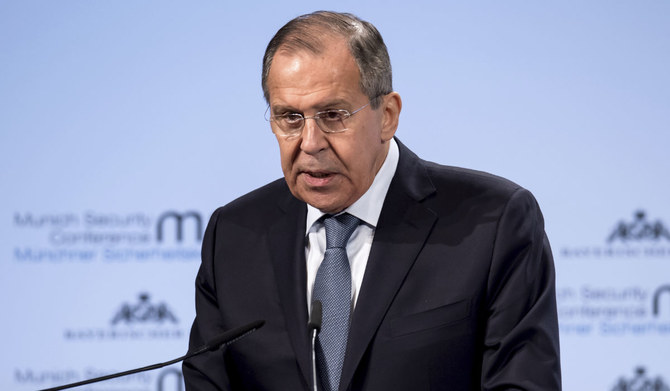
Lavrov: No justification for collective punishment of Palestinian people

Russia's foreign minister, Sergey Lavrov. (AP)
Short Url
Updated 10 December 2023
Follow

Lavrov: No justification for collective punishment of Palestinian people

MOSCOW: Russian Foreign Minister Sergey Lavrov on Sunday said it was not acceptable for Israel to use the Hamas attack on Oct. 7 as justification for the collective punishment of the Palestinian people and called for international monitoring on the ground in Gaza.
Israeli tanks battled their way to the center of Khan Younis on Sunday in a major new push into the heart of the central city in the southern Gaza Strip.
President Vladimir Putin has repeatedly blamed the war between Israel and Hamas on the failure of years of US diplomacy in the Middle East, while aiming to position Russia as an important player with ties to all the
major actors in the region.
Prime Minister Benjamin Netanyahu on Sunday voiced Israel’s “dissatisfaction” to President Putin over Russia’s vote in favor of a UN Security Council resolution calling for a Gaza ceasefire.
“The prime minister expressed his dissatisfaction with the positions expressed against Israel by Russian representatives at the UN and in other forums” when he spoke with Putin on Sunday, Netanyahu’s office said in a statement.
“Any country that had been struck with a criminal terrorist assault such as Israel experienced would have reacted with no less force than Israel is using,” he told Putin.
The US vetoed Friday’s Security Council resolution calling for a ceasefire in the Gaza war.
Netanyahu’s office said on Sunday Israel helped Cyprus foil an Iranian-ordered attack against Israelis and Jews on the island, claiming that such plots were on the rise since the Gaza
war erupted.
Netanyahu’s office said in the statement on behalf of the Mossad intelligence service that Israel was “troubled” by what it saw as Iranian use of Turkish-controlled northern Cyprus “both for terrorism objectives and as an operational and transit area.”
Earlier on Sunday, a Greek Cypriot newspaper in Cyprus’s government-controlled south reported authorities had detained two Iranians for questioning over suspected planning of attacks on Israeli citizens living in Cyprus.
The two individuals were believed to be in the early stages of gathering intelligence on potential Israeli targets, the Kathimerini Cyprus newspaper said without citing sources. Those individuals had crossed from the north, it said.
Barely a 40-minute flight from Israel, both sides of Cyprus are a popular holiday and investment destination for thousands of Israelis.


Venezuela looking to ‘new era’ after Maduro ouster, says interim leader

Updated 5 sec ago
Follow

Venezuela looking to ‘new era’ after Maduro ouster, says interim leader

  • After toppling Maduro, US President Donald Trump agreed to let Delcy Rodriguez take over, provided she toes Washington’s line
  • The new Venezuela, she said, “allows for understanding despite differences and through ideological and political diversity”

CARACAS: Venezuela’s interim president Delcy Rodriguez declared Wednesday her country was entering a new era marked by greater tolerance toward political rivals, following the US ouster of her former boss Nicolas Maduro.
At her first press conference since Maduro’s dramatic capture by US forces on January 3, Rodriguez cast herself as a unifier.
Following 12 years of repressive rule by Maduro, Venezuela is “opening up to a new political era,” Maduro’s former deputy told reporters at the presidential palace.
The new Venezuela, she said, “allows for understanding despite differences and through ideological and political diversity.”
After toppling Maduro, US President Donald Trump agreed to let Rodriguez take over, provided she toes Washington’s line.
- Calls for ‘peace’ -
In doing so, Trump sidelined the leader of the anti-Maduro opposition, Nobel Peace Prize laureate Maria Corina Machado, claiming she did not have enough “respect” in Venezuela.
Machado will meet Trump on Thursday at the White House to press her demands for a democratic transition that includes herself and Edmundo Gonzalez Urrutia, her candidate in 2024 elections which the opposition claims were stolen by Maduro.
So far, Trump has focused his energies on securing access to Venezuela’s vast oil reserves.
But he claimed that he had also been planning a second attack on Venezuela until the government last week announced the release of “large numbers” of the dissenters languishing in prison, sometimes for years.
Rodriguez claimed authorities had released 406 prisoners since December in a process that accelerated since last week, and which she said “has not yet concluded.”
The Foro Penal legal rights NGO, which defends many of the detainees, gave a much smaller tally of around 180 freed.
AFP’s count, based on data from NGOs and opposition parties, showed 70 people going free since January 8.
They include some Americans, a US State Department official confirmed on Tuesday, without saying how many.
The trickle of releases continued on Wednesday, with the release of 17 journalists and media workers.
Roland Carreno, a journalist and prominent opposition activist, who was detained in August 2024 during post-election protests, was part of the group.
According to the National Union of Press Workers he spent “one year, five months, and 12 days” behind bars.
A member of the Popular Will party, he was previously imprisoned between 2020 and 2023 on charges of terrorism — a charge frequently used to lock up opposition members in Venezuela.
In a video shared by another freed journalist, he called for “peace and reconciliation.”
Political analyst Nicmer Evans, director of the Punto de Corte news outlet was also released.
- Balancing act -
Rodriguez has been engaged in a delicate balancing act, trying to meet US demands without alienating the Maduro loyalists, who control the security forces and intelligence services.
To avoid scenes of jubilant opposition activists punching the air as they walk free from prison, the authorities have been releasing them quietly at other locations, far from the TV cameras and relatives waiting outside detention centers.
Carreno was released at a shopping mall.
Former presidential candidate Enrique Marquez, one of the first to be released, was driven home in a patrol car.
A number of Spanish and Italian citizens have also walked free from Venezuelan prisons in the past week.
The United States had already secured freedom for some of its nationals in a deal with Maduro last year.
- X access restored -
Domestically, Venezuelans regained one freedom on Tuesday — the ability to post on social media platform X, which had been blocked for more than a year by Maduro’s government.
Rodriguez updated her profile’s bio to “acting president” — she served as vice president under Maduro — and wrote: “Let us stay united, moving toward economic stability, social justice, and the welfare state we deserve to aspire to.”
Maduro’s X account was updated Tuesday with a photo of the deposed leader and his wife, Cilia Flores.
“We want you back,” the post reads.