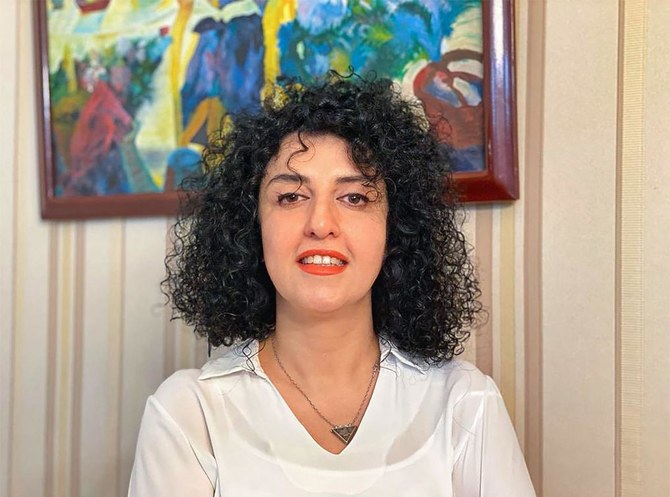
OSLO: The teenage children of jailed Iranian Nobel Peace Prize winner Narges Mohammadi fear they will never meet their mother again, but said they were proud of her struggle for women’s rights as they prepared to accept the award on her behalf on Sunday.
Mohammadi, 51, who is serving multiple sentences in Tehran’s notorious Evin prison on charges including spreading propaganda, won the award on Oct. 6 in a rebuke to Tehran’s theocratic leaders, prompting the Islamic Republic’s condemnation.
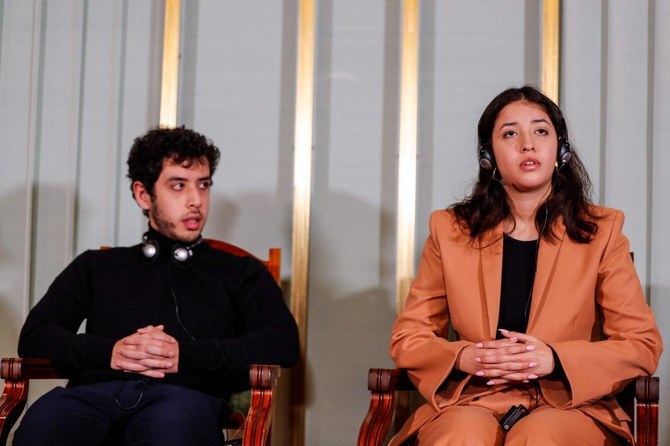
Her twin 17-year-old children, Ali and Kiana Rahman, who live in exile in Paris, are due to accept the award at Oslo’s City Hall and give the Nobel Peace Prize lecture on her behalf.
In a letter smuggled out of prison and published by Swedish broadcaster SVT this week, Mohammadi said she would continue to fight for human rights even if it led to her death. But she said she missed her children the most.
Kiana Rahman, who last saw her mother eight years ago, said: “When it comes to seeing her again, personally I am very pessimistic.”
“Maybe I’ll see her in 30 or 40 years, but I think I won’t see her again,” she told a press conference via a translator. “But that doesn’t matter because my mother will always live on in my heart and with my family.”
Mohammadi was awarded the Peace Prize just over a year after 22-year-old Mahsa Amini died in the custody of Iranian morality police after being detained for allegedly violating the rules of wearing a hijab, an Islamic head scarf.
Amini’s death provoked months of nationwide protests that posed the biggest challenge to Shiite clerical rule in years, and was met with a deadly security crackdown costing several hundred lives.
The Norwegian Nobel Committee said the award for Mohammadi also recognized hundreds of thousands who had demonstrated against the theocratic regime’s policies discriminating and oppressing women.
Iran has called the protests Western-led subversion, accusing the Nobel committee of meddling and politicizing human rights.
Mohammadi’s son Ali said he had accepted from early childhood that the family would live apart, but said he would stay optimistic he might see her again.
“If we don’t see her again we will always be proud of her and go on with our struggle,” he said.
Mohammadi’s husband Taghi Rahmani said the award would give her a larger voice even if her own conditions were likely to become more difficult.
“It’s a political prize and therefore there will be more pressure on Narges, but at the same time it is going to create a space for echoing the voice of the people” said Rahmani, who will also attend Sunday’s ceremony.
Mohammadi is the 19th woman to win the prize, which today is worth 11 million Swedish crowns, or around $1 million, and the fifth person to win it while in detention.
It is awarded on Dec. 10, the anniversary of the death of Swedish industrialist Alfred Nobel, who founded the awards in his 1895 will.


Children of Iran Nobel Peace Prize winner fear they won’t see her again
https://arab.news/cr4nf
Children of Iran Nobel Peace Prize winner fear they won’t see her again

- Her twin 17-year-old children are due to accept the award at Oslo’s City Hall and give the Nobel Peace Prize lecture on her behalf
- In a letter smuggled out of prison and published by Swedish broadcaster SVT this week, Mohammadi said she would continue to fight for human rights even if it led to her death


Sudan defense minister dismisses ‘intelligence document’ as fabrication after convoy strike
- Gen. Hassan Kabroun tells Arab News claims that army hid weapons in aid convoy are “completely false”
RIYADH: Sudan’s defense minister has firmly denied reports attributed to Sudanese intelligence alleging that a convoy targeted in North Kordofan was secretly transporting weapons under the cover of humanitarian aid.
Gen. Hassan Kabroun described the claims as “false” and an attempt to distract from what he called a militia crime.
The controversy erupted after news reports emerged that a document attributed to Sudan’s General Intelligence Service claimed the convoy struck in Al-Rahad on Friday was not a purely humanitarian mission, but was instead carrying “high-quality weapons and ammunition” destined for Sudanese Armed Forces units operating in the state.
The report further alleged that the convoy had been outwardly classified as humanitarian in order to secure safe passage through conflict zones, and that the Rapid Support Forces had destroyed it after gathering intelligence on its route and cargo.
Kabroun categorically rejected the narrative.
“First of all, we would like to stress the fact that this news is false,” he told Arab News. “Even the headline that talks about the security of the regions, such as Al-Dabbah, is not a headline the army would use.”
He described the document as fabricated and politically motivated, saying it was designed to “cover up the heinous crime they committed.”
The minister affirmed that the area targeted by drones is under full control of the Sudanese Armed Forces and does not require any covert military transport.
“Second, we confirm that the region that was targeted by drones is controlled by the army and very safe,” Kabroun said. “It does not require transporting any military equipment using aid convoys as decoys because it is a safe area controlled by the army, which has significant capabilities to transport humanitarian aid.”
According to the minister, the Sudanese military has both the logistical capacity and secure routes necessary to move equipment openly when needed.
“The army is professional and does not need to deliver anything to Kadugli or Dalang on board aid convoys,” he said. “The road between Dalang and Kadugli is open. The Sudanese forces used that road to enter and take control of the region. The road is open and whenever military trucks need to deliver anything, they can do so without resorting to any form of camouflage.”
Kabroun further rejected any suggestion that the military uses humanitarian operations as cover.
“Aid is transported by dedicated relief vehicles to the areas in need of this assistance,” he said. “Aid is not transported by the army. The army and security apparatus do not interfere with relief efforts at all, and do not even accompany the convoys.”
He stressed that the Sudanese Armed Forces maintains a clear institutional separation between military operations and humanitarian work, particularly amid the country’s crisis.
“These are false claims,” he said. “This fake news wanted to cover up the heinous crime they committed.”
Sudan has been gripped by conflict since April 2023, when fighting broke out between the Sudanese Armed Forces and the Rapid Support Forces, plunging the country into what the United Nations has described as one of the world’s worst humanitarian disasters.
The latest dispute over the convoy comes amid intensified fighting in South Kordofan, a strategically sensitive region linking central Sudan with the contested areas of Darfur and Blue Nile.
The false report suggested that intelligence monitoring had enabled the RSF to strike what it described as a military convoy disguised as humanitarian aid. But Kabroun dismissed that version outright.
“The intelligence agency is well aware of its duties,” he said. “The Sudanese Army has enough weapons and equipment to use in the areas of operations. These claims are completely false.”
He argued that the narrative being circulated seeks to shift blame for attacks on civilian infrastructure and humanitarian movements.
“This shows that they are trying to cover up the atrocities,” he added, referring to the militia.
Kabroun maintained that the army has regained momentum on multiple fronts and remains fully capable of sustaining its operations without resorting to deception.
“The region is secure, the roads are open, and the army does not need camouflage,” he said. “We are operating professionally and transparently.”
“These claims are completely false,” Kabroun said. “The Sudanese Army does not use humanitarian convoys for military purposes.”