Gaza health system ‘is on its knees’

1 / 4
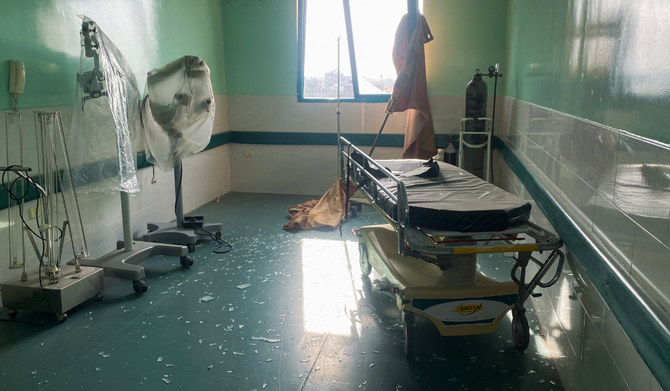
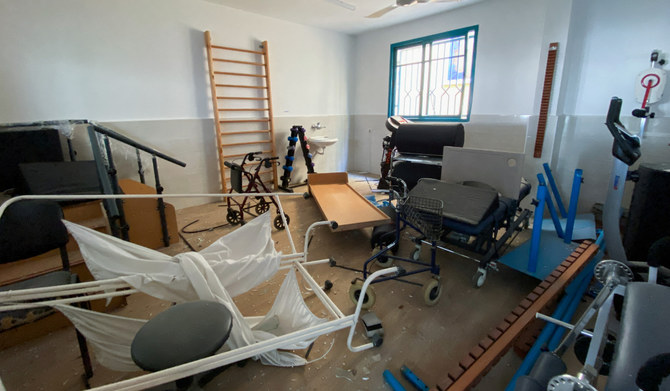
A view of Yafa hospital damaged by Israeli strikes, amid the ongoing conflict between Israel and the Palestinian Islamist group Hamas, in the central Gaza Strip, December 8, 2023. (REUTERS)
2 / 4
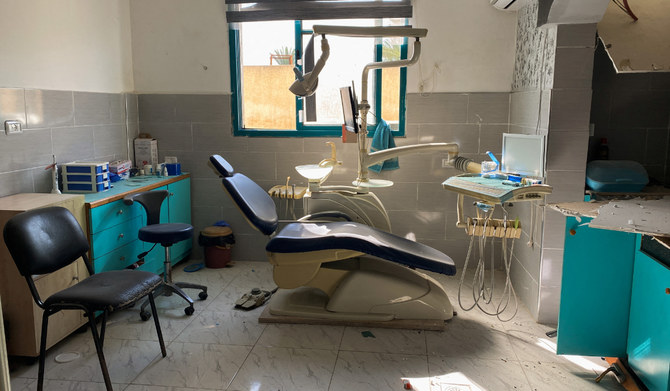
A view of Yafa hospital damaged by Israeli strikes, amid the ongoing conflict between Israel and the Palestinian Islamist group Hamas, in the central Gaza Strip, December 8, 2023. (REUTERS)
3 / 4
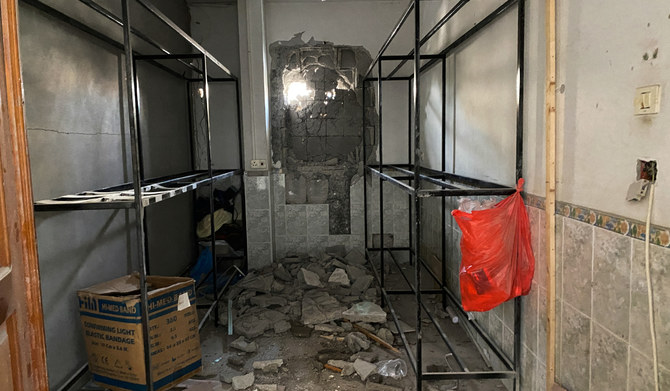
A view of Yafa hospital damaged by Israeli strikes, amid the ongoing conflict between Israel and the Palestinian Islamist group Hamas, in the central Gaza Strip, December 8, 2023. (REUTERS)
4 / 4
A view of Yafa hospital damaged by Israeli strikes, amid the ongoing conflict between Israel and the Palestinian Islamist group Hamas, in the central Gaza Strip, December 8, 2023. (REUTERS)
Short Url
Updated 09 December 2023
Follow

Gaza health system ‘is on its knees’

  • “Children and people begging and crying for water — we’re at that level, where the most normal and basic supplies are not available anymore,” Lindmeier said

GENEVA: Gaza’s health system is on its knees and cannot afford to lose another ambulance or a single hospital bed, the World Health Organization has warned, “The situation is getting more and more horrible by the day ... beyond belief, literally,” WHO spokeperson Christian Lindmeier told a press briefing in Geneva.
“The health system is on its knees. Gaza cannot afford to lose any more health facilities, another single ambulance, any more hospitals ... or even a single hospital bed more.”
The UN’s humanitarian agency OCHA said late on Thursday that only 14 of the 36 hospitals in the Gaza Strip were functioning in any capacity. The UN says about 80 percent of the population has been displaced, facing shortages of food, fuel, water, and medicine, along with the threat of disease.
“Children and people begging and crying for water — we’re at that level, where the most normal and basic supplies are not available anymore,” Lindmeier said.
“Right now, the calculation for Gaza is 1 to 2 liters of fresh water a day — that’s water for everything, not only for drinking.
“People are starting to cut down telephone poles to have a little firewood to keep warm or cook if they have anything available.
“Civilization is about to break down.”
Lindmeier said a convoy was supposed to take medical supplies to Al-Ahli Arab Hospital in Gaza City on Friday and evacuate 12 patients to the south.
“That mission, we were told this morning, had to be suspended because of the security situation,” he said.
Health workers in the Gaza Strip do not have enough food and water to continue working, he said.
“Patients are bleeding on the floor, trauma wards resemble battlefields,” said Lindmeier.
“This callousness must end. We need a ceasefire and we need it now.”


Tunisian police arrest member of parliament who mocked president

Updated 05 February 2026
Follow

Tunisian police arrest member of parliament who mocked president

  • Ahmed Saidani mocked the president in a Facebook post, describing him as the “supreme commander of sewage and rainwater drainage”

TUNIS: Tunisian police arrested lawmaker Ahmed Saidani on Wednesday, two of his colleagues ​said, in what appeared to be part of an escalating crackdown on critics of President Kais Saied.
Saidani has recently become known for his fierce criticism of Saied. On Tuesday, he mocked the president in a Facebook post, describing him as the “supreme commander of sewage and rainwater drainage,” blasting what he said ‌was the absence ‌of any achievements by Saied.
Saidani ‌was ⁠elected ​as ‌a lawmaker at the end of 2022 in a parliamentary election with very low voter turnout, following Saied’s dissolution of the previous parliament and dismissal of the government in 2021.
Saied has since ruled by decree, moves the opposition has described as a coup.
Most opposition leaders, ⁠some journalists and critics of Saied, have been imprisoned since he ‌seized control of most powers in 2021.
Activists ‍and human rights groups ‍say Saied has cemented his one-man rule and ‍turned Tunisia into an “open-air prison” in an effort to suppress his opponents. Saied denies being a dictator, saying he is enforcing the law and seeking to “cleanse” the country.
Once a supporter ​of Saied’s policies against political opponents, Saidani has become a vocal critic in recent months, accusing ⁠the president of seeking to monopolize all decision-making while avoiding responsibility, leaving others to bear the blame for problems.
Last week, Saidani also mocked the president for “taking up the hobby of taking photos with the poor and destitute,” sarcastically adding that Saied not only has solutions for Tunisia but claims to have global approaches capable of saving humanity.
Under Tunisian law, lawmakers enjoy parliamentary immunity and cannot be arrested for carrying out their ‌duties, although detention is allowed if they are caught committing a crime.