Security forces kill five militants in Pakistan’s northwest

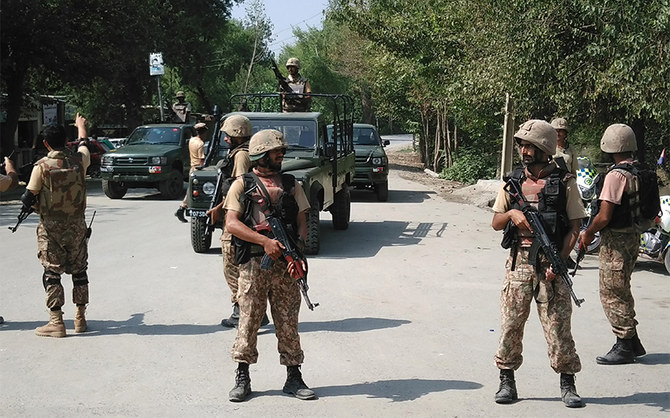
In this representational file photo, Pakistani soldiers cordon off a street leading to Christian colony following an attack by suicide bombers on the outskirts of Peshawar on September 2, 2016. (AFP/File)
Short Url
Updated 08 December 2023
Follow

Security forces kill five militants in Pakistan’s northwest

  • ISPR says the intelligence-based operation followed reports of militant presence in Tank district
  • Security personnel recovered weapons, ammunition and explosives from the area after the operation

ISLAMABAD: Pakistan’s security forces have killed five militants in an intelligence-based operation in the country’s southwest, said the army’s public relations wing, ISPR, in a statement on Friday.

The operation was carried out in Tank district of Khyber Pakhtunkhwa province between Thursday and Friday night after the security forces got information of militant presence in the Mullazai area.

The subsequent operation led to intense exchange of fire in which the militants were killed.

“The killed terrorists remained actively involved in numerous terrorist activities against Law Enforcement Agencies as well as extortion and target killing of innocent civilians,” the ISPR said.

“A cache of weapons, ammunition and explosives was also recovered during the operation,” it added.

Pakistan has experienced a surge in militant attacks since the beginning of the year in the two western provinces of Balochistan and Khyber Pakhtunkhwa that are situated right next to Afghanistan.

Officials in Islamabad have frequently blamed a proscribed militant network, Tehreek-e-Taliban Pakistan (TTP), for these attacks.

The TTP is said to have its leadership based in Afghanistan, making the Pakistani authorities request the administration in Kabul not to let their soil be used by armed groups to launch attacks against other countries.

The ISPR said the security forces had launched a “sanitization operation” in the area to eliminate any other militants as part of the country’s efforts to wipe out extremist violence.


Pakistan warns of heavy rain, snowfall and landslide risks in northern districts from today

Updated 5 sec ago
Follow

Pakistan warns of heavy rain, snowfall and landslide risks in northern districts from today

  • Khyber Pakhtunkhwa says snowfall can make roads slippery in tourist resorts like Naran, Kaghan and Kalam
  • Provincial authorities warn tourists and travelers to avoid unnecessary movement during the weather spell

PESHAWAR: The Provincial Disaster Management Authority (PDMA) of Pakistan’s Khyber Pakhtunkhwa warned Friday heavy rains and snowfall expected from today through Dec. 15 could trigger landslides, road closures and hazardous travel conditions across the northern districts.

The alert follows forecasts of widespread precipitation in the province’s mountainous regions, where steep slopes and winter road conditions routinely heighten the risk of disruption.

Dense fog is also expected in the plains, including Peshawar, Mardan, Nowshera and Swabi, potentially affecting visibility and slowing motorway traffic.

“The Provincial Disaster Management Authority has issued alerts to all relevant departments to take advance precautionary measures,” the agency said.

It warned that snowfall could make roads slippery in areas such as Naran, Kaghan, Kalam and Jabba, while heavy rain and snow “may increase the risk of landsliding.”

Residents living close to rivers, streams and seasonal water channels were advised to remain vigilant.

Rain and snowfall are also forecast in Chitral, Dir, Swat, Shangla, Kohistan, Mansehra, Abbottabad, Galyat, Haripur, Buner, Mohmand, Khyber, Orakzai, Kurram and North and South Waziristan.

Tourists and travelers were urged to avoid unnecessary movement during the weather spell. Daytime temperatures are expected to fall sharply as the cold system intensifies.

Local administrations have also been instructed to keep drainage systems active ahead of the expected rainfall.

Pakistan has faced a series of extreme-weather emergencies in recent years — from devastating floods in 2022 to recurring droughts and record heatwaves — despite contributing less than one percent to global carbon emissions.

Officials say climate volatility has made mountainous regions more prone to landslides and flash floods, highlighting the importance of early warnings and local preparedness.