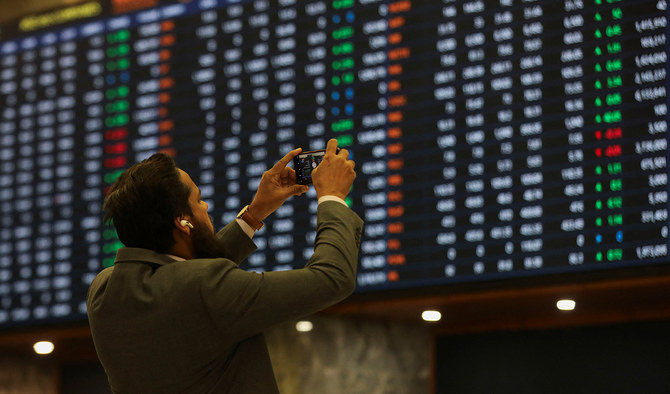
KARACHI: Pakistan equities on Friday hit yet another record high by breaching the 66,000-mark amid bullish sentiments built on the International Monetary Fund (IMF) program and completion of its first review, rupee stability, and the government’s plan to raise Rs90 billion through Islamic bonds, equity analysts said.
The key stock index, KSE100, closed the weekend trading session at a historic high level of 66,223 after gaining 1,505 points, or rising 2.33 percent. During the trading week, the index collectively gained 3,730 points. The recent rally has increased the market capitalization from $31.3 billion to $32.8 billion in a week.
“The stocks closed at a new record surge and new all-time high amid rupee stability and the government’s plan to launch Rs90 billion worth of Ijarah Sukuks for retail investors to diversify funding sources,” Ahsan Mehanti, CEO of Arif Habib Corporation, told Arab News.
He attributed the bull run to falling external debt, the positive outcome of the Special Investment Facilitation Council (SIFC), a civil-military hybrid forum established to fast-track decision-making and promote investment from foreign nations, and expectations for a current account surplus in November 2023.
In a landmark development for the country’s financial markets, the federal government launched one-year Ijarah Sukuk earlier in the day from the platform of Pakistan Stock Exchange (PSX) in the first phase.
In total, the government plans to raise Rs90 billion through three auctions of the bond.
Speaking at the gong ceremony, Prime Minister Anwaar-ul-Haq Kakar said Pakistan’s economy faced multiple challenges at the start of the financial year 2023-2024, but the government had tried to solve the structural and macroeconomic issues which helped improve the situation.
“I would like to thank the effort of all stakeholders to bring our economy back on track by lowering the exchange rate of dollar from all-time high of approximately 307 on September 5, 2023, in the interbank market to around 284 today,” he said.
Kakar maintained the capital market served as a catalyst for innovation, entrepreneurship and growth in the realm of finance.
“It provides fuel to business to expend, create jobs and contribute to overall development of society. As a part of federal government, we are committed to fostering an environment that nurtures and sustains this growth,” he added.
The prime minister said the capital market acted as a stabilizing force, absorbing shocks and steering the economy toward stability.
Economists say the current bull run is fueled by the successful completion of $3 billion IMF bailout program review, strong earnings growth and the steps taken by the government to discourage smuggling of various commodities and foreign currencies.
Pakistan expects another tranche of $700 million from IMF after the global lender’s board meeting on January 11, 2024.
“Pakistan stock exchange has tailwind of the IMF program, the completion of the first review, the enforcement measures by the establishment including curbing smuggling, de-dollarization and some improvements in the Afghan transit trade,” Dr. Khaqan Najeeb, former advisor to the finance ministry, told Arab News.
Going forward, he said the country would have to comply with the IMF standby arrangement to design another program for long term macroeconomic stability.
He noted this required more structural reforms in the economy after the new government takes over in the wake of the next general elections.


![]()

Pakistan stock market crosses another historic milestone by surging past 66,000 points
Short Url
https://arab.news/jvddc
Pakistan stock market crosses another historic milestone by surging past 66,000 points
- Analysts say the current bull run at the stock market is fueled by IMF program and policy measures for economic improvement
- An economic expert asks the government to comply with the IMF standby arrangement to ensure macroeconomic stability
Latest updates


© 2026 SAUDI RESEARCH & PUBLISHING COMPANY, All Rights Reserved And subject to Terms of Use Agreement.