

Pakistan regulator to issue schedule for upcoming national elections ‘in few days’

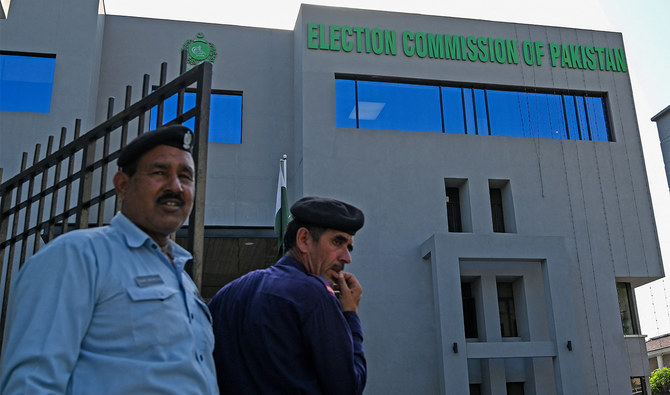
Security personnel stand guard at the headquarters of Election Commission of Pakistan in Islamabad on September 21, 2023. (AFP/File)
Short Url
Updated 08 December 2023
Follow

Pakistan regulator to issue schedule for upcoming national elections ‘in few days’

  • Elections were originally supposed to be held in November after dissolution of national and provincial assemblies in August 
  • But redrawing of hundreds of national, provincial constituencies based on a digital census delayed the polls to early next year 

ISLAMABAD: Pakistan’s election regulator will issue a schedule for the upcoming national elections “in few days,” its top official said on Thursday, as the South Asian country gears up for the February 8 polls. 

Elections were originally expected to take place in November after Pakistan’s national and two provincial assemblies were dissolved in August before reaching the end of their tenure. However, Pakistan’s election regulator decided to redraw hundreds of national and provincial constituencies based on a digital census carried out in April before arranging the electoral contest. 

The Election Commission of Pakistan (ECP) later scheduled the voting process for the last week of January, before announcing Feb. 8 as the final date after consultations with the country’s President Dr. Arif Alvi on the Supreme Court’s instructions. 

In his message on Voters Day, Chief Election Commissioner (CEC) Sikandar Sultan Raja once again assured the masses that February 8 would be the polling day, dispelling speculation about further delay in the conduct of national elections. 

“Election schedule will be issued in few days,” Raja said in a statement. “Polling [for the general election] will be held on February 8, 2024.” 

As Pakistan gears up for the general elections, many analysts expect the polls to lead to the South Asian country to some stability after more than a year of political turmoil, following the ouster of ex-prime minister Imran Khan in a parliamentary no-trust vote in April 2022. 

The CEC’s statement came a day after Caretaker Information Minister Murtaza Solangi said the federal cabinet did not have any “second thoughts” about holding the polls on February 8. 

“The thing is, problems of security and the weather will always remain,” Solangi said in an interview. “But in the federal cabinet, there is no doubt, neither is there any worry nor any second thoughts that we would not hold elections on Feb. 8.” 

Pakistan has seen a surge in militant attacks in its western regions bordering Afghanistan ever since a fragile truce between Islamabad and the Pakistani Taliban broke down in November 2022. 

The Jamiat Ulama-e-Islam Pakistan (JUI-F), a prominent religious party, last month urged the ECP to delay polls till the security situation in the country improved. 

Solangi said Pakistan had held elections in the past despite the threat of militancy, when the security situation was far worse. 

“Maybe our memories are a bit weak,” he said. “What was the security situation in 2008 and 2013? If we compare it [to now] then it is nothing. 

This week, the ECP also issued a directive for satellite television channels, warning them against airing speculative news about a delay in elections. 


Pakistan has ruled out military operation in northwestern Tirah Valley

Updated 4 sec ago
Follow

Pakistan has ruled out military operation in northwestern Tirah Valley

  • Residents in northwestern Tirah Valley fled their homes this month fearing a military operation against militants
  • Defense minister says army conducting intelligence-based operations in area, residents’ migration “routine” practice

Islamabad: Defense Minister Khawaja Asif on Tuesday clarified that the military was not conducting a military operation in the northwestern Tirah Valley, saying that the ongoing residents’ migration from the area was a routine practice that has been going on for several years. 

The defense minister’s clarification came as residents of Tirah Valley in Pakistan’s northwestern Khyber Pakhtunkhwa (KP) province bordering Afghanistan fled their homes this month, fearing a planned military operation by the army against militants, particularly the Tehreek-e-Taliban Pakistan (TTP) group. 

Pakistan’s information ministry on Sunday issued a clarification that the armed forces were not involved in the “depopulation” of the valley. It pointed to a notification from the provincial Khyber Pakhtunkhwa Relief, Rehabilitation and Resettlement Department in December which demanded the release of funds, reportedly Rs4 billion [$14.24 million], for the voluntary movement of people from Tirah Valley. 

Speaking to reporters at a news conference alongside Information Minister Attaullah Tarar and Special Assistant to the PM for Information and KP Affairs Ikhtiar Wali Khan, Asif said the last military operation in the area was conducted several years ago. He said the military had decided that intelligence-based operations (IBOs) were more effective than military operations as they resulted in lower civilian casualties. 

“So over a long period of time, the army gave up [military] operation in favor of IBOs,” Asif said. “For many years this practice has been continuing. Hence, there is no question of an operation there.”

The defense minister described the migration of residents from Tirah Valley as a “routine” practice due to the harsh cold. 

He criticized the provincial government, led by the Pakistan Tehreek-e-Insaf (PTI) party for not serving the people of the area, accusing it of not building any schools, hospitals, or police stations in Tirah Valley.

Asif said around 400-500 TTP members lived in the valley with their families, alleging that hemp was being harvested there on over 12,000 acres of land. He said that while hemp is also used for medicinal and construction purposes, its dividends were going to militants and politicians. 

“All of this hemp is harvested there and the dividends from it either go to the people associated with politics or the TTP,” the minister said.

“We have initiated the process to stop this so that the people benefit from this harvest and so that schools and hospitals are constructed there.”

The minister said that a district-level jirga or tribal council met representatives of the KP government on Dec. 11, 24 and 31 to decide matters related to the residents’ migration in the area. 

Holding up the KP Relief, Rehabilitation and Resettlement Department notification, Asif said:

“In the presence of this notification, in the presence of this tribal council and in the presence of all of these things, where do you see the army?“

The minister accused the provincial government of deflecting its “failures” in the province to the armed forces or to a military operation that did not exist. 

The migration has exposed tensions between the provincial government and the military establishment over the use of force in the region.

KP Law Minister Aftab Alam Afridi said earlier this month that the provincial government will not allow a military operation to take place in the area, arguing that past military campaigns had failed to deliver lasting stability.