

Denmark’s parliament adopts law banning Qur'an burnings

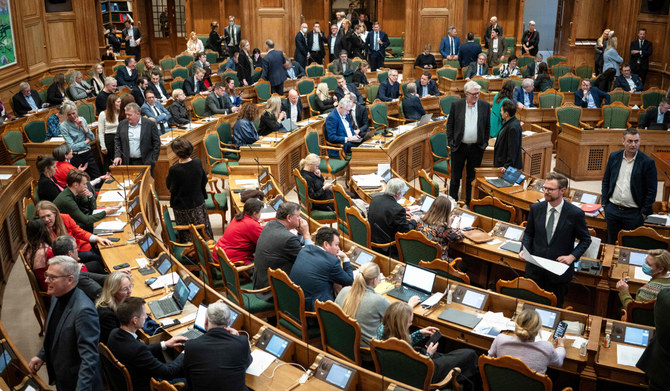
Members of the Danish Parliamant Folketinget attend the debate on a new law against inappropriate treatment of writings of importance to religious communities, in Copenhagen, Denmark, on December 7, 2023. (AFP)
Short Url
Updated 08 December 2023
Follow

Denmark’s parliament adopts law banning Qur'an burnings

  • Over the summer, Denmark and neighboring Sweden became the focus of anger across several Muslim countries after a slew of protests involving burnings and desecrations of the Qur'an

COPENHAGEN: Denmark’s parliament on Thursday adopted a law criminalizing the “inappropriate treatment” of religious texts, effectively banning Qur'an burnings after a series of desecrations of Islam’s holy book sparked anger in Muslim countries over the summer.
The bill, which prohibits “inappropriate treatment of writings with significant religious importance for a recognized religious community,” was passed with 94 votes in favor and 77 opposed in the 179-seat Folketing.
“We must protect the security of Denmark and the Danes. Therefore, it is important that we now have better protection against the systematic insults we have seen for a long time,” Justice Minister Peter Hummelgaard said in a statement.
In practical terms, it will be forbidden to burn, tear or otherwise defile holy texts publicly or in videos intended to be disseminated widely.
Those who break the law, which will be evaluated after three years, risk a fine or up to two years in prison.
Over the summer, Denmark and neighboring Sweden became the focus of anger across several Muslim countries after a slew of protests involving burnings and desecrations of the Qur'an.
Nearly a thousand protesters attempted to march to the Danish embassy in Baghdad’s fortified Green Zone in late July following a call by firebrand cleric Moqtada Sadr.
In response to the worsened security situation, the Scandinavian country temporarily tightened border controls, but returned to normal on August 22.
Between July 21 and October 24 this year, 483 book burnings or flag burnings were recorded in Denmark, according to national police figures.

Initially announced at the end of August, the bill was amended following criticism that its first draft limited freedom of expression and would be difficult to enforce.
It was originally planned to cover objects of significant religious importance.
The first draft was also criticized by some — including politicians, artists, media and freedom of speech experts — as a return to a blasphemy law that Denmark abolished in 2017.
During a lengthy debate in parliament ahead of the vote, opposition lawmakers railed against the government, accusing it of sacrificing freedom of expression.
“It is a betrayal. A huge failure on the part of the government,” Inger Stojberg, leader of far-right Denmark Democrats, told parliament.
In 2006, a wave of anti-Danish anger and violence erupted in the Muslim world following the publication of caricatures of the Prophet Muhammad.
“Imagine that we are becoming the generation that curtailed freedom of speech. I hadn’t actually thought this would be — and certainly not after the Muhammad crisis. Back then, we stood firm,” Stojberg said.
In neighboring Sweden, the government has condemned desecrations of the Qur'an at protests while upholding the country’s constitutionally protected freedom of speech and assembly laws.
It has vowed to explore legal means of stopping protests involving the burning of holy texts in certain circumstances.
Denmark is not the only European country to have banned burnings of the Qur'an.
According to Denmark’s justice ministry, eight European countries — Austria, Belgium, Estonia, Finland, Germany, Italy, Poland and Romania — do so to varying degrees.
In Greece, for example, the burning of a sacred text can be banned if the act takes place in or near a religious site.


Congress taking first votes on Iran war as debate rages about US goals

Updated 6 sec ago
Follow

Congress taking first votes on Iran war as debate rages about US goals

  • The US Senate is headed toward a vote on President Donald Trump’s decision to embark on a war against Iran
  • It’s an extraordinary test in Congress for a conflict that has rapidly spread across the Middle East with no clear US exit strategy
WASHINGTON: The US Senate is headed toward a vote Wednesday on President Donald Trump’s decision to embark on a war against Iran, an extraordinary test in Congress for a conflict that has rapidly spread across the Middle East with no clear US exit strategy.
The legislation, known as a war powers resolution, gives lawmakers an opportunity to demand congressional approval before any further attacks are carried out. The Senate resolution and a similar bill being voted on in the House later this week face unlikely paths through the Republican-controlled Congress and would almost certainly be vetoed by Trump even if they were to pass.
Nonetheless, the votes marked a weighty moment for lawmakers. Their decisions on the five-day-old war — which Trump entered without congressional approval — could determine the fates of US military members, countless other lives and the future of the region.
“Wars without clear objectives do not remain small. They get bigger, bloodier, longer and more expensive,” said Senate Democratic leader Chuck Schumer at a news conference Tuesday. “This is not a necessary war. It’s a war of choice.”
Trump administration scrambles for congressional support
After launching a surprise attack against Iran on Saturday, Trump has scrambled to win support for a conflict that Americans of all political persuasions were already wary of entering. Trump administration officials have been a frequent presence on Capitol Hill this week as they try to reassure lawmakers that they have the situation under control.
“We are not going to put American troops in harm’s way,” Secretary of State Marco Rubio told reporters in a raucous news conference at the Capitol Tuesday.
But six US military members were killed over the weekend in a drone strike in Kuwait.
Trump has also not ruled out deploying US ground troops. He has said he is hoping to end the bombing campaign within a few weeks, but his goals for the war have shifted from regime change to stopping Iran from developing nuclear capabilities to crippling its navy and missile programs.
“I think they are achieving great success with what they’ve done so far,” Senate Majority Leader John Thune said Tuesday, adding that what happens next in the country will be “largely up to the Iranian people.”
Almost all Republican senators were readying to vote Wednesday against the war powers resolution to halt military action, but a number still expressed hesitation at the idea of deploying troops on the ground in Iran.
“I don’t think the American people want to see troops on the ground,” said Sen. Bill Cassidy, R-Louisiana, as he exited a classified briefing Tuesday. He added that Trump administration officials “left open that possibility,” but it wasn’t an option they were emphasizing.
Lawmakers to go on record
The votes in Congress this week represented potentially consequential markers of just where lawmakers stand on the war as they look ahead to midterm elections and the consequences of the conflict.
“Nobody gets to hide and give the president an easy pass or an end-run around the Constitution,” said Sen. Tim Kaine, the Virginia Democrat leading the war powers resolution. “Everybody’s got to declare whether they’re for this war or against it.”
Republican leaders have successfully, though narrowly, defeated a series of war powers resolutions pertaining to several other conflicts that Trump has entered or threatened to enter. This one, however, is different.
Unlike Trump’s military campaigns against alleged drug boats or even Venezuelan leader Nicolás Maduro, the attack on Iran represents an open-ended conflict that is already ricocheting across the region. For Republicans who are used to operating in a political party dominated by Trump and his promises of keeping the US out of foreign entanglements, the moment represented a bit of whiplash.
“War is ugly, it always has been ugly, but we’re taking out a regime that has been trying to attack us for quite some time,” said Sen. Markwayne Mullin, an Oklahoma Republican.
Meanwhile, Sen. Lindsey Graham, a South Carolina Republican who has long pushed Trump to engage overseas, argued that the widening conflict represented an opportunity for Arab and European countries to join in the fight against Iran and the militant groups it supports.
“I don’t mind people being on record as to whether or not they think this is a good idea,” he told reporters, but also argued that too much power over the military was ceded to Congress in the War Powers Act, which mandates that presidents must withdraw troops from a conflict within 90 days if there is no congressional authorization.
House vote looms
On the other side of the Capitol, House leaders were also readying for an intense debate over the war followed by a vote Thursday.
“I do believe we have the votes to defeat it, I certainly hope we do,” House Speaker Mike Johnson said after an all-member briefing on Tuesday night.
Meanwhile, House Democratic leader Hakeem Jeffries said he expected a strong showing from Democrats in favor of the war powers resolution.
As lawmakers emerged from a closed-door briefing Tuesday night, Rep. Gregory Meeks, the top Democrat on the House Foreign Affairs Committee, implored the Trump administration to “come to Congress” and speak directly to the American people about the rationale for the war.
His voice filled with emotion as he said, “Our young men and women’s lives are on the line.”