

Pakistani court to hear evidence on Dec. 12 in ex-PM Sharif’s appeal against corruption conviction

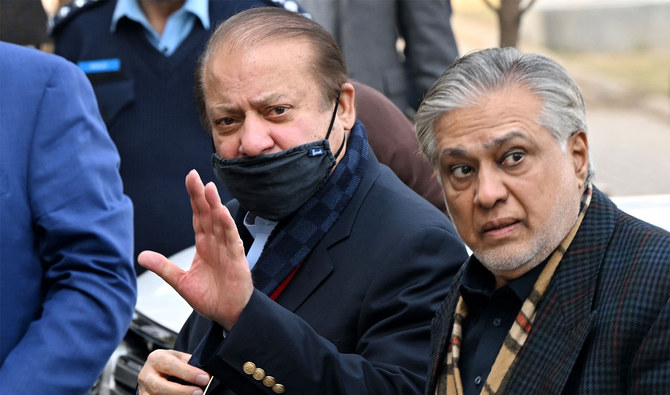
Pakistan's former Prime Minister and graft convict Nawaz Sharif (L) waves as he arrives to appear before the High Court in Islamabad, Pakistan, on December 7, 2023. (AFP)
Short Url
Updated 07 December 2023
Follow

Pakistani court to hear evidence on Dec. 12 in ex-PM Sharif’s appeal against corruption conviction

  • Ex-PM Sharif was handed a seven-year imprisonment sentence in the Al-Azizia corruption case in December 2018 
  • Islamabad High Court rejects anti-graft body’s request to transfer case to accountability court, increase Sharif’s sentence

ISLAMABAD: The Islamabad High Court (IHC) ruled on Thursday it would hear evidence on Dec. 12 in an appeal by former prime minister Nawaz Sharif against his conviction in the Al-Azizia reference, rejecting a request by the national anti-graft body to enhance his sentence and remand the case before an accountability court. 

The Al-Azizia Steel Mills case became a high-profile corruption case that centered on allegations of financial irregularities and money laundering linked to the establishment of the facility in Saudi Arabia by Sharif and his family.

A local accountability court in the federal capital sentenced him to seven years in December 2018 and imposed a fine of £2.5 million in the case. The verdict also disqualified the ex-premier from holding any public office for 10 years and ordered him to forfeit all his properties. 

“We have two options, the first is that we call for evidence and decide the appeal on merit, and the second is that we remand the reference back to the accountability court [for fresh hearing],” IHC Chief Justice Aamer Farooq said, who was heading a division bench hearing Sharif’s appeal against the conviction. 

Deciding a case on merit means the court will consider the evidence in the case, including the charges and defense as opposed to matters of jurisdiction or procedure. 

Following the Al-Azizia verdict, Sharif was arrested from the court premises and remained in prison for about seven months before he left for London in November 2019 for medical treatment after securing bail from a Pakistani court. 

Sharif returned to Pakistan from self-imposed exile after nearly four years in October and filed appeals against his convictions in two separate corruption references, Al-Azizia and Avenfield. The IHC acquitted the former prime minister in the Avenfield reference last month. 

Pakistan’s anti-graft body, the National Accountability Bureau (NAB) had requested the court to increase Sharif’s sentence in the Al-Azizia reference and remand the case back to an accountability court. 

Sharif’s counsel and ex-federal law minister Azam Nazeer Tarar urged the court to decide the matter on merit as “a lot of excesses have already been committed against Nawaz Sharif.” 

Amjad Pervaiz, another legal counsel of the former prime minister, informed the court that three references were filed against his client on the Supreme Court’s directions in the Panama Papers case. 

He said Sharif was acquitted in the Flagship reference and convicted in the Avenfield and Al-Azizia cases. 

“A single reference should have been filed [against Sharif] as all three references accused him of having assets beyond means,” Pervaiz told the court. 

Pervaiz said Al-Azizia Steel Company Private Limited was registered in Saudi Arabia in 2001 while the Hill Metal Establishment was set up in Jeddah in 2005-2006 by Sharif’s son Hussain Nawaz, after he sold the Al-Azizia mill. 

“Nawaz Sharif had nothing to do with bank accounts or operations of these companies,” Pervaiz said, highlighting that Sharif had also not held any public office from October 1999 to May 2013. 

He said the NAB had accused Sharif of owning these companies without any solid evidence at its disposal. 

At one point during the hearing, NAB’s prosecutor urged the court to first look into petitions regarding a video scandal of the late accountability court judge Arshad Malik. 

Malik had handed Sharif the seven-year sentence in the Al-Azizia case but Sharif’s counsel contended that they did not want to discuss the issue as Malik had passed away. 

Sharif’s party had released a video of the late judge in which he could be heard saying he was blackmailed to issue a verdict against the former prime minister. 

After hearing both parties to the case, the court ruled it would hear the case on merit and adjourned proceedings till Tuesday. 


Pakistan has ruled out military operation in northwestern Tirah Valley

Updated 4 sec ago
Follow

Pakistan has ruled out military operation in northwestern Tirah Valley

  • Residents in northwestern Tirah Valley fled their homes this month fearing a military operation against militants
  • Defense minister says army conducting intelligence-based operations in area, residents’ migration “routine” practice

Islamabad: Defense Minister Khawaja Asif on Tuesday clarified that the military was not conducting a military operation in the northwestern Tirah Valley, saying that the ongoing residents’ migration from the area was a routine practice that has been going on for several years. 

The defense minister’s clarification came as residents of Tirah Valley in Pakistan’s northwestern Khyber Pakhtunkhwa (KP) province bordering Afghanistan fled their homes this month, fearing a planned military operation by the army against militants, particularly the Tehreek-e-Taliban Pakistan (TTP) group. 

Pakistan’s information ministry on Sunday issued a clarification that the armed forces were not involved in the “depopulation” of the valley. It pointed to a notification from the provincial Khyber Pakhtunkhwa Relief, Rehabilitation and Resettlement Department in December which demanded the release of funds, reportedly Rs4 billion [$14.24 million], for the voluntary movement of people from Tirah Valley. 

Speaking to reporters at a news conference alongside Information Minister Attaullah Tarar and Special Assistant to the PM for Information and KP Affairs Ikhtiar Wali Khan, Asif said the last military operation in the area was conducted several years ago. He said the military had decided that intelligence-based operations (IBOs) were more effective than military operations as they resulted in lower civilian casualties. 

“So over a long period of time, the army gave up [military] operation in favor of IBOs,” Asif said. “For many years this practice has been continuing. Hence, there is no question of an operation there.”

The defense minister described the migration of residents from Tirah Valley as a “routine” practice due to the harsh cold. 

He criticized the provincial government, led by the Pakistan Tehreek-e-Insaf (PTI) party for not serving the people of the area, accusing it of not building any schools, hospitals, or police stations in Tirah Valley.

Asif said around 400-500 TTP members lived in the valley with their families, alleging that hemp was being harvested there on over 12,000 acres of land. He said that while hemp is also used for medicinal and construction purposes, its dividends were going to militants and politicians. 

“All of this hemp is harvested there and the dividends from it either go to the people associated with politics or the TTP,” the minister said.

“We have initiated the process to stop this so that the people benefit from this harvest and so that schools and hospitals are constructed there.”

The minister said that a district-level jirga or tribal council met representatives of the KP government on Dec. 11, 24 and 31 to decide matters related to the residents’ migration in the area. 

Holding up the KP Relief, Rehabilitation and Resettlement Department notification, Asif said:

“In the presence of this notification, in the presence of this tribal council and in the presence of all of these things, where do you see the army?“

The minister accused the provincial government of deflecting its “failures” in the province to the armed forces or to a military operation that did not exist. 

The migration has exposed tensions between the provincial government and the military establishment over the use of force in the region.

KP Law Minister Aftab Alam Afridi said earlier this month that the provincial government will not allow a military operation to take place in the area, arguing that past military campaigns had failed to deliver lasting stability.