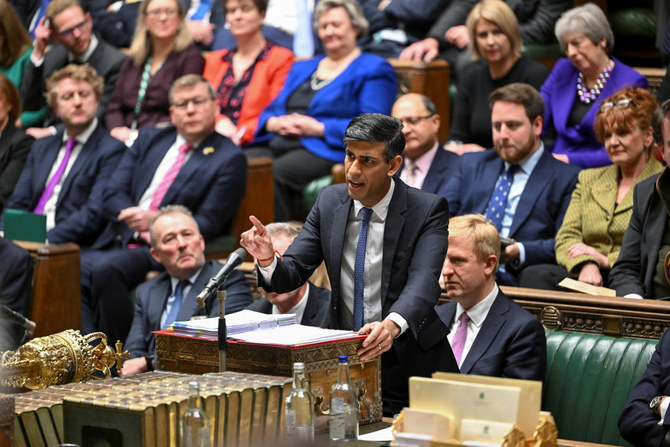
LONDON: British Prime Minister Rishi Sunak was battling to keep his party together on Thursday a day after unveiling a plan to disregard some human rights law to send migrants to Rwanda, bringing back to the fore deep divisions in his party.
Facing the biggest challenge to his year-long tenure, Sunak is trying to stop lawmakers on the Conservative Party’s right wing from rebelling over their demand that Britain should quit international treaties to set its own migration policy.
His immigration minister quit on Wednesday and he is facing questions as to whether he can get his key policy through a vote in parliament. Some Conservative lawmakers said on Thursday that Sunak could face a leadership challenge.
The prime minister was due to hold a press conference at 1100 GMT.
One Conservative politician, who reluctantly supports the Rwanda plan, said the last year had shown that his colleagues can be ruthless in removing a struggling prime minister.
“I have a feeling of deja vu,” he said.
The draft legislation comes three weeks after Britain’s Supreme Court ruled that Rwanda was not a safe place to send those arriving in small boats on the southern coast of England, and that the plan would breach British and international law.
The Rwanda scheme is at the center of the government’s strategy to stop illegal migration. The court’s decision was a setback for Sunak who is struggling to revive a weak economy and is heavily trailing the main opposition party ahead of an election expected next year.
Sunak could make the vote in parliament on the new legislation next week a confidence vote — meaning that if he loses, it could trigger a national election — in an attempt to shore up party support.
So far only one Conservative lawmaker has publicly called for a no confidence vote, but she said six of her colleagues have done so privately.
To trigger a leadership challenge, 53 of the 350 Conservative lawmakers in parliament must write letters of no confidence to the chairman of the 1922 Committee.
Sunak suffered his first parliamentary defeat this week as members of parliament voted to establish a compensatory body for victims of the infected blood scandal.
The prime minister has pleaded with his party to get behind the legislation as the best chance to get flights to Rwanda leaving before the next election.
‘IT WON’T WORK’
A poll last month showed immigration was one of the three biggest issues facing the country. Only the economy and National Health Service were seen as more important.
Last year net legal migration hit a record of 745,000 people and around 45,000 arrived illegally.
Rwanda currently only has the capacity to accept a few hundred migrants from Britain, but ministers say the plan will act as a vital deterrent to discourage people from making the crossings.
The new bill will instruct judges to ignore some sections of the Human Rights Act (HRA) and provisions of domestic or international law that might deem that Rwanda was not a safe destination, though appeals by people based on specific circumstances would still be permitted.
The former interior minister Suella Braverman, former immigration minister Robert Jenrick and their allies say that does not go far enough, with some wanting Britain to leave the European Convention on Human Rights altogether.
“I’m very concerned that the bill on the table will allow a merry-go-round of legal claims and litigation,” Braverman told BBC radio, but said no one was talking about changing the party’s leader.
“The reality is, and the solid truth is, that it won’t work and it will not stop the boats.”


![]()

UK PM Sunak faces party revolt after unveiling new Rwanda asylum plan
Short Url
https://arab.news/pae9j
UK PM Sunak faces party revolt after unveiling new Rwanda asylum plan
- The Rwanda scheme is at the center of the government’s strategy to stop illegal migration


Latest updates


© 2026 SAUDI RESEARCH & PUBLISHING COMPANY, All Rights Reserved And subject to Terms of Use Agreement.