RIYADH: Award-winning artist Sultan Al-Mrshood — who is currently presenting his work at the Saudi Feast Food Festival — has mastered the art of sculpting hyper-realistic representations of nature from wood, inspired by his childhood living on a farm.
Al-Mrshood has a booth at the festival’s Olive Exhibition — showcasing the fruit’s use as food and cosmetics — where he says his artwork often has admirers gathering for long periods.
The sculptor has an assortment of work on display including an eagle, a wooden cane entwined by a snake, and several handcrafted rosaries made from coconut wood, and the pits of olives and dates.

In his stand, the sculptor presents his collection of carved sculptures resembling an eagle, a snake crutch, carved canvases, and a variety of hand-made rosaries made of olive and date pits and coconut wood. (AN photos by Huda Bashatah)
Al-Mrshood has crafted three snake canes, with each taking about three months to complete. He sold the latest one, facilitated by the Ministry of Culture at the festival, for SR30,000 ($8,000). Seven years ago, Al-Mrshood sold a cane to Prince Sultan bin Salman who gifted it to Bahrain’s foreign minister at the time, Khalid bin Ahmad Al-Khalifa.
“Each of my pieces is mixed with an event or ancient history in Saudi civilization … the snake (cane), which embodies the story of the staff of Moses, is the secret of my fame and was sold to Prince Sultan bin Salman,” he noted.
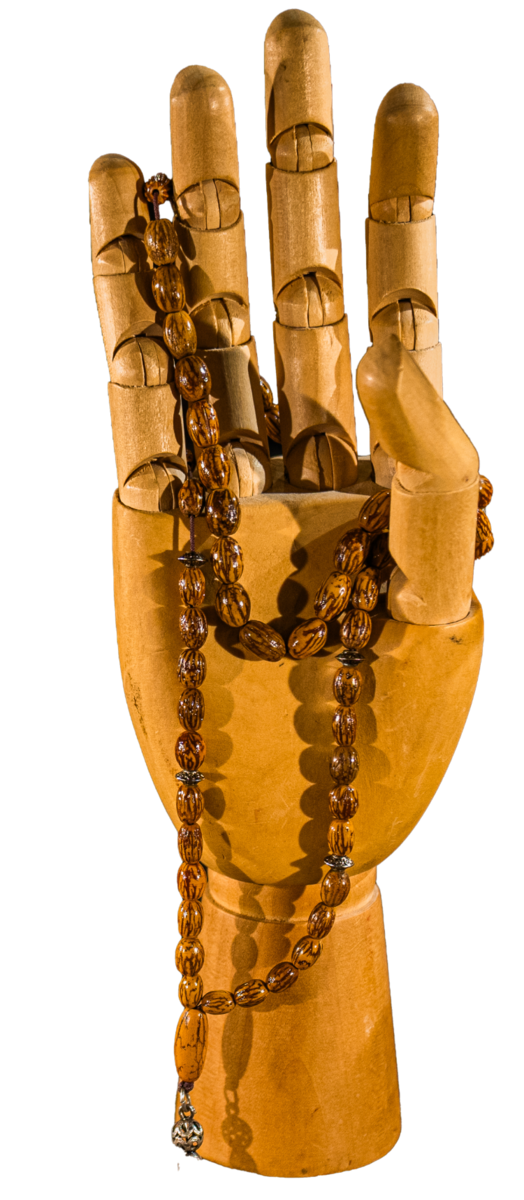
Saudi artist sultan Al-Mrshood carves rosaries from pits of olives and dates. (AN photos by Huda Bashatah)
He has also sold one to a well-known cane collector in Al-Qassim province.
Al-Mrshood previously won third place for his wood sculptures in a Souq Okaz competition. Souq Okaz is a part of Taif Season which showcases Arab culture through food, art and goods from the UAE, Kuwait, Bahrain, Oman, Iraq, Egypt, Jordan, Lebanon, Morocco and Tunisia.
Al-Mrshood says that he has received positive feedback from the community on his snake canes. “It is classified as one of the rarest canes found in Saudi Arabia … The fact that there are not many sculptors in Saudi Arabia makes it very important and relevant. All the visitors’ responses are admiration and amazement.”

Sultan Al-Mrshood said ‘The snake crutch, which embodies the story of the staff of Moses, is the secret of my fame and was sold to Prince Sultan bin Salman.’ (Supplied)
He is inspired by images of a farm in Buraidah where he was raised. “I lived part of my life on a simple farm. My childhood at the farm was filled with adventures and I would always play with the wooden sticks and create shapes out of them. I would try to make masterpieces out of whatever was around me even though I didn’t know I would be an artist.”
“I have been an artist since childhood, and I was a painter before I was a sculptor. The art of sculpture is a complex process that relies on geometry, imagination, sculpting skill, and the use of many methods.”
Al-Mrshood says he is inspired when in “a mixture of calm solitude, meditation, and walking.”
He currently works at the Ministry of Culture as an instructor, passing on his knowledge to young Saudis through wood carving classes.
On challenges he faces as a wood sculptor, Al-Mrshood noted the “lack of availability to purchase manual machines to help me work accurately and quickly.”
While he caters for a niche market, which has its difficulties, there is also the appeal of its exclusivity. “If there are many wood carvers in Saudi Arabia, the price would decrease, but since the number of wood carvers in Saudi Arabia is very low, the prices of our handcrafted producers increase. This makes individuals like us very important and valued.”