Lahore cat cafe soothes feline lovers, hopes rescues will find purr-fect homes

Customers play with cats at the Safari Pet Cafe in Lahore, Pakistan on December 2, 2023. (AN Photo)
Short Url
Updated 06 December 2023
Follow

Lahore cat cafe soothes feline lovers, hopes rescues will find purr-fect homes

  • Safari Pet Cafe in Lahore offers paying customers a space to de-stress with time spent with cats
  • Owner in talks with cat rescue service, plans to house felines at cafe and encourage adoption

LAHORE: A cat walked lazily past one of several bean bags on the floor, while another lounged on a shelf in a room full of children and adults cuddling the furry creatures against the backdrop of walls filled with murals and portraits of cats.

Welcome to the Safari Pet Cafe in Pakistan’s eastern city of Lahore, a haven for humans craving fluffy feline company, which also hopes to double as an adoption center for strays in the furture.

“Definitely, with this pet cafe, we have a plan for rescued cats and their adoption here,” veterinarian Dr. Iqrar Ahmed, who opened the cafe in the city’s Banker’s Society in November, told Arab News last week, saying he was in talks with a rescue service called “Crazy Pets” and would house cats at his cafe and encourage visitors to adopt them.

“They will be stray cats, we will keep them here and have people adopt them.”
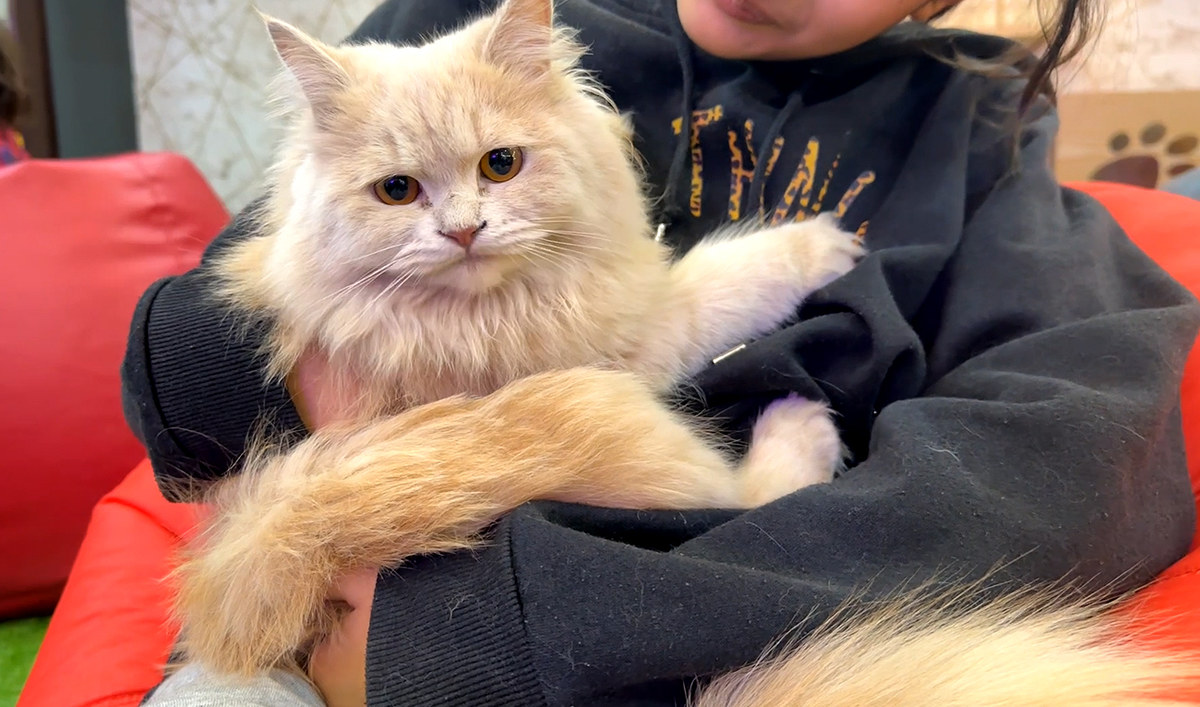


A customer holds a cat at the Safari Pet Cafe in Lahore, Pakistan on December 2, 2023. (AN Photo)

Around the vet, dozens of cats weaved in between the tables and chairs or curled up on bean bags as cafe-goers sat enjoying coffee. 

Apart from a comfortable, loving space for the animals, Ahmed hopes he can bring cat lovers some joy with his cafe, while boosting awareness over pet raising and adoption.

In a country where people are discouraged from bringing their pets with them even to public parks, Ahmed’s is a rare space, cashing in on an idea first popularized in Japan to allow stressed-out workers to wind down by stroking a cat while sipping a cappuccino or latte — or tea, if you prefer.

The cafe has homed some cats of its own, but also allows customers to bring their own pets there. The space has regular customers who come seeking relaxation from the stresses of life, or because they want to publicly socialize with their cats or show them off. Then there are also those who cannot keep a cat at home.

“There are many kids, like me, who never got permission to keep a pet,” Ahmed said as he stroked a golden Persian cat. “Pet café is a place where you can bring your pets or if you don’t have pets and want to spend time with pets, [you can come here].”

The ground floor of the cafe, where the kitchen is located, is a no-go area for the feline creatures, but the second story is where they are allowed to freely lounge and play, with an Astroturf to walk on and plenty of shelves to climb and nap on.
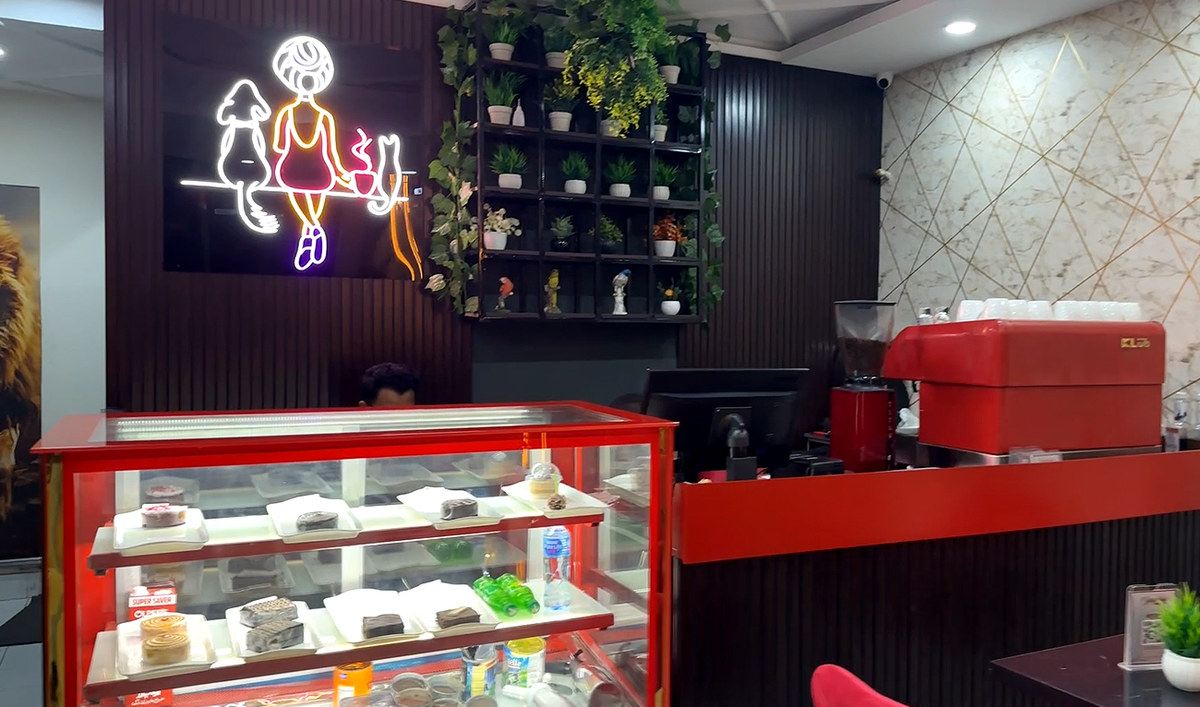


An interior view of the Safari Pet Cafe in Lahore, Pakistan, on December 2, 2023. (AN Photo)

“The quality of cats here is beautiful and sweet, so it’s a good idea and when I heard about it, I felt happy,” said Subhana Faraz, who was visiting the cafe with her husband, two sons, and pet cat named Milo.

“Often, we have to leave them [our pets] at home and when we go back home after a long time, they get disturbed. So, we like such places where we can take them.”

Student Syed Ramil Ahmed, 14, said having pets and being around animals helped him deal with stress.

“First of all, if you have a pet, you can’t feel lonely at all because it doesn’t leave you. When you return from somewhere, when we come back from school, they always come running to us immediately,” he said as a tiny white kitten slept in his lap. 

“You can give them all your love and they love you back equally.”


Macroeconomic instability, inconsistent policies hinder FDI in Pakistan— economists, OICCI

Updated 4 sec ago
Follow

Macroeconomic instability, inconsistent policies hinder FDI in Pakistan— economists, OICCI

  • Pakistan’s foreign direct investment fell 26 percent to $748 million from $1.01 billion a year earlier — data
  • Foreign investors also avoid Pakistan due to its repeated reliance on loans from the IMF, say economists

KARACHI: Despite being the fifth-largest consumer market in the world, Pakistan has failed to attract its “due share” of foreign direct investment (FDI) due to inconsistent policies, regional conflicts and macroeconomic stability, economists and a senior official of the Overseas Investors Chamber of Commerce and Industry (OICCI) said this week. 

Prime Minister Shehbaz Sharif has pursued economic diplomacy recently, traveling frequently to the China, Saudi Arabia, the UAE and other countries. However, these efforts have yet to translate into sustained inflows, as Pakistan has attracted a mere $3 billion in annual FDI over the past two decades, according to the SBP’s data.

Pakistan’s FDI fell 26 percent to $748 million from $1.01 billion a year earlier, extending the downward trend from $2.5 billion recorded in FY25 and $2.3 billion in FY24.

“Pakistan has not been able to attract its due share of the foreign direct investment,” OICCI Secretary General Abdul Aleem said on Friday.
 
The OICCI represents over 200 multinational companies operating in Pakistan, which have collectively reinvested $23 billion over the decade to 2023, according to the group’s website.

“One of the reasons that Pakistan has not been able to attract as much FDI as it should is also a situation in a region where there are conflicts.”

Aleem was referring to Pakistan’s recent border skirmishes with Afghanistan and its four-day military conflict with India in May this year. 

Portfolio investment has also been far from impressive, rising to $160 million in July–Oct in FY26 from $97.2 million a year earlier. Portfolio investment reflects how much money foreigners invest in or withdraw from a country’s stock market.

Last month, Karachi-based market research firm Topline Securities reported that Pakistan had lost around $4 billion in portfolio investments over the past decade.

Arab News reached out to Pakistan’s finance adviser Khurram Schehzad and Jamil Ahmad Qureshi, the secretary-general of the Special Investment Facilitation Council but they were not immediately available for comment. 

Finance Minister Muhammad Aurangzeb told Arab News last month that Pakistan was now better positioned to seek foreign investment due to early signs of macroeconomic stabilization after a prolonged crisis.

‘GREATER CLARITY, CONTINUITY’

Sana Tawfik, head of research at Arif Habib Limited, said Pakistan could see more sustained foreign investment flows through consistent reforms and “clear policies.”

“But foreign investors look for greater clarity and continuity before committing large and long-term capital,” she noted. 

Pakistan’s former finance adviser, Khaqan Najeeb, agreed. He said macroeconomic instability and policy shifts complicate business planning.

“Infrastructure gaps and regulatory hurdles further soften investor confidence,” Najeeb said, noting that Pakistan’s net FDI was hovering around the $1.5-2 billion mark, far below the country’s potential. 

Najeeb pointed out that Islamabad’s repeated reliance on bailouts from the International Monetary Fund (IMF) is also a major reason why foreign investors avoid Pakistan’s debt-burdened yet resilient economy.

Pakistan has secured at least 26 loans from the IMF since joining the organization in 1950, according to the Fund’s website. Pakistan secured a $7 billion bailout program from the global lender last year and is expecting a $1.2 billion tranche after the Executive Board’s meeting next week.

“I think chronic macroeconomic instability, currency volatility, reserves positions going down, going back to the IMF so many times have played a role in this,” he said. 

He said Pakistan’s FDI inflows had remained “modest” due to its recurring balance of payments pressures, noting that periodic IMF programs create “uncertainty for long-term investors.”

Aleem said he was working with the government to streamline Pakistan’s tax structure and ease of doing business, noting that foreign investors often had concerns about the South Asian country’s “slow” legal system.

“It is not enough to say improvements have been made internally,” he said. 

“You have to stand up internationally and at the right forums, share transparently what is good and what is not good in the country.”