

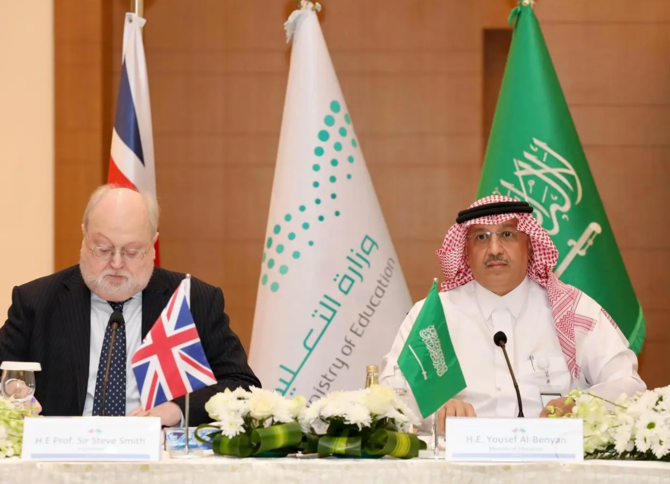

RIYADH: Saudi Arabia’s Minister of Education Yousef Al-Benyan has participated in roundtable meetings involving representatives from the Kingdom and British universities, the Saudi Press Agency said on Tuesday.
A meeting was held at the ministry’s headquarters in Riyadh in the presence of the British Prime Minister’s Special Representative to Saudi Arabia on Education Steve Smith, university leaders and representatives from the two countries.
The education minister spoke of the role of roundtable meetings in his opening speech, noting their importance in strengthening the ongoing strategic partnership between the two countries in the field of education, which began in 2018 when Crown Prince Mohammed bin Salman signed a memorandum of understanding to establish a partnership.
Al-Benyan said: “Our strategic partnership focuses on six main areas, which include building a stronger and deeper partnership in the field of education; supporting the professional development of Saudi educators and enhancing their knowledge, skills and abilities; as well as enhancing cooperation and partnerships in the field of university education, including research cooperation, student scholarships, and transnational education.
“The educational partnership with the United Kingdom aims to increase the participation of the British private education sector in Saudi education, establish British schools and universities, address skills gaps, train healthcare professionals, and support the development of education, in line with the ambition of the Kingdom’s Vision 2030.”
Sharing policies relating to special educational needs and disabilities, and curriculum development would be part of the process, he added.
Al-Benyan stressed the importance of working within the partnership to open two British universities in the Kingdom by 2025, and to activate student exchange programs in Saudi universities to ensure that Saudi students had access to the latest knowledge and practical training to enhance opportunities for researchers from both countries while establishing joint research projects.
The work program of the roundtable meetings has focused on education within the UK’s framework for science and technology; investment in university education in the Kingdom; and the Saudi Innovative Educational City initiative.
In addition, bilateral cooperation in the field of research and innovation; a review of national research, development and innovation in the Kingdom and its strategic directions; as well as the role of the British Council in supporting university educational cooperation between the two countries by holding bilateral meetings between the Saudi universities and their British counterparts have also been looked at.
Meanwhile, the Leaders Development Institute has signed a declaration of intent with Loughborough University in England to strengthen ties between the two countries to contribute to the development of the sports sector and lead to equality and mutual respect.
The agreement will secure cooperation in various fields, including research and development, professional development programs for sports professions, and exchange of technical and administrative expertise.
LDI Director General Dr. Mezna Al-Marzooqi and Prof. Chris Linton, Loughborough University’s deputy vice chancellor, signed the agreement, while Badr Al-Kadi, the deputy sports minister, and British Ambassador to the Kingdom Neil Crompton attended the signing ceremony.
“Loughborough University is bound to improve the professional development programs of sports professions and occupations in the Kingdom, support the institute in the field of research and development, and strengthen the capabilities of training providers in the sector,” the SPA said.
King Abdulaziz University also held a scientific meeting with representatives of the British universities, which was organized by the university’s Department of International Cooperation Agreements, in coordination with the British Council.
The meeting discussed aspects of cooperation and partnerships in the educational and research fields.
President of Imam Muhammad bin Saud Islamic University Dr. Ahmed bin Salem Al-Amri also received the British universities delegation on Monday.
The visiting delegation included representatives from 18 British universities, who discussed ways to enhance scientific visits, vocational training, and ways to exchange scientific and research experiences between the two countries through the use of research laboratories and dual certificates.


