

Messi named Time magazine’s ‘Athlete of the Year’

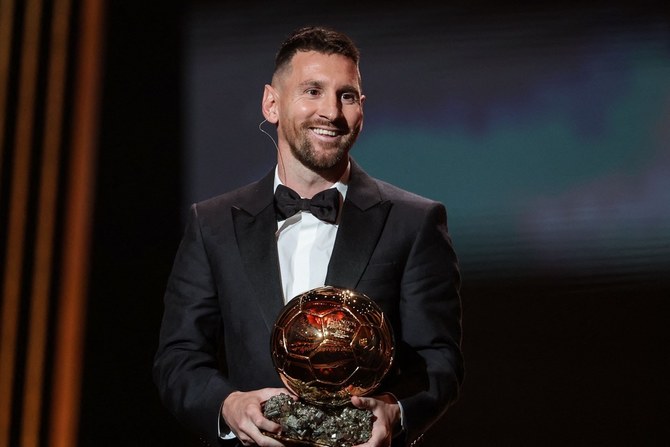
Inter Miami CF's Argentine forward Lionel Messi receives his 8th Ballon d'Or award during the 2023 Ballon d'Or France Football awards ceremony. Messi is Time magazine's "Athlete of the Year" for 2023. (File/AFP)
Short Url
Updated 06 December 2023
Follow

Messi named Time magazine’s ‘Athlete of the Year’

  • Time: Lionel Messi this year managed to do what once seemed impossible, when he signed with Inter Miami: Turning the US into a soccer country
  • Messi was quoted by Time as saying that his first preference after PSG had been a fairytale return to Barcelona, but that move stalled over the club’s finances

LOS ANGELES: Lionel Messi has been named Time magazine’s “Athlete of the Year” for 2023 after a trailblazing season marked by an eighth Ballon d’Or award and his ground-breaking move to Major League Soccer’s Inter Miami.

Time said the Argentine superstar had already had a transformative impact on the American sporting landscape, which has been historically slow to embrace football.

“Lionel Messi this year managed to do what once seemed impossible, when he signed with Inter Miami: Turning the US into a soccer country,” Time commented.

The 36-year-old Messi made his debut for Miami in July following an acrimonious departure from Paris Saint-Germain.

The eight-time Ballon d’Or winner made an instant impact on Miami’s fortunes, playing a pivotal role in helping the team win the expanded Leagues Cup, a cross-border competition for teams from MLS and Mexico’s top flight.

Messi finished the campaign with 11 goals in 14 appearances across all competitions, but an injury toward the end of the season meant he was unable to help Miami force their way into the playoffs.

Messi was quoted by Time as saying that his first preference after PSG had been a fairytale return to Barcelona, but that move stalled over the club’s finances.

“I tried to return, and it did not happen,” Messi said, adding that he was also “thinking a lot” about joining the wave of overseas players who have headed to the Saudi Pro League.

“It was Saudi Arabia or MLS, and both options seemed very interesting to me,” Messi told the magazine.

Time said Messi’s arrival had driven a surge in attendances, ticket prices, merchandise sales and viewership, revealing that on the day of his debut, subscriptions to Apple TV — which retains exclusive rights to MLS —had jumped by 110,000, a 1,700 percent increase over the previous day.


FIFA reports a record of 5,973 international transfers in January window

Updated 05 February 2026
Follow

FIFA reports a record of 5,973 international transfers in January window

  • That marks a 3 percent increase from the previous year in cross-border deals between clubs
  • In women’s soccer, clubs spent more than $10 million on international transfers

ZURICH: A record number of 5,973 international transfers were recorded in the January trading window for men’s soccer, according to a FIFA report released Thursday.
That marks a 3 percent increase from the previous year in cross-border deals between clubs in different countries, where the transactions are processed by FIFA.
However, the total spending was down about 18 percent from last year’s record, to $1.95 billion. That’s still some 20 percent more than the previous record from January 2023, FIFA said.
In women’s soccer, clubs spent more than $10 million on international transfers, up 85 percent from the previous record a year ago, while the number of international transfers was down by 6 percent to 420.
The FIFA research does not include domestic transfers of players between two clubs in the same country.

England tops spending
English clubs were again the biggest spenders with a $363 million outlay on transfer fees and recouped just $150 million by selling players to clubs in other countries. Italy followed in second with $283 million, with Brazil, Germany, and France also making the top five.
French clubs benefited most, earning $218 million in transfer sales, followed by Italy, Brazil, England and Spain.
In the United States, clubs spent $99 million and took in $48 million in transfer fees, according to the FIFA research.
English women’s clubs also topped the spending with over $5 million, and also were the biggest earners.