

Saudi aviation strategy boosts global connectivity, official says

1 / 2
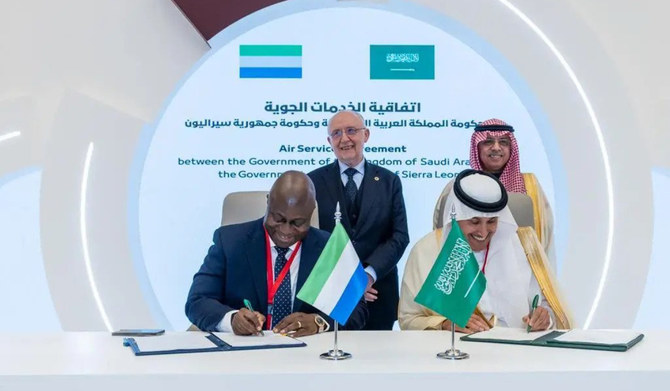
Al-Jasser signs a cooperation agreement in air transport services with Sierra Leone's Minister of Transport and Aviation, Haji Vandi Turay, on the sidelines of the 15th International Conference on Air Service Negotiations (ICAN 2023), which will continue until Thursday. (Supplied)
2 / 2
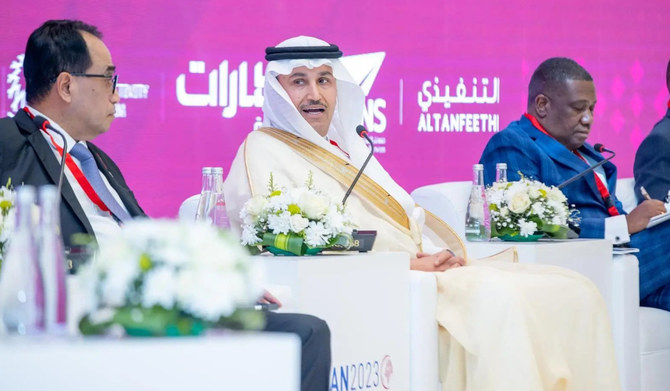
Al-Jasser speaking at a ministerial session titled "The Impact of Air Transport on Economic Development" at the 15th International Conference on Air Service Negotiations (ICAN 2023) of the International Civil Aviation Organization (ICAO), which kicked off on Sunday (December 3) in Riyadh and continue until Thursday. (Supplied)
Short Url
Updated 04 December 2023
Follow

Saudi aviation strategy boosts global connectivity, official says

RIYADH: Saudi Arabia’s Minister of Transport and Logistics Saleh Al-Jasser highlighted the success of the national aviation strategy in making Saudi Arabia more globally connected during the 15th International Conference on Air Services Negotiations in Riyadh.

Al-Jasser, who also chairs the General Authority of Civil Aviation, said that the strategy encompasses plans to swiftly advance the country’s air transport sector, including expanding the flight network of Saudi airports.

Speaking at a ministerial session titled “The Impact of Air Transport on Economic Development” at the ICAN 2023 of the International Civil Aviation Organization, Al-Jasser noted the development of airport infrastructure across the Kingdom. This includes the construction of new airports, such as the King Salman Airport in Riyadh, and enhancing air service levels at all airports. The focus is also on transforming the King Abdulaziz Airport in Jeddah into a global air service hub and increasing aircraft numbers.

He said that the ministry’s goal is to boost the transport and logistics sector’s contribution to GDP to 10 percent, viewing civil aviation as a key driver.

The session also featured discussions with Indonesian Minister of Transport Budi Karya Sumadi, the Ministry of External Affairs, International Trade and Civil Aviation of Saint Lucia’s Alva Romanus Baptiste, and Minister of Transport of the Republic of Seychelles Anthony Gerard D’Offay. They shared insights on the role of civil aviation in economic development and global connectivity.

Al-Jasser inaugurated the 15th ICAN conference on Sunday, which was attended by key figures in international aviation. The inauguration was attended by notable figures including GACA President Abdulaziz Al-Duailej and ICAO Council President Salvatore Sciacchitano.

Al-Jasser also signed a cooperation agreement in air transport services with Minister of Transport and Aviation of Sierra Leone Fanday Turay on the sidelines of the event, which will continue until Thursday.

The agreement complements the Convention on International Civil Aviation, also known as the Chicago Convention, signed in 1944, aiming to regulate safe and efficient air transport between the two countries and enhance airline competition, safety and civil aviation security standards.

The bilateral agreement is part of Saudi Arabia’s broader strategy to establish international partnerships, sign new bilateral agreements and achieve ambitious goals in enhancing global air connectivity, with plans to become a global logistics hub and handle 330 million passengers annually by 2030.

The agreement also focuses on supporting the mutual economic interests of national airlines, enhancing their role in the air transport market of both countries, and embracing modern approaches to market entry and air transport.

This is part of a broader strategy in the civil aviation sector to forge international partnerships and sign new bilateral agreements. These initiatives are geared toward expanding the Kingdom’s global air network to 250 destinations.


Experimental farm in Al-Lith looks into future of Saudi Arabian agriculture

Updated 01 February 2026
Follow

Experimental farm in Al-Lith looks into future of Saudi Arabian agriculture

  • Research initiative reflects strategic transformation

JEDDAH: An experimental farm in Saudi Arabia’s Al-Lith Governorate is one of the research initiatives reflecting the strategic transformation taking place in the Kingdom’s agricultural sector.

The farm uses highly efficient, sustainable production models that combine scientific research with commercial application, contributing to strengthening the country’s food security system and the sustainability of water resources.

Located in the Ghumaiqa Center on an area of about 10 hectares, the cutting-edge farm is a testing platform for modern agricultural technologies that tackle the challenge of water scarcity.

The farm includes developed open fields and modern greenhouses, supported by smart irrigation encompassing drip and sprinkler irrigation alongside surface and subsurface technologies.

All the systems operate via smart controls that enable the monitoring of water consumption and ensure improved efficiency, thereby achieving a balance between agricultural production and water conservation.

The farm also uses treated and diluted low-salinity seawater.

It aims to diversify agricultural water sources, reduce reliance on freshwater, and open new horizons for agriculture in coastal and semi-arid environments.

The project represents a promising investment opportunity in the field of smart agriculture, enabling the development of commercially scalable production models, particularly for high-value vegetables and fruits, while reducing operational costs associated with water and energy, enhancing the economic feasibility of future agricultural projects.

In addition, the project contributes to transferring and localizing agricultural expertise, supporting local food supply chains, and creating an attractive environment for agricultural investment.

This aligns with Sustainable Development Goals and enhances the efficiency of the private sector in adopting innovative agricultural solutions.

Yahya bin Abdulrahman Al-Mahabi, the director of the Ministry of Environment, Water and Agriculture office in Al-Lith Governorate, told the Saudi Press Agency that the project represented the future of agriculture in the Kingdom.

He explained that the vision was based on investing in technology, enhancing the return on water per unit, and integrating scientific research with investment opportunities.

Al-Mahabi spoke of the experimental farm as a modern, scalable and replicable model applicable in several regions of the Kingdom, particularly in coastal environments.

Al-Mahabi highlighted the Ministry of Environment, Water and Agriculture’s commitment to supporting distinctive projects that contributed to achieving food security while developing rural areas and enhancing agricultural production efficiency, in line with the objectives of the Kingdom’s Vision 2030.