Philippine police identify possible suspects after deadly blast at Catholic mass 

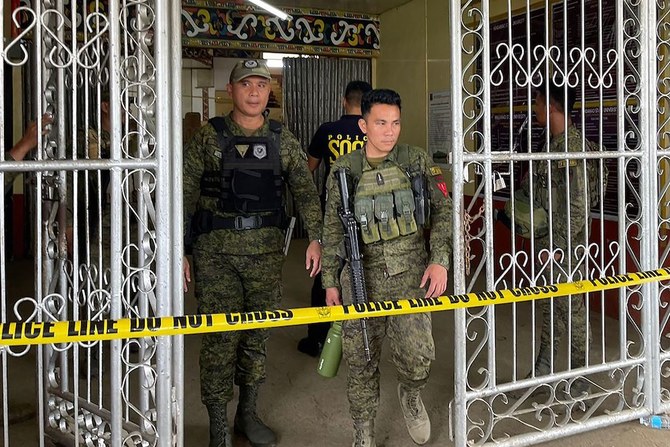
Military personnel stand guard at the entrance of a gymnasium while police investigators look for evidence after a bomb attack at Mindanao State University in Marawi on Dec. 3, 2023. (AFP)
Short Url
Updated 04 December 2023
Follow

Philippine police identify possible suspects after deadly blast at Catholic mass 

  • Powerful explosion in Marawi killed at least 4, injured 50 others  
  • Daesh reportedly claimed responsibility for the attack late on Sunday

MANILA: Philippine police are looking into possible suspects behind the bombing at a Catholic mass in the country’s south, a regional police chief said on Monday after the blast that killed four people was claimed by Daesh militants. 

On Sunday, a powerful explosion ripped through a gymnasium at Mindanao State University in Marawi, a southern Philippine city that was besieged by pro-Daesh militants for five months in 2017. The death toll stood at four as of Monday, while around 50 others were injured from the blast. 

Daesh claimed responsibility for the attack late on Sunday, saying that its members had detonated an explosive device at the gathering, according to reports.  

“Following the explosion, the PNP (Philippine National Police) created a special investigation task group to focus and expedite the investigation relative to this incident … We (now) have persons of interest,” regional police chief Allan Nobleza told reporters, adding that one of the suspects was linked to a local militant group.  

“The investigation is still ongoing. In order not to preempt the investigation, we will not divulge the names.”  

Gen. Romeo Brawner Jr., chief of staff of the Philippines’ Armed Forces, said that Sunday’s attack may have been in response to a series of recent military operations that had targeted local militant groups.  

Philippine forces launched an operation targeting the local Dawlah Islamiyah cell in the southern province of Maguindanao on Friday, killing 11 suspected militants including the group’s alleged leader Abdullah Sapal. The militant group, which has been linked to bombings and other deadly attacks in the southern Philippines, pledged allegiance to Daesh in 2015. 

In another operation in Sulu province on Saturday, government forces killed Mudzrimar Sawadjaan, also known as Mundi, a senior leader of another Daesh affiliate, the Abu Sayyaf Group. Brawner said Mundi was the mastermind of two major attacks in the Sulu capital of Jolo, including the 2019 cathedral bombings that killed at least 20 people. 

Both Dawlah Islamiyah —also known as the Maute group — and the ASG were behind the 2017 Marawi siege, a five-month battle that killed more than 1,100 people and forced more than 300,000 others from their homes. 

“Because of the accomplishments … we believe that that could be one of the strong possibilities why this (attack) occurred,” Brawner told reporters in Marawi on Monday.  

“We will go after the perpetrators as soon as possible and use all resources at our disposal in order to make this happen.”  


Top US defense official hails ‘model ally’ in South Korea talks

Updated 5 sec ago
Follow

Top US defense official hails ‘model ally’ in South Korea talks

SِEOUL: The Pentagon’s number three official hailed South Korea as a “model ally” as he met with local counterparts in Seoul on Monday, days after Washington’s new defense strategy called for reduced support for partners overseas.
Under Secretary of Defense for Policy Elbridge Colby arrived in South Korea on Monday and is seen as a key proponent of President Donald Trump’s “America First” foreign policy.
That policy — detailed in Washington’s 2026 National Defense Strategy (NDS) released last week — calls for the United States to prioritize deterring China and for long-standing US allies to take “primary responsibility” for their own defense.
Arriving in Seoul on his first overseas trip as the Pentagon’s number three official, Colby in a post on X called South Korea a “model ally.”
And he praised President Lee Jae Myung’s pledge to spend 3.5 percent of the country’s GDP on the military.
That decision, he told a forum, “reflects a clear-eyed and sage understanding of how to address the security environment that we all face and how to put our storied and historic alliance on sound footing for the long haul,” according to South Korea’s Yonhap News Agency.
“Such adaptation, such clear-eyed realism about the situation that we face and the need for greater balance in the sharing of burdens, will ensure that deterrence remains credible, sustainable and resilient in this changing world,” he added, according to the agency.
Colby also met Monday with South Korea’s defense and foreign ministers, who touted Seoul’s development of nuclear-powered attack submarines as proof the country was taking more responsibility for its defense.
Details remain murky on where the nuclear submarines will be built, however.
South Korea’s leader said last month it would be “extremely difficult” for them to be built outside the country.
But Trump has insisted they will be built in the United States.
Longstanding treaty allies, ties between the United States and South Korea were forged in the bloodshed of the Korean War.
Washington still stations 28,500 troops in South Korea as a deterrent against the nuclear-armed North.