US stock rally could wobble if tensions spike after Red Sea attacks

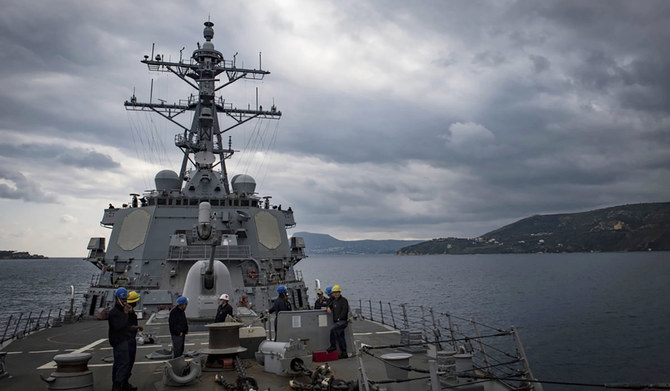
This Nov. 12, 2018 photo shows The USS Carney in the Mediterranean Sea. The American warship and multiple commercial ships came under attack Sunday, Dec. 3, 2023 in the Red Sea, the Pentagon said, potentially marking a major escalation in a series of maritime attacks in the Mideast linked to the Israel-Hamas war. (AP)
Short Url
Updated 04 December 2023
Follow

US stock rally could wobble if tensions spike after Red Sea attacks

  • The developments risk inflaming fears that the Israel-Hamas war could widen into a broader conflict encompassing the US and regional players like Iran

NEW YORK: An attack on an American warship and commercial vessels in the Red Sea on Sunday risks reigniting investor worries about a widening of the war between Israel and Hamas, potentially complicating the outlook for a rally that saw US stocks crest a fresh closing high for the year last week.
The Pentagon said it was aware of reports regarding attacks on an American warship and commercial vessels in the Red Sea on Sunday, while Yemen’s Houthi group claimed drone and missile attacks on two Israeli vessels in the area.
Also on Sunday, a US military official told Reuters the United States carried out a self-defense strike in Iraq against an “imminent threat” at a drone staging site.
The developments risk inflaming fears that the Israel-Hamas war could widen into a broader conflict encompassing the US and regional players like Iran. Such worries flared after Hamas’ Oct. 7 attack into southern Israel but subsided in recent weeks.
Quincy Krosby, chief global strategist at LPL Financial, said a widening conflict could push some investors to take profits on the recent rally in stocks. The S&P 500 rose nearly 9 percent in November on signs of easing inflation and hopes the Federal Reserve is done raising interest rates. The index is up almost 20 percent on the year after notching a 2023 closing high on Friday at 4594.63.
“The market is sensitive to any expansion of this conflict,” she said. “I think active managers in any event are more likely to lock in their gains if this is a harbinger of a deeper military conflict that involves the US.”
Past spikes in geopolitical tensions have made investors head for popular havens such as gold, Treasuries and the US dollar. Signs of an intensifying Middle East conflict could also boost oil prices, which have slumped in recent weeks.
Phil Orlando, chief equity market strategist at Federated Hermes, said rising tensions in the region could send West Texas Intermediate crude prices up to between $80 and $90 per barrel. Prices on Friday stood at $74.07.
The developments come as investors eye factors that could sway stocks in coming weeks. A US employment report due on Friday could bolster the case for those arguing that a cooling economy will keep the Fed from raising interest rates further and possibly loosen monetary policy sooner than expected.
Other potential catalysts include the Fed’s monetary policy meeting on Dec. 12-13, as well as seasonal factors such as tax-loss selling and the so-called Santa Claus rally.
Orlando said a spike in geopolitical tensions could drop the S&P 500 by “one or two hundred points.”
“There’s no question this represents an opportunity for investors to take profits,” he said. “However I’m still convinced the index ends the year at 4,600.”


Saudi Aramco achieves significant progress in its gas production plan

Updated 26 February 2026
Follow

Saudi Aramco achieves significant progress in its gas production plan

RIYADH: Saudi Aramco has announced the achievement of significant progress in its plan to expand gas production, with the start of production at the Jafurah field, the largest unconventional gas field in the Middle East, and the commencement of operational activities at the Tanajib Gas Plant, one of the largest gas plants in the world.

The oil giant aims to increase its sales gas production capacity by approximately 80 percent by 2030 compared to 2021 production levels, reaching nearly 6 million barrels of oil equivalent per day from total gas and associated liquids production, according to the Saudi Press Agency.

This is expected to generate additional operating cash flows ranging between $12 billion and $15 billion in 2030, subject to future demand for sales gas and liquids prices.

President and CEO of Saudi Aramco, Amin Al-Nasser, said: “We are proud to commence production at the Jafurah field and begin operations at the Tanajib Gas Plant. These are major achievements for Saudi Aramco and the future of energy in the Kingdom. Our ambitious gas program is expected to become a key source of profitability.”

He affirmed that these mega-projects contribute to meeting the growing domestic demand for gas, supporting industrialization and development in several key sectors, in addition to producing significant quantities of high-value liquids.

Al-Nasser expressed his gratitude for the support, trust, and attention that Saudi Aramco receives from the Custodian of the Two Holy Mosques, King Salman bin Abdulaziz Al Saud, and His Royal Highness Prince Mohammed bin Salman bin Abdulaziz Al Saud, crown prince and prime minister, noting that this has had the most profound impact on the company’s achievements and distinguished projects that serve the Kingdom’s Vision 2030.

The gas extracted from the Jafurah field is expected to support the Kingdom’s growth targets in key sectors such as energy, artificial intelligence, major industries, and petrochemicals, potentially providing a major boost to the Kingdom’s economy and strengthening its position among the world’s top ten gas producers.

Saudi Aramco began first producing unconventional shale gas from the Jafurah field in December 2025, with technology playing a pivotal role in unlocking the potential of the Jafurah field and establishing it as a global benchmark for unconventional gas development. 

Since its inception, the project has leveraged technology to help reduce drilling and stimulation costs and enhance well productivity, contributing to its strong economic prospects.

The Jafurah area covers 17,000 sq. km and is estimated to contain 229 trillion standard cubic feet of raw gas and 75 billion barrels of condensates. The Jafurah field project aims to produce 2 billion standard cubic feet per day of sales gas, 420 million standard cubic feet per day of ethane, and approximately 630,00 barrels per day of gas liquids and condensates by 2030.

The Tanajib Gas Plant is a key pillar in Aramco’s strategy to increase gas processing capacities and diversify its energy product portfolio, helping to foster long-term economic growth. 

Operations began in December 2025, and its raw gas processing capacity is expected to reach 2.6 billion standard cubic feet per day in 2026. The start of operations at the Tanajib Plant coincided with the commencement of production from the Marjan field expansion and development program. 

The plant is distinguished by its digital integration, enhanced operational efficiency, capability to execute complex projects, and optimal use of resources. It processes raw gas associated with crude oil production from the offshore Marjan and Zuluf fields.

Aramco’s gas expansion is expected to create thousands of direct and indirect job opportunities, generating significant added value and strengthening its position as a reliable energy provider. 

It also helps meet the growing demand for natural gas and enhances its supply to national industries. 

The expansion strategy supports efforts aimed at achieving the optimal energy mix for local electricity generation, advancing the Kingdom’s liquid fuel displacement program, which will have a positive environmental impact, supporting the Kingdom’s ambition to achieve net-zero emissions by 2060, enhancing energy security, and contributing to building a more diversified national economy.