COP28 delegates urge greater action on climate-linked health risks

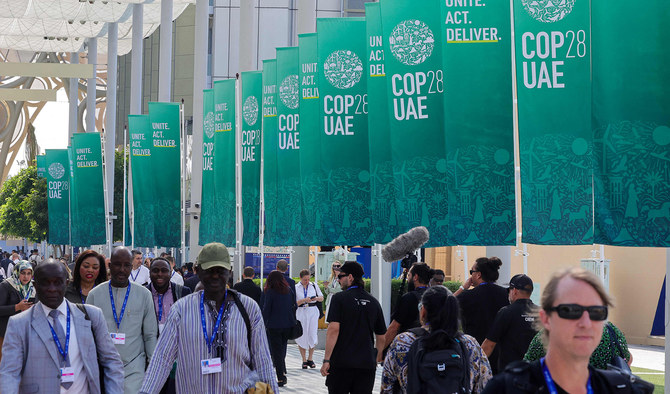
Participants walk past banners at the COP28 United Nations climate summit in Dubai, UAE on December 3, 2023. (AFP)
Short Url
Updated 03 December 2023
Follow

COP28 delegates urge greater action on climate-linked health risks

  • In September, Storm Daniel killed over 11,000 in Libya, floods in Pakistan last year fueled a 400% increase in malaria cases
  • Experts say countries will need to boost funding for healthcare amid heatwaves, diseases like malaria and cholera spreading

DUBAI: Physicians, activists and country representatives at this year's COP28 U.N. climate summit in Dubai have called for greater global efforts to protect people from the increasing health and safety risks posed by climate change. 

With global temperatures set to continue climbing for decades, experts say countries will need to boost funding for healthcare as heatwaves become more dangerous and diseases like malaria and cholera spread. 

Climate-related impacts "have become one of the greatest threats to human health in the 21st century", COP28 President Sultan Ahmed Al-Jaber said in a statement. 

Late on Saturday, 123 of the nearly 200 countries gathered at COP28 signed a declaration acknowledging their responsibility to keep people safe. The declaration made no mention of fossil fuels, the main source of climate-warming emissions. 

Thanks to climate change, cases of malnutrition, malaria, diarrhoea and heat stress are already on the rise in some regions. 

A small group of physicians in white coats and climate activists held a small demonstration within the COP28 compound to raise awareness of the issue on Sunday. 

"We are in a lot of trouble," said Joseph Vipond, an emergency physician from Alberta, Canada. He recalled the case of a child dying from an asthma attack made worse by smoke inhalation from Western Canada's record wildfires this year. "This is having real world impacts." 

Climate change is also increasing the frequency of dangerous storms and more erratic rainfall. 

In September Storm Daniel killed more than 11,000 people in Libya, and last year's massive flooding in Pakistan fueled a 400% increase in malaria cases across the country, according to the World Health Organization. 

Governments and philanthropic bodies are expected later on Sunday to announce new financing for climate-related health issues. 

The World Bank on Sunday launched a new Climate and Health program to explore possible interventions and public health solutions for developing countries. 

Ten of the world's top development banks including the World Bank also said on Sunday they would work together to help countries track climate impacts, including public health risks, and to identify investment opportunities and priorities. 

In a statement, the banks said the window of opportunity to secure a liveable planet was "rapidly closing". 

Microsoft co-founder turned philanthropist Bill Gates said scientists were working on new treatments for and prevention of mosquito-spread malaria as the rise in temperatures creates more hospitable habitat for the insects to breed. 

"We have new tools at the lab level that decimate mosquito populations," said Gates, whose foundation supports public health research and projects for the developing world. 

"These new innovations give us a chance, at a reasonable cost, to make progress." 

Former U.S. Secretary of State Hillary Clinton also spoke on Sunday at COP28, urging reform to the world's insurance system as another key requirement to keep people safe. 

"Right now insurance companies are pulling out of so many places, they're not insuring homes, they're not insuring businesses," Clinton said, addressing a panel on women and climate resiliency 

"As the climate changes, as storms increase and drought and heat increase ... it's people everywhere who are going to be left out with no backup, no insurance for their business or their home," she said. 


Pakistani politicians urge dialogue with Imran Khan’s party as PM offers talks

Updated 07 January 2026
Follow

Pakistani politicians urge dialogue with Imran Khan’s party as PM offers talks

  • National Dialogue Committee group organizes summit attended by prominent lawyers, politicians and journalists in Islamabad
  • Participants urge government to lift alleged ban on political activities and media restrictions, form committee for negotiations 

ISLAMABAD: Participants of a meeting featuring prominent politicians, lawyers and civil society members on Wednesday urged the government to initiate talks with former prime minister Imran Khan’s Pakistan Tehreek-e-Insaf (PTI) party, lift alleged bans on political activities after Prime Minister Shehbaz Sharif recently invited the PTI for talks. 

The summit was organized by the National Dialogue Committee (NDC), a political group formed last month by former PTI members Chaudhry Fawad Husain, ex-Sindh governor Imran Ismail and Mehmood Moulvi. The NDC has called for efforts to ease political tensions in the country and facilitate dialogue between the government and Khan’s party. 

The development takes place amid rising tensions between the PTI and Pakistan’s military and government. Khan, who remains in jail on a slew of charges he says are politically motivated, blames the military and the government for colluding to keep him away from power by rigging the 2024 general election and implicating him in false cases. Both deny his allegations. 

Since Khan was ousted in a parliamentary vote in April 2022, the PTI has complained of a widespread state crackdown, while Khan and his senior party colleagues have been embroiled in dozens of legal cases. Prime Minister Shehbaz Sharif last month invited the PTI for talks during a meeting of the federal cabinet, saying harmony among political forces was essential for the country’s progress.

“The prime objective of the dialogue is that we want to bring the political temperatures down,” Ismail told Arab News after the conference concluded. 

“At the moment, the heat is so much that people— especially in politics— they do not want to sit across the table and discuss the pertaining issues of Pakistan which is blocking the way for investment.”

Former prime minister Shahid Khaqan Abbasi, who heads the Awaam Pakistan political party, attended the summit along with Jamaat-e-Islami senior leader Liaquat Baloch, Muttahida Quami Movement-Pakistan’s Waseem Akhtar and Haroon Ur Rashid, president of the Supreme Court Bar Association. Journalists Asma Shirazi and Fahd Husain also attended the meeting. 

Members of the Pakistan Peoples Party, the ruling Pakistan Muslim League-Nawaz (PML-N) and the PTI did not attend the gathering. 

The NDC urged Prime Minister Shehbaz Sharif, President Asif Ali Zardari and PML-N chief Nawaz Sharif to initiate talks with the opposition. It said after the government forms its team, the NDC will announce the names of the opposition negotiating team after holding consultations with its jailed members. 

“Let us create some environment. Let us bring some temperatures down and then we will do it,” Ismail said regarding a potential meeting with the jailed Khan. 

Muhammad Ali Saif, a former adviser to the Khyber Pakhtunkhwa chief minister, told participants of the meeting that Pakistan was currently in a “dysfunctional state” due to extreme political polarization.

“The tension between the PTI and the institutions, particularly the army, at the moment is the most fundamental, the most prominent and the most crucial issue,” Saif noted. 

‘CHANGED FACES’

The summit proposed six specific confidence-building measures. These included lifting an alleged ban on political activities and the appointment of the leaders of opposition in Pakistan’s Senate and National Assembly. 

The joint communique called for the immediate release of women political prisoners, such as Khan’s wife Bushra Bibi and PTI leader Yasmin Rashid, and the withdrawal of cases against supporters of political parties.

The communiqué also called for an end to media censorship and proposed that the government and opposition should “neither use the Pakistan Armed Forces for their politics nor engage in negative propaganda against them.”

Amir Khan, an overseas Pakistani businessperson, complained that frequent political changes in the country had undermined investors’ confidence.

“I came here with investment ideas, I came to know that faces have changed after a year,” Amir Khan said, referring to the frequent change in government personnel. 

Khan’s party, on the other hand, has been calling for a “meaningful” political dialogue with the government. 

However, it has accused the government of denying PTI members meetings with Khan in the Rawalpindi prison where he remains incarcerated. 

“For dialogue to be meaningful, it is essential that these authorized representatives are allowed regular and unhindered access to Imran Khan so that any engagement accurately reflects his views and PTI’s collective position,” PTI leader Azhar Leghari told Arab News last week.