

Rising human activity threatens space sustainability, warn experts at COP28

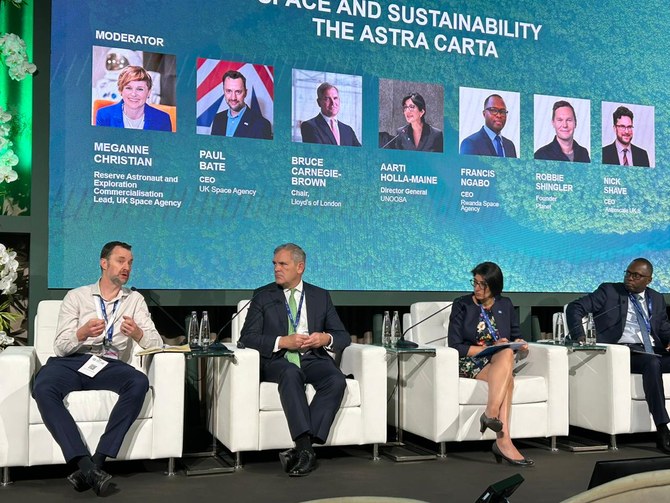
During a panel on “Sustainability in Space,” the speakers noted that while space exploration programs were traditionally exclusively led by governments, the entry of the private sector has added complexity to the situation, with a significantly increased number of satellites being launched each year. AN Photo
Short Url
Updated 03 December 2023
Follow

Rising human activity threatens space sustainability, warn experts at COP28

DUBAI: A threat to space sustainability has been underscored by experts at COP28 in Dubai, shedding light on the escalating impact of increased human activity. 

During a panel on “Sustainability in Space,” the speakers noted that while space exploration programs were traditionally exclusively led by governments, the entry of the private sector has added complexity to the situation, with a significantly increased number of satellites being launched each year. 

Bruce Carnegie-Brown, chairman, of LIoyd’s of London, a leading insurance firm, said: “We have seen some 9,000 satellites now in Low Earth Orbit, and that has doubled just in the last two years. So, the risks are going up, the frequency of potential collisions is going up, and the debris as a result is hugely on the rise.”  

He added: “We need to put in place things at the outset that force people to clean up after themselves, rather than think about it as an afterthought.”  

According to Nick Shave, CEO of Astroscale, a British space firm, the problem is even more severe. “There are 40,000 objects in space that are anything bigger than about a grapefruit. As you can see, there’s quite a difference in those numbers. And that’s because there’s a lot of fragmentation. We’ve seen different pieces of debris or debris and satellites hit each other and create fragmentation,” Shave explained. 

The increasing incidents of space collisions are even more concerning as the debris simply stays in orbit for decades or even longer, and it is difficult, if not impossible, to remove, warned another expert. 

“If you are in the ocean, or you’re on land or in the air, if something breaks, it kind of comes down, and then you can easily pick it up. If something breaks in space, it’s up there for hundreds of years,” said Robbie Schingler, founder of Planet Labs PBC. 

However, experts added that technologies were being developed to solve the problem. “There are a number of companies, including my company Astroscale, developing what we call active debris removal technology,” said Shave.  

He explained that these technologies go into orbit to assess the debris up close, capture it with robotics or other technologies, bring it down into a lower orbit, and dispose of it in the Earth’s atmosphere.  

Shave added: “There are other ways we are looking to dispose of that forward. So, there are a number of technologies that we’re in the technology proving phase at the moment.” 

Even astronauts, who are currently the only inhabitants of space, believe that more — much more — should be done to protect space. 

“When I am asked about whether I, we are, part of the problem or part of the solution to anthropogenic climate change, I want to be guilty of nothing more than being an ambassador for sustainability. What more can we do? What more should we do to show, not merely say, that our sector is doing to space sustainability for a sustainable Earth?” said Meganne Christian, reserve astronaut and exploration commercialization lead at the UK Space Agency. 

Related


Free trade negotiations between GCC, India mark new phase of partnership, says sec-gen

Updated 24 February 2026
Follow

Free trade negotiations between GCC, India mark new phase of partnership, says sec-gen

RIYADH: The Gulf Cooperation Council’s secretary-general affirmed that the negotiations for a free trade agreement between the GCC and India, and the signing of the joint statement, represents a new phase of strategic partnership.

Jasem Mohamed Al-Budaiwi said that this contributes to enhancing close cooperation and strengthening economic and trade ties, according to the Saudi Press Agency.

This came during the signing ceremony of the joint statement on launching the free trade agreement negotiations between the Al-Budaiwi and India’s Minister of Commerce and Industry, Piyush Goyal, which took place in New Delhi, on Tuesday.

During the signing ceremony, Al-Budaiwi said that the Terms of Reference, signed on Feb. 5, provide a comprehensive and clear framework for these negotiations. The two nations agreed to discuss enhancing cooperation in vital strategic areas, including trade in goods, customs procedures, and services.

Additionally, the framework covers Sanitary and Phytosanitary measures, intellectual property rights, cooperation on Micro, Small, and Medium Enterprises, along with other topics of mutual interest. This reflects the comprehensive nature of the agreement and its ability to keep pace with the future economy.

Al-Budaiwi expressed hope that these negotiations would lead to a comprehensive and ambitious free trade agreement that works to remove customs and non-customs barriers, enhance the flow of quality investments in both directions, and achieve further liberalization in trade and investment cooperation between the GCC and India for mutual benefit. 

This would provide a stimulating economic environment and an investment climate that opens broad horizons for the business sector, supports supply chains, and accelerates the pace of economic growth in line with the ambitious developmental visions of the GCC states. 

The top official affirmed the full readiness of the General Secretariat to host the first round of negotiations at its headquarters in Riyadh during the second half of this year.

The two sides held a meeting during which they reviewed the existing cooperation relations between the GCC and India and discussed ways to develop and elevate them to broader horizons, serving mutual interests and enhancing opportunities for strategic partnership between the two sides, particularly in the economic, investment, and trade fields.

They praised the role undertaken by the negotiating teams from both sides, appreciating the efforts contributing to reaching a comprehensive agreement that enhances economic integration and supports the smooth flow of trade between the two nations.