COP28: 50 oil and gas companies sign charter to accelerate climate action in industrial sector

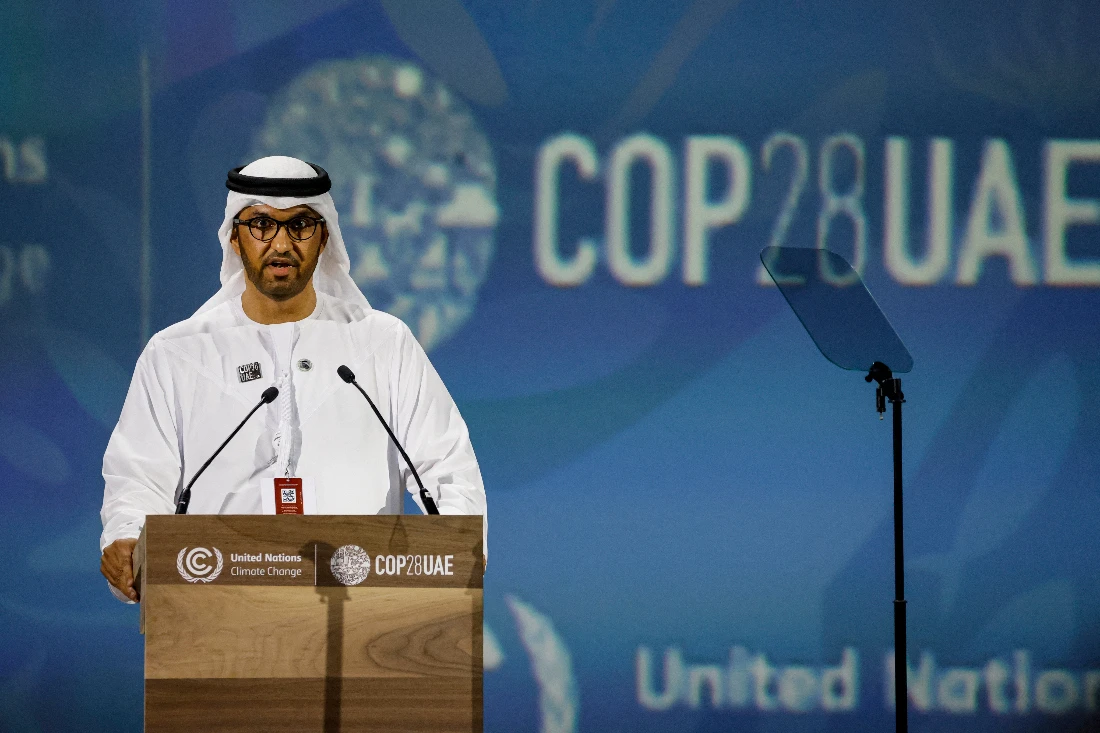
COP28 President Dr. Sultan Al-Jaber said the Oil and Gas Decarbonisation Charter recognized that climate change requires collective action. (FIle/AFP)
Short Url
Updated 03 December 2023
Follow

COP28: 50 oil and gas companies sign charter to accelerate climate action in industrial sector

  • National Oil Companies represented over 60 percent of signatories, the largest-ever number of NOCs to commit to a decarbonisation initiative
  • Signatories have committed to net-zero operations by 2050, ending routine flaring by 2030, and near-zero upstream methane emissions

COP28 Presidency and Saudi Arabia launched the Oil and Gas Decarbonisation Charter (OGDC), a global industry charter aimed at speeding up climate action across the oil and gas sectors.

Officials said 50 oil and gas companies, representing more than 40 percent of global oil production, have signed the charter, reported Emirates News Agency (WAM).

National Oil Companies represented over 60 percent of signatories, the largest-ever number of NOCs to commit to a decarbonisation initiative.

Signatories have committed to net-zero operations by 2050, ending routine flaring by 2030, and near-zero upstream methane emissions.

In a WAM statement, COP28 President Dr. Sultan Al-Jaber said, “The launch of the charter is a great first step - and whilst many national oil companies have adopted net-zero 2050 targets for the first time, I know that they and others, can and need to do more. We need the entire industry to keep 1.5C within reach and set even stronger ambitions for decarbonisation.”

Under the charter, oil and gas companies also agreed to continue to work towards industry best practices in emission reductions. Some of the key actions they agreed to take included: investing in renewables, low-carbon fuels and negative emissions technologies; reducing energy poverty; and providing secure and affordable energy to support the development of all economies.

Signatories will also work on increasing alignment with broader industry best practices to accelerate decarbonisation of operations and reduce emissions by 2030.

Al-Jaber added that the charter recognized that climate change is “a collective challenge that requires strong and focused action from producers and consumers of energy, fundamental changes across society and the energy sector, as well as international collaboration, to advance the energy transition and reduce greenhouse gas emissions from oil and gas.”


He stressed that a clear plan is needed to focus efforts on the right direction. “If we want to accelerate progress across the climate agenda, we must bring everyone in to be accountable and responsible for climate action. We must all focus on reducing emissions and apply a positive can-do vision to drive climate action and get everyone to take action.”


The charter was a key initiative under the Global Decarbonisation Accelerator (GDA), which was launched at the COP28 World Climate Action Summit.


Saudi POS transactions see 20% surge to hit $4bn: SAMA

Updated 05 December 2025
Follow

Saudi POS transactions see 20% surge to hit $4bn: SAMA

RIYADH: Saudi Arabia’s total point-of-sale transactions surged by 20.4 percent in the week ending Nov. 29, to reach SR15.1 billion ($4 billion).

According to the latest data from the Saudi Central Bank, the number of POS transactions represented a 9.1 percent week-on-week increase to 240.25 million compared to 220.15 million the week before.

Most categories saw positive change across the period, with spending on laundry services registering the biggest uptick at 36 percent to SR65.1 million. Recreation followed, with a 35.3 percent increase to SR255.99 million. 

Expenditure on apparel and clothing saw an increase of 34.6 percent, followed by a 27.8 percent increase in spending on telecommunication. Jewelry outlays rose 5.6 percent to SR354.45 million.

Data revealed decreases across only three sectors, led by education, which saw the largest dip at 40.4 percent to reach SR62.26 million. 

Spending on airlines in Saudi Arabia fell by 25.2 percent, coinciding with major global flight disruptions. This followed an urgent Airbus recall of 6,000 A320-family aircraft after solar radiation was linked to potential flight-control data corruption. Saudi carriers moved swiftly to implement the mandatory fixes.

Flyadeal completed all updates and rebooked affected passengers, while flynas updated 20 aircraft with no schedule impact. Their rapid response contained the disruption, allowing operations to return to normal quickly.

Expenditure on food and beverages saw a 28.4 percent increase to SR2.31 billion, claiming the largest share of the POS. Spending on restaurants and cafes followed with an uptick of 22.3 percent to SR1.90 billion.

The Kingdom’s key urban centers mirrored the national decline. Riyadh, which accounted for the largest share of total POS spending, saw a 14.1 percent surge to SR5.08 billion, up from SR4.46 billion the previous week. The number of transactions in the capital reached 75.2 million, up 4.4 percent week-on-week.

In Jeddah, transaction values increased by 18.1 percent to SR2.03 billion, while Dammam reported a 14 percent surge to SR708.08 million.

POS data, tracked weekly by SAMA, provides an indicator of consumer spending trends and the ongoing growth of digital payments in Saudi Arabia. 

The data also highlights the expanding reach of POS infrastructure, extending beyond major retail hubs to smaller cities and service sectors, supporting broader digital inclusion initiatives. 

The growth of digital payment technologies aligns with the Kingdom’s Vision 2030 objectives, promoting electronic transactions and contributing to the nation’s broader digital economy.