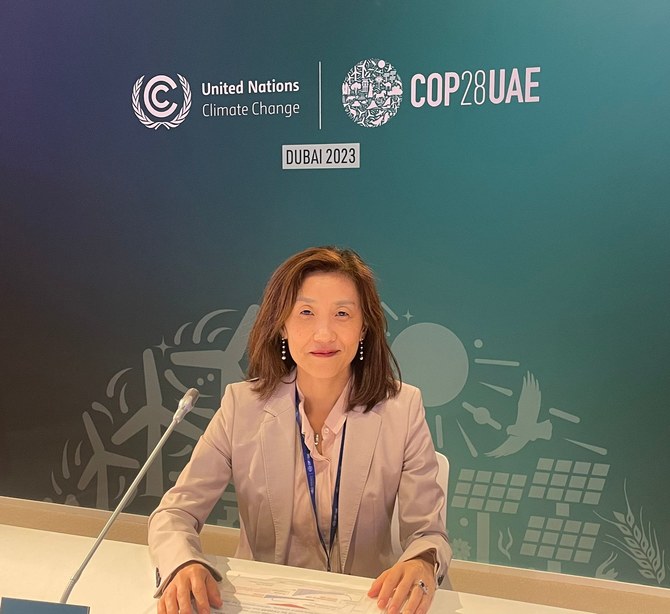

DUBAI: Japan must maintain close partnerships with countries like Saudi Arabia and the UAE if it is to achieve its goal to be a carbon-neutral economy by 2050, its Foreign Ministry press secretary said.
Kobayashi-Terada Maki made the comments in an interview with Arab News Japan as COP28 opened in Dubai.
“We are very dependent on other countries in terms of energy, and even though we are going to increase energy efficiency, we certainly need means of energy production,” she said.
Japanese companies and entities would be signing cooperation deals throughout the climate summit in the UAE, she said.
Japan is one of the only G7 countries that is close to achieving its environmental goals. Kobayashi-Terada said the country was on track to reach its target of reducing greenhouse gas emissions by 46 percent by 2030, compared with 2013 levels, and was working toward its goal of achieving net zero by 2050.
“We are on the right trajectory for really achieving our objectives right now. So that’s what we are very much proud of and we are very confident.”
The Japanese government has put in place a green transformation program, under which it aims raise 150 trillion yen ($1.02 trillion) in private-public investment to help achieve its goals.
“We are also using carbon pricing to subsidize companies that are heavy emitters to support energy efficiency,” Kobayashi-Terada said.
“By 2028, we will charge according to the amount of CO2 emissions for companies who are importing fossil fuels. By 2033, we are also pricing emissions so that the heavy emitters will pay for insurance. We will gradually increase this price so that companies can have incentives to reduce emissions.”
Later this month, Japan’s Ministry of Economy, Trade and Industry will host the Asia Zero Emission Community, which aims to encourage greater cooperation between Asian countries on reducing emissions.
“We will work together with Asian countries to utilize cutting-edge technology and also provide assistance to develop their capacity,” Kobayashi-Terada said.
Speaking at COP28, Japan’s Prime Minister Kishida Fumio said his government would increase its lending to the World Bank and the African Development Bank.
“We are going to be the first contributors and we will contribute $10 million,” the press secretary said.
* This article originally appeared on Arab News Japan, click here to read it.