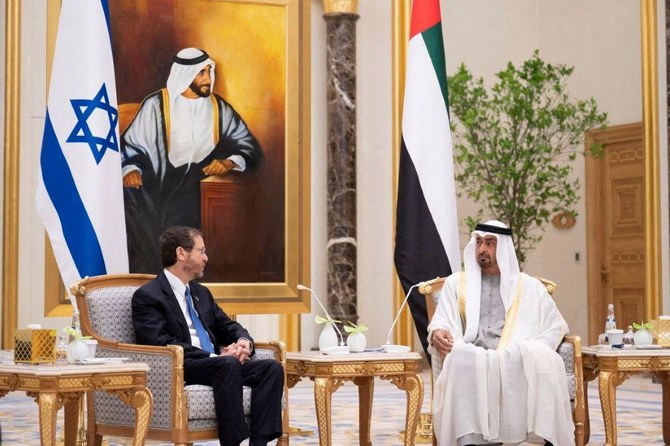
DUBAI: Israeli President Isaac Herzog met his Emirati counterpart on the sidelines of UN climate talks on Thursday as part of a diplomatic push to release hostages held by Hamas.
Herzog’s visit to the United Arab Emirates comes nearly eight weeks into the Israel-Hamas war and coincides with a day-long extension to a truce that has seen Israeli hostages freed in exchange for the release of Palestinian prisoners.
During his meeting with UAE President Sheikh Mohammed bin Zayed, Herzog underlined “the necessity to act in any way possible to free the Israeli hostages held captive by the murderous terrorist organization Hamas,” a statement from his office said.
He “appealed” to his Emirati counterpart “to employ his full political weight to promote and speed up the return home of the hostages,” the statement said.
In a separate statement on X, formerly Twitter, Herzog said he would hold “a series of diplomatic meetings” in Dubai to push for the release of hostages.
More than 140 heads of state and government are due to address COP28 on Friday and Saturday, including Herzog, who is scheduled to make a speech lasting three minutes on Friday.
“In my meetings with world leaders I intend to raise the firm demand for the immediate and unconditional release of all the hostages held by Hamas in Gaza,” Herzog said.
“In addition, I will detail and emphasize efforts to provide more and more humanitarian aid to the civilians of Gaza,” he added.
Palestinian president Mahmud Abbas was also scheduled to speak at COP28 but his office said he was no longer going and his foreign minister would take his place.
Since the truce began on November 24, 70 Israeli hostages have been freed in return for 210 Palestinian prisoners.
Around 30 foreigners, most of them Thais working in Israel, have been freed outside the terms of the deal.
Israel has made clear it sees the truce as a temporary halt intended to free hostages, but there are growing calls for a more sustained pause in the conflict.
Fighting began on October 7 when Hamas and other militants from the Gaza Strip poured over the border into Israel, killing 1,200 people, mostly civilians, and kidnapping about 240, according to Israeli authorities.
In response, Israel vowed to destroy Hamas and unleashed an air and ground campaign that the Hamas government in Gaza says has killed nearly 15,000 people, also mostly civilians.
The war has cast a shadow over the UN climate talks in Dubai with activists demanding a permanent cease-fire and an end to Israel’s 17-year blockade of the Gaza Strip.
The UAE is one of the few Arab states to recognize Israel, having established ties in 2020 as part of the US-brokered Abraham Accords. But it is at pains to show solidarity with Palestinians.
It has dispatched a 150-bed field hospital to Gaza and has pledged to take in 2,000 Palestinians, including 1,000 children and an equal number of cancer patients, for treatment.


![]()


Israel’s Herzog meets UAE counterpart to push for hostage release
Short Url
https://arab.news/24q5s
Israel’s Herzog meets UAE counterpart to push for hostage release
- During his meeting with UAE President Sheikh Mohammed bin Zayed, Herzog underlined ‘the necessity to act in any way possible to free the Israeli hostages’
- Since the truce began on Nov. 24, 70 Israeli hostages have been freed in return for 210 Palestinian prisoners


Iran Guards say will block oil exports as long as war continues
- Shipping traffic through the strategic Strait of Hormuz, through which nearly 20 percent of the world’s crude oil usually transits, has been severely disrupted
TEHRAN: Iranian forces will not allow the export of oil from the region to allies of the United States and Israel as long as the war continues, a Revolutionary Guards spokesman said Tuesday.
“The Iranian armed forces... will not allow the export of a single liter of oil from the region to the hostile side and its partners until further notice,” said Ali Mohammad Naini, according to a report from Iran’s Tasnim news agency.
He said any change would take place based on the conditions of the conflict.
On February 28, the US and Israel launched strikes against Iran that killed its supreme leader Ayatollah Ali Khamenei and triggered a war that has spread across the Middle East.
Iran has responded with drone and missile strikes targeting Israel and US interests across the region.
Shipping traffic through the strategic Strait of Hormuz, through which nearly 20 percent of the world’s crude oil usually transits, has been severely disrupted.
Iranian forces have repeatedly targeted oil tankers passing through the strategic waterway since the war began.
Oil prices have since risen dramatically to over $100 per barrel — the highest since Russia’s invasion of Ukraine in 2022 — before reversing course Monday after US President Donald Trump said military operations would be ending soon.
“Their efforts to reduce and control the price of oil and gas will be temporary and fruitless,” IRGC spokesman Naini said. “Trade in war conditions is hinged on security.”
The Revolutionary Guards late on Monday urged countries to expel their US and Israeli ambassadors to gain passage through the Strait of Hormuz.
“Any Arab or European country that expels the Israeli and American ambassadors from its territory will have complete freedom and authority to pass through the Strait of Hormuz starting tomorrow,” the Guards said, as quoted by Iranian state TV.
“The Iranian armed forces... will not allow the export of a single liter of oil from the region to the hostile side and its partners until further notice,” said Ali Mohammad Naini, according to a report from Iran’s Tasnim news agency.
He said any change would take place based on the conditions of the conflict.
On February 28, the US and Israel launched strikes against Iran that killed its supreme leader Ayatollah Ali Khamenei and triggered a war that has spread across the Middle East.
Iran has responded with drone and missile strikes targeting Israel and US interests across the region.
Shipping traffic through the strategic Strait of Hormuz, through which nearly 20 percent of the world’s crude oil usually transits, has been severely disrupted.
Iranian forces have repeatedly targeted oil tankers passing through the strategic waterway since the war began.
Oil prices have since risen dramatically to over $100 per barrel — the highest since Russia’s invasion of Ukraine in 2022 — before reversing course Monday after US President Donald Trump said military operations would be ending soon.
“Their efforts to reduce and control the price of oil and gas will be temporary and fruitless,” IRGC spokesman Naini said. “Trade in war conditions is hinged on security.”
The Revolutionary Guards late on Monday urged countries to expel their US and Israeli ambassadors to gain passage through the Strait of Hormuz.
“Any Arab or European country that expels the Israeli and American ambassadors from its territory will have complete freedom and authority to pass through the Strait of Hormuz starting tomorrow,” the Guards said, as quoted by Iranian state TV.
Latest updates


© 2026 SAUDI RESEARCH & PUBLISHING COMPANY, All Rights Reserved And subject to Terms of Use Agreement.