

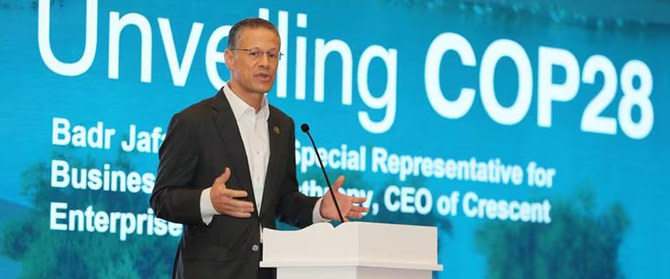

DUBAI: As global leaders converge on Dubai to attend the UN COP28 to discuss ways to mitigate the effects of climate change and strategies, there are calls for cross-border collaboration ensuring inclusivity to achieve common goals.
To effectively highlight these aspects of climate activism, the first-of-its-kind Business and Philanthropy Climate Forum has been organized with 55 sessions highlighting over 20 actionable opportunities for immediate climate and nature-centric interventions.
The forum will be attended by 1,300 business leaders and philanthropists from over 100 countries and seeks to provide a unique platform for enhanced cross-border collaboration.
READ MORE: Click here for our coverage of COP28
In an exclusive interview with Arab News, Badr Jafar, COP28 special representative for business and philanthropy, highlighted the goals of the forum, the expected role of the private sector, and the need for an all-inclusive approach for equitable and just solutions to address climate issues.
Stressing the need for a paradigm shift, Jafar called on all stakeholders to move beyond the dichotomy of activism versus capitalism. “The climate conversation needs a new paradigm of activism that embraces dynamism, capital, and action networks of business and philanthropy,” he said.
The COP28 #BPCF will host an action-orientated agenda featuring Heads of State and Government, global business leaders, philanthropists and NGO heads from around the world. pic.twitter.com/4TCinRN5nY
— Business & Philanthropy Climate Forum (@bpcforum) November 30, 2023
Highlighting the global nature of environmental challenges, Jafar laid emphasis on an inclusive approach, especially with respect to the Global South. He was of the view that with 75 percent of the global population residing in these areas, they are not only at the forefront of climate change impacts but are also key players in global growth.
Almost 50 percent of the business leaders participating in the forum hail from the Global South indicating the region’s importance and underlining the commitment to ensuring their active involvement in shaping climate-related policies.
HIGHLIGHTS
- The first-of-its-kind Business and Philanthropy Climate Forum has been organized with 55 sessions highlighting over 20 actionable opportunities for immediate climate and nature-centric interventions.
- The forum will be attended by 1,300 business leaders and philanthropists from over 100 countries and seeks to provide a unique platform for enhanced cross-border collaboration.
“Achieving an equitable climate and nature transition by 2050 is going to require an ‘all-hands-on-deck’ response from every part of the global community,” Jafar asserts. “To deliver this just transition, we will need trillions, not billions.”
He also underscored the pivotal role of the private sector in driving climate action. With private capital markets surpassing $23 trillion, businesses can play a significant role in fixing climate finance. The forum aims to mobilize action platforms, leveraging the innovative capacity of businesses to address urgent climate needs — from breakthrough technologies to transforming food supply chains.
“The active and decisive engagement of businesses is absolutely critical to driving meaningful action on climate and nature,” said Jafar. “Private capital markets have more than doubled over the past decade, reaching over $23 trillion.”
The executive backed his arguments with concrete examples highlighting the collaboration between business and philanthropy to scale climate projects and businesses, fund innovation, and reduce emissions.
“An example is the announcement of a large-scale ‘Blended Finance Vehicle,’ to scale climate projects and businesses in emerging markets and developing economies,” he stated. “Other examples include launching of the ‘Climate and Nature Moonshots,’ an innovative venture that will fund 10 innovative projects focused on renewable energy and protection of natural habitat and biodiversity.”
As an Emirati businessperson, Jafar also discussed the role of Gulf-based companies, especially in the energy sector, in fostering sustainable practices. Calling for viewing energy and societal challenges as interconnected, he emphasized that a green and inclusive approach to development can usher in a new model of growth for emerging economies.
Achieving an equitable climate and nature transition by 2050 is going to require an ‘all-hands-on-deck’ response from every part of the global community
Badr Jafar, COP28 special representative for business and philanthropy
“If the first Sustainable Development Goal is to eradicate extreme poverty by 2030, we must look at both energy and society’s challenges through a single lens,” Jafar remarked. “Countries can fully evaluate smart energy policies as enablers of development, especially in regions like MENA where supporting a fair and just energy evolution must also facilitate economic growth and resultant critical jobs.”
Jafar acknowledged the trust gap between industrialized and developing nations and outlined COP28’s focus on proper engagement from regions most affected by climate change. The UAE and Saudi Arabia, acting as gateways for emerging markets, present an unprecedented opportunity to showcase the transformative journey of the Global South.
“When it comes to emerging markets, we know that the Global South is going to bear the brunt of climate change,” he said.
“Issues like extreme heat, water scarcity, and poor air quality (have) already created systemic challenges, despite the fact that the richest 10 percent of the world have per capita carbon footprints 11 times higher than the poorest 50 percent.”
Jafar wants all the stakeholders to understand the interconnected nature of human development with climate goals. He emphasized the need to address the needs of the 800 million (people) without electricity and the 2.3 billion lacking access to clean cooking fuels. Initiatives discussed at the forum aim to create inclusive climate policies that provide equitable opportunities for billions worldwide.
“Ultimately, we can no longer afford to decouple the human development agenda — which encompasses 12 of the 17 UN Sustainable Development Goals — from the climate agenda, or the nature agenda for that matter,” Jafar asserted. “They are two sides of the same coin, and the edge of that coin is conducive and inclusive climate policy that embraces a greener evolution of all of our systems.”


