

Asian publishers join campaign to counter Western narrative on Palestine

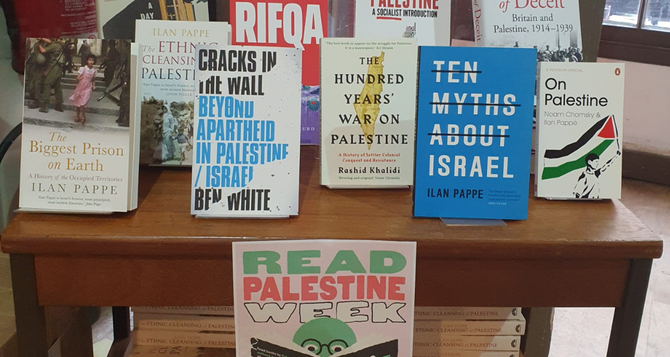
Books on Palestine are on display at the Bookmarks Bookshop in London on Nov. 29, 2023 for #ReadPalestine week. (Bookmarks Bookshop)
Short Url
Updated 30 November 2023
Follow

Asian publishers join campaign to counter Western narrative on Palestine

  • #ReadPalestine campaign makes available works by Palestinian authors 
  • Publishers say literary community ‘cannot remain neutral’ over plight of the Palestinians

JAKARTA: Asian publishers want to counter the Western media narrative as they take part in a global initiative launched this week to encourage people to read Palestinian authors and history. 

#ReadPalestine started on Wednesday and runs through to Dec. 5. 

It was created by Publishers for Palestine, a global solidarity collective comprising more than 350 publishers who have called for an end to all violence against Palestinian people and for Tel Aviv and its allies to be held accountable for war crimes in the wake of the deadly Israeli onslaught on Gaza that started last month. 

The collective, which includes more than 70 Asian publishers, has made available for free download more than 30 works of poetry, fiction and nonfiction. 

“The initiative aims to be an amplifier for the Palestinian cause within the literary community, particularly in the West,” Iskandar Kamel of Malaysia’s Kawah Buku told Arab News.

“The way they have muted themselves and chosen to align with genociders, adopting an apolitical stance and neutrality in the face of atrocities, is entirely unacceptable. This is especially noteworthy considering that, all the while, they have preached about human rights and liberal principles to the Global South.”

Kamel cited as an example the biggest annual book fair in Frankfurt, which last month called off an awards ceremony to celebrate Palestinian writer Adania Shibli. 

“Publishers, bookstores, authors and the entire literary community cannot remain neutral; choosing to be apolitical is not an option. It is our responsibility to play our part,” he said. 

Ronny Agustinus, chief editor of the Indonesian publishing company Marjin Kiri, is a member of the International Alliance of Independent Publishers, which wrote a letter condemning the cancelation of the Frankfurt event. 

“Because there are so many misunderstandings about Palestine from various parties, it becomes important to share studies and reading materials as thoroughly and as much as possible about Palestine so that we can get the whole picture,” he said. 

“Literature can paint the reality of Palestinian lives poignantly and evocatively.” 

The #ReadPalestine free ebook list includes “Wild Thorns,” a novel by Sahar Khalifeh about life in the Israeli-occupied West Bank, and “Things You May Find Hidden in My Ear” by Mosab Abu Toha, a Palestinian poet whose abduction by Israeli forces made global headlines earlier this month. He was later released following an international outcry.   

“Writers and publishers bear histories and narratives; and with them, truth. Western media is so powerful and it has skewed the thinking of many people, including writers. We can fight against that through our books and writings,” said Faye Cura of Philippines-based Gantala Press. 

When it comes to Palestinian literature, women writers are Cura’s favorite. 

“Many people have biased views against Muslim women, thinking they are ‘conservative,’ ‘passive,’ ‘silent,’ etc. The women writers definitely resist all that and paint a stronger, more powerful image of the Palestinian woman,” she said. 

She hopes that #ReadPalestine will forge strong relations among writers, translators, artists and publishers across the world so that the “conversation and resistance continue until liberation.”

Malaysian publisher The Patriots said speaking about the Palestinian plight was also a responsibility of the literary community. 

“We are collectively disappointed with this ongoing cancel culture against the Palestinian literature. It is against free speech to do so,” The Patriots said in a statement to Arab News. 

“We hope this initiative could at the very least break this hostile attempt. The Palestinians could not, should not and must not be stifled.”  


UK pays Guantanamo detainee ‘substantial’ compensation over US torture questions

Updated 12 January 2026
Follow

UK pays Guantanamo detainee ‘substantial’ compensation over US torture questions

  • Abu Zubaydah has been held at Guantanamo Bay without charge for 20 years
  • British security services knew he was subjected to ‘enhanced interrogation’ but failed to raise concerns for 4 years

LONDON: A Saudi-born Palestinian being held without trial by the US has received a “substantial” compensation payment from the UK government, the BBC reported.

Abu Zubaydah has been imprisoned at Guantanamo Bay in Cuba for almost 20 years following his capture in Pakistan in 2002, and was subjected to “enhanced interrogation” techniques by the CIA.

He was accused of being a senior member of Al-Qaeda in the aftermath of the Sept. 11 terror attacks on the US. The allegations were later dropped but he remains in detention.

The compensation follows revelations that UK security services submitted questions to the US to be put to Abu Zubaydah by their US counterparts despite knowledge of his mistreatment.

He alleged that MI5 and MI6 had been “complicit” in torture, leading to a legal case and the subsequent compensation.

Dominic Grieve, the UK’s former attorney general, chaired a panel reviewing Abu Zubaydah’s case.

He described the compensation as “very unusual” but said the treatment of Abu Zubaydah had been “plainly” wrong, the BBC reported.

Grieve added that the security services had evidence that the “Americans were behaving in a way that should have given us cause for real concern,” and that “we (UK authorities) should have raised it with the US and, if necessary, closed down co-operation, but we failed to do that for a considerable period of time.”

Abu Zubaydah’s international legal counsel, Prof. Helen Duffy, said: “The compensation is important, it’s significant, but it’s insufficient.”

She added that more needs to be done to secure his release, stating: “These violations of his rights are not historic, they are ongoing.”

Duffy said Abu Zubaydah would continue to fight for his freedom, adding: “I am hopeful that the payment of the substantial sums will enable him to do that and to support himself when he’s in the outside world.”

He is one of 15 people still being held at Guantanamo, many without charge. Following his initial detention, he arrived at the prison camp having been the first person to be taken to a so-called CIA “black site.”

He spent time at six such locations, including in Lithuania and Poland, outside of US legal jurisdiction. 

Internal MI6 messages revealed that the “enhanced interrogation” techniques he was subjected to would have “broken” the resolve of an estimated 98 percent of US special forces members had they been subjected to them.

CIA officers later decided he would be permanently cut off from the outside world, with then-President George W. Bush publicly saying Abu Zubaydah had been “plotting and planning murder.”

However, the US has since withdrawn the allegations and no longer says he was a member of Al-Qaeda.

A report by the US Senate Select Committee on Intelligence said Abu Zubaydah had been waterboarded at least 83 times, was locked in a coffin-like box for extended periods, and had been regularly assaulted. Much of his treatment would be considered torture under UK law.

Despite knowledge of his treatment, it was four years before British security services raised concerns with their American counterparts, and their submission of questions within that period had “created a market” for the torture of detainees, Duffy said.

A 2018 report by the UK Parliament’s Intelligence and Security Committee was deeply critical of the behavior of MI5 and MI6 in relation to Abu Zubaydah. 

It also criticized conduct relating to Guantanamo detainee Khalid Sheikh Mohammed, widely regarded as a key architect of the Sept. 11 attacks, warning that the precedent set by Abu Zubaydah’s legal action could be used by Mohammed to bring a separate case against the UK.

MI5 and MI6 failed to comment on Abu Zubaydah’s case. Neither the UK government nor Mohammed’s legal team would comment on a possible case over his treatment.