

Pakistan polls regulator to unveil final constituency list today, rejects ‘rumors’ of election delay

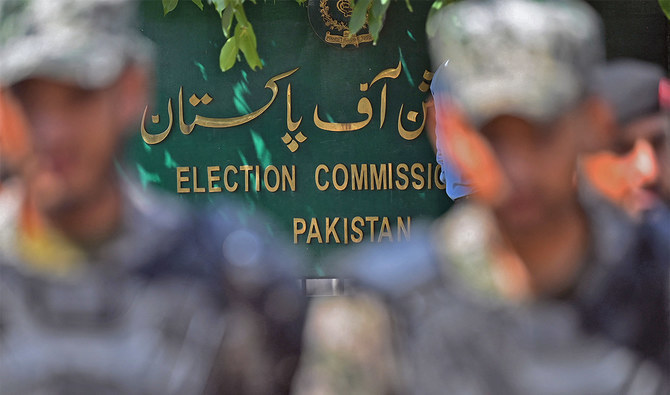
Paramilitary soldiers stand guard outside the Pakistan’s election commission building in Islamabad, Pakistan, on August 2, 2022. (AFP/File)
Short Url
Updated 30 November 2023
Follow

Pakistan polls regulator to unveil final constituency list today, rejects ‘rumors’ of election delay

  • Says will approach media regulator against those spreading false news
  • Election Commission has announced vote would take place on Feb. 8

ISLAMABAD: Pakistan’s main election oversight body has rejected “rumors” of a delay in general elections, and plans to release the final list of constituencies today, Thursday, state-media said. 

The Election Commission of Pakistan announced earlier this month the vote, originally expected in November and then scheduled for the last week of January, would instead take place on Feb. 8, a date chosen following consultations with the country’s President Dr. Arif Alvi that were requested by the Supreme Court.

“Election Commission has decided to approach PEMRA against those spreading such false news [of election delay] so that legal action can be taken against those spreading such misleading news,” the ECP said in a statement, referring to the electronic media regulator.

“The news that election lists have not been prepared is completely false.”

Pakistan’s state news agency APP reported that the ECP would release “the final list of constituencies based on the 7th Population and Housing Census 2023 on Thursday, earlier than initially planned.”

“Objections concerning the new constituencies for the national and four provincial assemblies were deliberated and concluded on November 22,” APP reported.

Pakistan’s parliament was dissolved by the president on then Prime Minister Shehbaz Sharif’s advice on Aug. 9, setting the stage for a national election amid political and economic crises. A caretaker administration subsequently took over with the constitutional mandate to hold new elections in 90 days.

However, as the outgoing Sharif government had approved the results of a new census in August, the election commission was constitutionally bound to redraw hundreds of new constituency boundaries based on the fresh population count, delaying the election by several months.

Meanwhile, there has been widespread speculation in Pakistan that elections may be delayed even beyond February. The opposition party led by former premier Imran Khan says there are plans to delay polls as Khan’s popularity, even from behind bars, grows.

Analysts have said any delay in the election could fuel public anger and add to uncertainty in the nuclear-armed nation.

The last general election in July 2018 was won by the party of the cricketer-turned-politician Khan, who was sworn in days later as prime minister for the first time.

Khan has been at the heart of political turmoil since he was ousted as prime minister in a no-confidence vote last year, raising concern about Pakistan’s stability. He has since been convicted and jailed in a graft case, following which he has been barred from taking part in any election for five years.

Khan has accused the powerful military, which has ruled Pakistan intermittently since independence in 1947, of being responsible for his ouster. The military has denied the charge.

In addition to the legal issues that could crop up if the vote is delayed, the side-lining of Khan, the country’s most popular leader according to polls, will cast doubt over the credibility of the elections.


Pakistan, global crypto exchange discuss modernizing digital payments, creating job prospects 

Updated 05 December 2025
Follow

Pakistan, global crypto exchange discuss modernizing digital payments, creating job prospects 

  • Pakistani officials, Binance team discuss coordination between Islamabad, local banks and global exchanges
  • Pakistan has attempted to tap into growing crypto market to curb illicit transactions, improve oversight

ISLAMABAD: Pakistan’s finance officials and the team of a global cryptocurrency exchange on Friday held discussions aimed at modernizing the country’s digital payments system and building local talent pipelines to meet rising demand for blockchain and Web3 skills, the finance ministry said.

The development took place during a high-level meeting between Finance Minister Muhammad Aurangzeb, Pakistan Virtual Assets Regulatory Authority (PVARA) Chairman Bilal bin Saqib, domestic bank presidents and a Binance team led by Global CEO Richard Teng. The meeting was held to advance work on Pakistan’s National Digital Asset Framework, a regulatory setup to govern Pakistan’s digital assets.

Pakistan has been moving to regulate its fast-growing crypto and digital assets market by bringing virtual asset service providers (VASPs) under a formal licensing regime. Officials say the push is aimed at curbing illicit transactions, improving oversight, and encouraging innovation in blockchain-based financial services.

“Participants reviewed opportunities to modernize Pakistan’s digital payments landscape, noting that blockchain-based systems could significantly reduce costs from the country’s $38 billion annual remittance flows,” the finance ministry said in a statement. 

“Discussions also emphasized building local talent pipelines to meet rising global demand for blockchain and Web3 skills, creating high-value employment prospects for Pakistani youth.”

Blockchain is a type of digital database that is shared, transparent and tamper-resistant. Instead of being stored on one computer, the data is kept on a distributed network of computers, making it very hard to alter or hack.

Web3 refers to the next generation of the Internet built using blockchain, focusing on giving users more control over their data, identity and digital assets rather than big tech companies controlling it.

Participants of the meeting also discussed sovereign debt tokenization, which is the process of converting a country’s debt such as government bonds, into digital tokens on a blockchain, the ministry said. 

Aurangzeb called for close coordination between the government, domestic banks and global exchanges to modernize Pakistan’s payment landscape.

Participants of the meeting also discussed considering a “time-bound amnesty” to encourage users to move assets onto regulated platforms, stressing the need for stronger verifications and a risk-mitigation system.

Pakistan has attempted in recent months to tap into the country’s growing crypto market, crack down on money laundering and terror financing, and promote responsible innovation — a move analysts say could bring an estimated $25 billion in virtual assets into the tax net.

In September, Islamabad invited international crypto exchanges and other VASPs to apply for licenses to operate in the country, a step aimed at formalizing and regulating its fast-growing digital market.