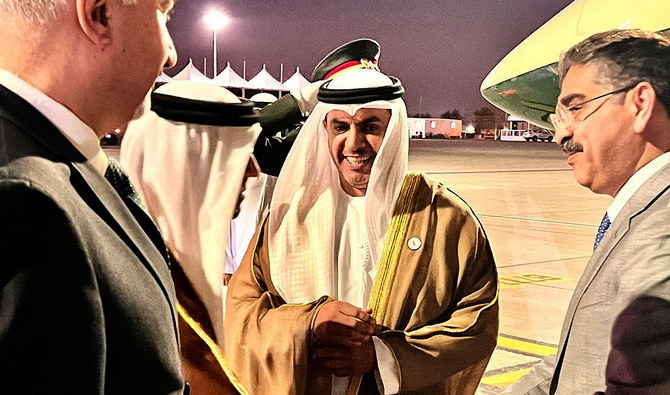
ISLAMABAD: Caretaker Prime Minister Anwaar-ul-Haq Kakar on Wednesday arrived in Dubai to attend the United Nations climate conference scheduled to be held between Nov. 30 and Dec. 12, with the participation of around 70,000 people, including global leaders, academics and youth representatives.
According to officials in Islamabad, Pakistan will set up its own pavilion and focus on critical issues to help countries across the world build climate resilience together.
Mitigating the impact of climate change has become a major priority for the government after the country was hit unprecedented monsoon rains and floods that caused massive infrastructure and agricultural losses last year.
Kakar will attend the COP28 conference where he will spearhead Pakistan’s delegation and present its case.
Minister for Justice of the United Arab Emirates H.E. Abdullah Sultan bin Awad Al Nuaimi, Pakistan’s Ambassador to the UAE and the Pakistani diplomatic staff welcomed the Prime Minister at Dubai’s Al-Maktoum Airport,” said a brief statement issued after the Pakistani PM’s arrival.
“The Prime Minister will attend the World Climate Action Summit on December 1 and 2,” it added.
Kakar, who is on a week-long visit to the Middle East to sign multibillion-dollar deals, is accompanied by Foreign Minister Jalil Abbas Jilani, Finance Minister Dr. Shamshad Akhtar, Climate Change Minister Ahmed Irfan Aslam and Energy Minister Muhammad Ali.
The Pakistani delegation plans to call for an early operationalization of the loss and damage fund to help countries vulnerable to climate change deal with natural disasters caused by erratic weather conditions.
It also intends to argue for the inclusion of developing countries in the fund, diverging from developed nations’ focus only on the least developed states.
Prior to arriving in Dubai, the prime minister held some vital meetings with the top Kuwaiti leaders and witnessed the signing of ten major investment deals in the Gulf country.


![]()

Pakistan PM arrives in Dubai to attend major UN climate conference
Short Url
https://arab.news/4fd62
Pakistan PM arrives in Dubai to attend major UN climate conference
- Pakistan will set up its own pavilion at the event and focus on building climate resilience with other states
- Prime Minister Kakar will attend the World Climate Action Summit beginning on Dec. 1 at COP28 conference
Latest updates


© 2026 SAUDI RESEARCH & PUBLISHING COMPANY, All Rights Reserved And subject to Terms of Use Agreement.