

Pause in fighting allows delivery of life-saving food assistance in Gaza, but more access is needed, says World Food Programme

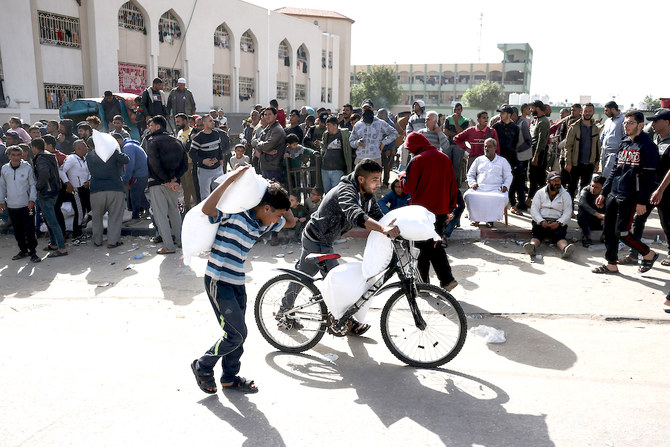
Around 90,000 displaced residents in UN shelters received fresh bread sourced from the only currently operational WFP-run bakery. (AFP)
Short Url
Updated 29 November 2023
Follow

Pause in fighting allows delivery of life-saving food assistance in Gaza, but more access is needed, says World Food Programme

  • WFP regional director: Gaza at risk of famine as six days are ‘simply not enough’ to provide necessary assistance
  • Only operational WFP-run bakery is working ad-hoc on first day of pause in hostilities

GAZA: The UN World Food Programme delivered desperately needed food to more than 120,000 people in Gaza during the initial pause in fighting but has reiterated that the supplies it was able to provide were woefully inadequate to address the level of hunger seen by staff in the UN shelters and communities.

“Thanks to the pause, our teams have been in action on the ground, going into areas we haven’t reached for a long time. What we see is catastrophic. There’s a risk of famine and starvation on our watch and to prevent it, we need to be able to bring in food at scale and distribute it safely,” said Corinne Fleischer, WFP’s director for the Middle East, North Africa and Eastern Europe. “Six days is simply not enough to provide all the assistance needed. The people of Gaza have to eat every day, not just for six days.”

Samer Abdeljaber, WFP Palestine representative and country director, said: “Our team recounted what they saw: hunger, desperation, and destruction. People who have not received any relief in weeks. The team could see the suffering in their eyes. This pause offered a window of relief that we hope paves the way for longer-term calm. Safe and unimpeded humanitarian access cannot stop now.”

After weeks of very limited humanitarian aid deliveries through the Rafah border, WFP joined on Nov. 26 an inter-agency convoy that delivered 7.6 metric tons of food assistance to around 23,616 people in Al-Ahli hospital and surrounding hard-to-reach areas.

Since Nov. 24, WFP has reached 121,161 people in UN shelters and host communities with food, including bread, food parcels, and e-vouchers.

During the pause in fighting, the convoy also conducted wider-reaching assessments to inform its response, expanded logistics capacities by setting up storage units and safely transported food items across Gaza.

Around 90,000 displaced residents in UN shelters received fresh bread sourced from the only currently operational WFP-run bakery, which is working on an ad-hoc basis on the first day of the pause in hostilities.

A further 7,545 people received food parcels in host communities during this time.

WFP and other partners continue to test the delivery of aid from Jordan as a complementary supply corridor for the Gaza emergency. The UN agency dispatched 51 metric tons of food supplies, including 14 metric tons of ready-to-eat food and 37 metric tons of date bars, via seven trucks departing from Amman to Rafah, Egypt, as part of a joint convoy with the UN agency for Palestinian refugees UNRWA.

WFP has reiterated that a six-day-long pause was not enough to make any meaningful impact. Operations on the ground need uninterrupted and regular supplies of adequate quantities of food and other essential commodities into Gaza, WFP said.

WFP has reached a total of 825,858 people with emergency food and electronic food vouchers across Gaza and the West Bank since the start of the crisis.


Syrian government vows to protect Kurds in Aleppo, accuses SDF of planting explosives

Updated 4 sec ago
Follow

Syrian government vows to protect Kurds in Aleppo, accuses SDF of planting explosives

  • Kurdish-led group targeting neighborhoods with mortars, machine guns, Ministry of Defense says
  • Army declares Ashrafieh, Sheikh Maqsoud ‘closed military zone’ after hundreds of civilians evacuated

LONDON: The Syrian government on Wednesday affirmed its commitment to protect all citizens, including Kurds, as armed tensions in Aleppo between the Syrian army and the Kurdish-led Syrian Democratic Forces continued for a fourth day.

The Ministry of Defense accused the SDF of planting explosives on roads and setting booby traps in the Sheikh Maqsoud and Ashrafieh neighborhoods, and bombarding them with mortar shells and heavy machine gun fire.

The army designated the two neighborhoods a “closed military zone” after the Syrian Arab Red Crescent evacuated 850 civilians from the area.

The government said in a statement that the SDF played no role in the city’s security and military affairs.

“This confirms that the exclusive responsibility for maintaining security and protecting residents falls upon the Syrian state and its legitimate institutions, in accordance with the constitution and applicable laws,” it said.

Protecting all citizens, including Kurds, was a non-negotiable responsibility upheld without discrimination based on ethnicity or affiliation, it said.

It also rejected any portrayal of its security measures as targeting a specific community, according to the Syrian Arab News Agency.

“The authorities concerned stress that those displaced from areas of tension are exclusively civilians, all of them Kurdish citizens who left their neighborhoods out of fear of escalation,” the statement said.

“They sought refuge in areas under the control of the state and its official institutions, which clearly demonstrates the trust of Kurdish citizens in the Syrian state and its ability to provide them with protection and security and refutes claims alleging that they face threats or targeted actions.”

The government called for the withdrawal of armed groups from Aleppo.

At least three civilians and a Syrian soldier have been killed and dozens more injured in Aleppo since Tuesday. Authorities have accused the SDF of targeting medical and educational facilities.

The escalation in violence has dealt a blow to an agreement between the two sides that was meant to be implemented by the end of last year.

The Syrian government reached an agreement with the SDF in March that included plans to integrate the group’s military, territory and natural resources, including oil fields, into the new government in Damascus.