

‘Quetta Paye’: In southwestern Pakistan, soupy trotters are a soul food in winters

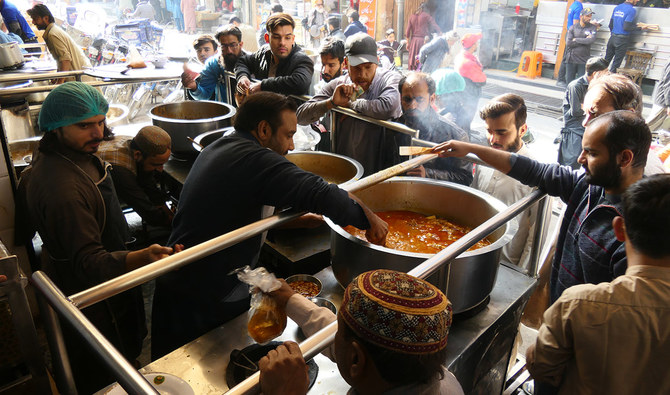
People gather at Bismillah Paye shop at Prince Road food street in Quetta, Pakistan on November 27, 2023. (AN Photo)
Short Url
Updated 29 November 2023
Follow

‘Quetta Paye’: In southwestern Pakistan, soupy trotters are a soul food in winters

  • Though originally popular in Punjab, paye, loaded with protein and fat, have become the perfect winter food in bitterly cold Balochistan
  • Bismillah Paye shop on Quetta’s Prince Road food street has been serving goat, cow and buffalo trotters to customers since 1981

QUETTA: Ejaz Ahmed, 42, cracked jokes and laughed as he poured the thick, aromatic gravy into bowl after bowl for a long line of customers at his Bismillah Paye shop on Quetta’s Prince Road food street.

The tiny restaurant’s speciality is goat, cow and buffalo trotters, or paye, slow cooked for hours, often overnight, in a base of onions and garlic, with several curry-based spices added to the meat and bones as they are stewed. The dish has a soup-like consistency, is served with a garnish of fresh diced ginger, long coriander leaves and sliced lemon and often eaten as a breakfast food in the winter months in Pakistan.

Though paye is most popular among ethnic Punjabi families in central and eastern Pakistan, it has over the decades made a place for itself on dining tables across the country, including the southwestern Balochistan province, where trotters, loaded with protein and fat, have come to be considered the perfect winter food.

Ahmed, whose family are Punjabi migrants from India, said his late father introduced paye to local Pashtun and Baloch tribesmen in the province in 1981.

“We have been serving local tribesmen in Balochistan for the last four decades with ‘chotay paaye’ (goat trotters) and ‘bare paaye’ (cow or buffalo trotters), which are our [most] famous dishes,” the 42-year-old told Arab News, stirring paye in a large pot with layers of fat floating on the top.
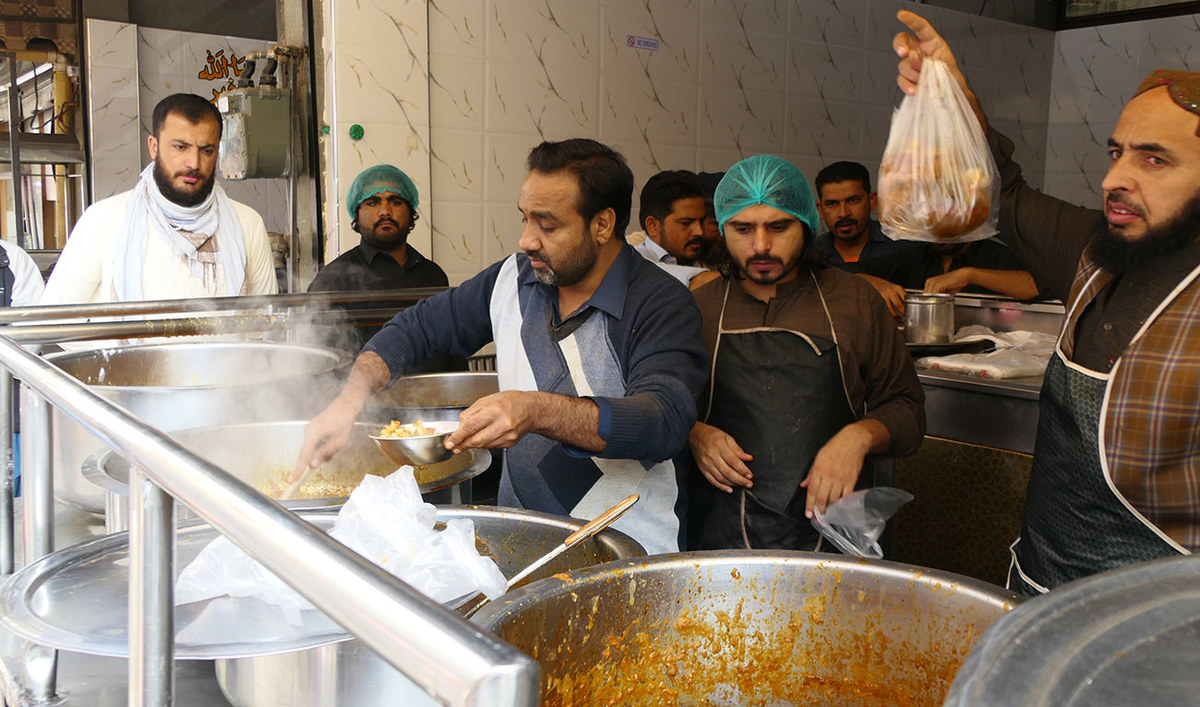


People gather at Bismillah Paye shop at Prince Road food street in Quetta, Pakistan on November 27, 2023. (AN Photo)

In the winter season, the shop owner said, he sold 30 dozen chotay paaye and 200 baray paaye in a day as people thronged to the restaurant in the biting cold of the provincial capital of Quetta, where even running water freezes in December and January.

The shop is open from 6am until midnight, offering goat trotter curry for Rs450 ($1.60) a plate and cow or buffalo trotter curry for Rs400 ($1.42).

Dr. Farrukh Ahmad, 60, who said he had been eating paye at the famous shop since he was a student, said its taste had improved with time.

“No one in Quetta was familiar with paye 40 years ago. I remember when I was a science student in college, we came to know that this small paye shop has been opened newly and we used to come here to eat paye during student life,” Ahmad told Arab News.
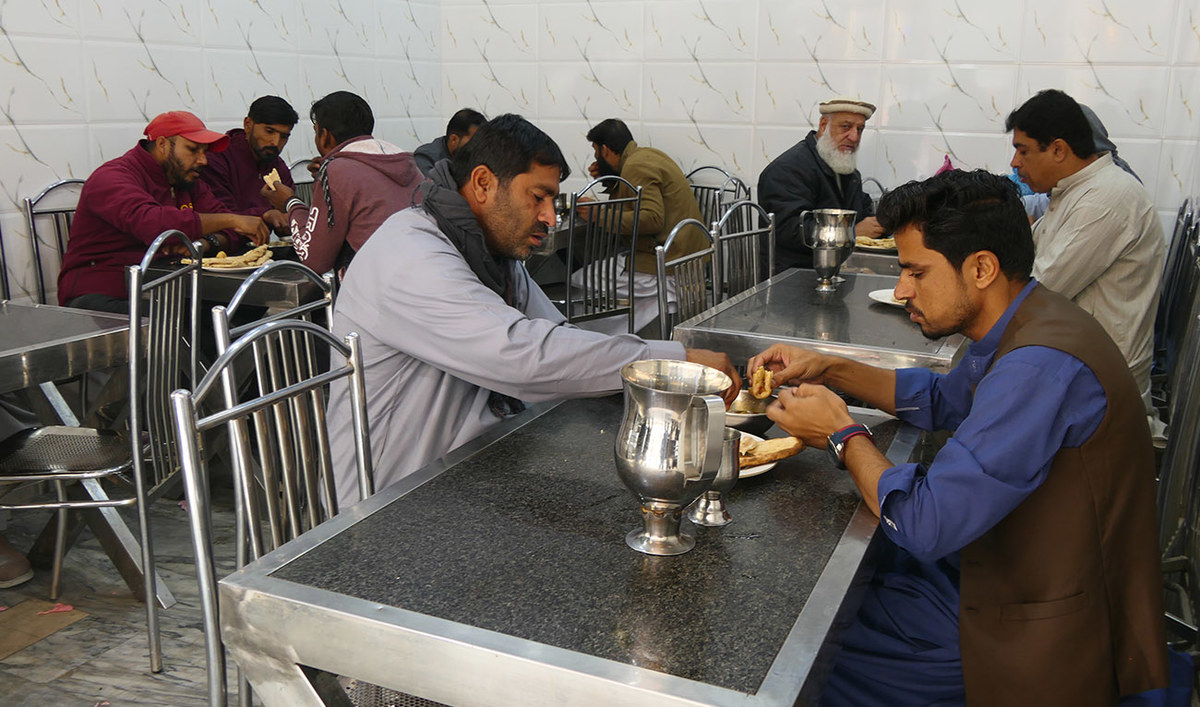


People are seen eating paye, a local dish made from goat, cow, and buffalo trotters at Bismillah Paye shop on Prince Road food street in Quetta, Pakistan, on November 27, 2023. (AN Photo)

“These paye are cheap so people can afford to eat them and they have so many benefits. It protects you from flu and chest infection, it keeps your chest warm. And later people take it away in parcel bags for children.”

Mian Saeed Nawab, 55, a resident of the northwestern Swat valley who was visiting Quetta, said he had not “eaten such paye anywhere in my life.”

“People used to say Lahori and Peshwari paye were famous but like sajji [slow-cooked lamb] and other traditional foods from Balochistan, now the paye of Balochistan are also very much popular these days and people eat them more in the cold,” Nawaz said.

Indeed, while paye originated as an amalgamation of South and Central Asian cuisine and were adapted by cooks in Lahore in present-day Pakistan, and India’s Lucknow, Ahmed said his version was loved province-wide, with clients showing up from far off villages in Kalat, Mastung, Khuzdar, Chaman, Ziarat and Killa Abdullah districts during winters.

“Now we call them ‘Quetta ke paye’,” Ahmed said with a smile, “just like they say ‘Lahori paye’.”


Pakistan PM orders accelerated privatization of power sector to tackle losses

Updated 15 December 2025
Follow

Pakistan PM orders accelerated privatization of power sector to tackle losses

  • Tenders to be issued for privatization of three major electricity distribution firms, PMO says
  • Sharif says Pakistan to develop battery energy storage through public-private partnerships

ISLAMABAD: Pakistan’s prime minister on Monday directed the government to speed up privatization of state-owned power companies and improve electricity infrastructure nationwide, as authorities try to address deep-rooted losses and inefficiencies in the energy sector that have weighed on the economy and public finances.

Pakistan’s electricity system has long struggled with financial distress caused by a combination of factors including theft of power, inefficient collection of bills, high costs of generating electricity and a large burden of unpaid obligations known as “circular debt.” In the first quarter of the current financial year, government-owned distribution companies recorded losses of about Rs171 billion ($611 million) due to poor bill recovery and operational inefficiencies, official documents show. Circular debt in the broader power sector stood at around Rs1.66 trillion ($5.9 billion) in mid-2025, a sharp decline from past peaks but still a major fiscal drain. 

Efforts to contain these losses have been a focus of Pakistan’s economic reform program with the International Monetary Fund, which has urged structural changes in the energy sector as part of financing conditions. Previous government initiatives have included signing a $4.5 billion financing facility with local banks to ease power sector debt and reducing retail electricity tariffs to support economic recovery. 

“Electricity sector privatization and market-based competition is the sustainable solution to the country’s energy problems,” Prime Minister Shehbaz Sharif said at a meeting reviewing the roadmap for power sector reforms, according to a statement from the prime minister’s office.

The meeting reviewed progress on privatization and infrastructure projects. Officials said tenders for modernizing one of Pakistan’s oldest operational hubs, Rohri Railway Station, will be issued soon and that the Ghazi Barotha to Faisalabad transmission line, designed to improve long-distance transmission of electricity, is in the initial approval stages. While not all power-sector decisions were detailed publicly, the government emphasized expanding private sector participation and completing priority projects to strengthen the electricity grid.

In another key development, the prime minister endorsed plans to begin work on a battery energy storage system with participation from private investors to help manage fluctuations in supply and demand, particularly as renewable energy sources such as solar and wind take a growing role in generation. Officials said the concept clearance for the storage system has been approved and feasibility studies are underway.

Government briefing documents also outlined steps toward shifting some electricity plants from imported coal to locally mined Thar coal, where a railway line expansion is underway to support transport of fuel, potentially lowering costs and import dependence in the long term.

State authorities also pledged to address safety by converting unmanned railway crossings to staffed ones and to strengthen food safety inspections at stations, underscoring broader infrastructure and service improvements connected to energy and transport priorities.