Pakistan’s PM arrives in Kuwait on two-day visit to sign multibillion-dollar deals

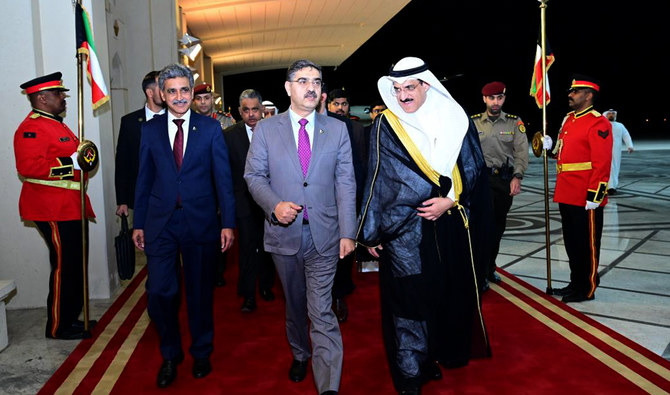
In this handout photo, taken and released by the Prime Minister's Office of Pakistan, Kuwait's Minister for Electricity, Water and Renewable Energy, Dr Jassim Mohammed Abdullah Al-Ostad (right), receives Pakistan's Interim Prime Minister Anwaar-ul-Haq Kakar as he arrives in Kuwait on November 28, 2023. (Photo courtesy: PMO)
Short Url
Updated 28 November 2023
Follow

Pakistan’s PM arrives in Kuwait on two-day visit to sign multibillion-dollar deals

  • Kakar is on week-long visit to Middle East starting with UAE where he signed deals worth billions of dollars on Monday
  • Kakar will also attend the World Climate Action Summit scheduled to take place in Dubai on Dec. 1-2 as part of COP28

ISLAMABAD: Prime Minister Anwaar-ul-Haq Kakar arrived on a two-day visit to Kuwait on Tuesday to meet the top leadership of the Middle Eastern country and sign a number of bilateral cooperation and investment deals.
Kakar is on a week-long visit to the Middle East, starting with the United Arab Emirates where he signed deals worth billions of dollars on Monday. His visit to Abu Dhabi was followed by Kuwait and then onwards to Dubai for the United Nations climate conference, or COP28.
“Caretaker Prime Minister Anwaar-ul-Haq Kakar arrived in Kuwait for his two-day official visit,” the PM Office in Islamabad said in a brief statement. “Kuwait’s Minister for Electricity, Water and Renewable Energy, Dr. Jassim Mohammed Abdullah Al-Ostad received the Prime Minister upon his arrival.”
According to Pakistan’s foreign office, Kakar will meet Crown Prince Sheikh Meshal Al Jaber Al Sabah and Prime Minister Sheikh Ahmed Nawaf Al Ahmed AL Sabah during his stay in Kuwait.
“The visit will include signing of various MoUs in the field of Manpower, Information Technology, Mineral exploration and Food Security, Energy and Defense,” it added.
Prior to Kakar’s arrival, Pakistan’s commerce minister Dr. Gohar Ejaz had held a meeting with the top echelon of the Kuwait Investment Authority to fortify the economic ties between the two countries through enhanced investment cooperation.
While acknowledging the current trade standing at $100 billion, Ejaz envisioned Pakistan’s trade potential at $1 trillion. He also outlined the goal of elevating the GDP from $300 billion to $3 trillion, making Pakistan an unparalleled investment destination in the coming decade.
The Pakistani prime minister spent much of the day in Abu Dhabi where he visited the famous Sheikh Zayed Grand Mosque which is a masterpiece of modern Islamic architecture with capacity to accommodate over 40,000 visitors.
He started his visit to the place by paying his respect at the mausoleum of the late Sheikh Zayed bin Sultan Al Nahyan. Kakar was briefed about the mosque’s noble message that highlights notions of coexistence, tolerance and openness to other cultures.
From Kuwait, the prime minister will leave for Dubai to attend the World Climate Action Summit, scheduled to take place on Dec. 1-2 as part of COP28.


Pakistan, UK sign £35 million Green Compact to strengthen climate resilience

Updated 21 December 2025
Follow

Pakistan, UK sign £35 million Green Compact to strengthen climate resilience

  • Pakistan ranks among nations most vulnerable to climate change and has seen erratic changes in its weather patterns
  • UK will help Pakistan mobilize climate finance, strengthen regulatory frameworks and develop bankable climate projects

ISLAMABAD: Pakistan and the United Kingdom (UK) have formalized a comprehensive climate partnership with the launch of a Green Compact that aims to enhance climate resilience, accelerate clean energy transition and scale up nature-based solutions, including mangrove conservation, Pakistani state media reported on Sunday.

The agreement, signed in Islamabad by Federal Minister for Climate Change and Environmental Coordination Dr. Musadik Malik and UK Minister for International Development Jennifer Chapman, unlocks £35 million in targeted support for green development and long-term climate action, according to Radio Pakistan broadcaster.

Pakistan ranks among nations most vulnerable to climate change and has seen erratic changes in its weather patterns that have led to frequent heatwaves, untimely rains, storms, cyclones, floods and droughts in recent years. In 2022, monsoon floods killed over 1,700 people, displaced another 33 million and caused over $30 billion losses, while another 1,037 people were killed in floods this year.

Mohammad Saleem Shaikh, a spokesperson for Pakistan’s Ministry of Climate Change, described the compact as a “decisive move toward action-oriented climate cooperation,” noting that its implementation over the next decade will be critical for Pakistan which regularly faces floods, heatwaves and water stress.

“The Compact is structured around five core pillars: climate finance and investment, clean energy transition, nature-based solutions, innovation and youth empowerment, and adaptation and resilience,” the report read.

“Under the agreement, the UK will work with Pakistan to mobilize public and private climate finance, strengthen regulatory frameworks for green investment, and develop bankable climate projects.”

Clean energy forms a central component of Pakistan’s transition, with Islamabad planning to expand solar and wind generation to reduce fossil fuel dependence, improve energy security and stabilize power costs, according to Shaikh.

“Renewable energy is now economically competitive, making the transition both environmentally and financially viable,” he was quoted as saying.

“Nature-based solutions, particularly large-scale mangrove restoration, will protect coastal communities from storm surges and erosion while enhancing biodiversity and carbon sequestration.”

Under the Compact, technical support, mentoring and access to investors will be provided to climate-smart startups and young innovators, reflecting Pakistan’s recognition of youth-led initiatives as central to future climate solutions.

On the occasion, Chapman, on her first official visit to Pakistan, underscored the urgency of climate action, highlighting the UK’s support for renewable energy, mangrove and ecosystem restoration, early-warning systems, climate budgeting and international investment flows into Pakistan.

Shaikh described the Green Compact as “a strategic turning point” in Pakistan–UK relations on climate change, saying its effective implementation is essential for Pakistan to meet its national climate targets.