

Rare survey details how Gazans wary of Hamas before Israel attack

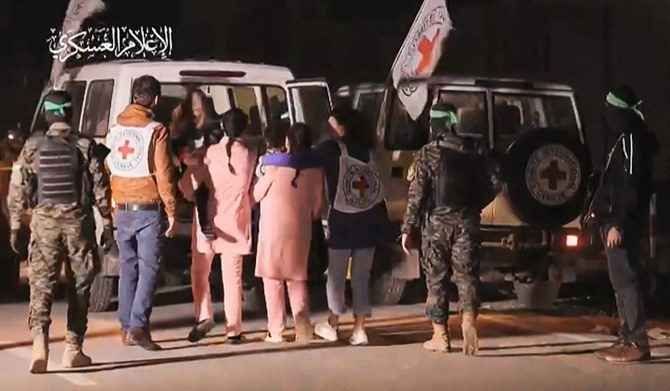
An image grab from a handout video released by the Hamas Media Office shows Hamas fighters accompanying newly released Israeli hostages (in pink) to a Red Cross vehicle, in the Gaza Strip on November 27, 2023. (AFP)
Short Url
Updated 28 November 2023
Follow

Rare survey details how Gazans wary of Hamas before Israel attack

  • Despite the majority negative view of Hamas uncovered by Jamal’s research, the report cautions that following the Hamas attack on Israel, perceptions may have changed

PRINCETON, United States: Many Gazans were hostile to Hamas ahead of the group’s brutal October 7 attack on Israel, with some describing its rule as a second occupation, according to rare polling data analyzed by a US-Palestinian researcher.
The findings are striking against a backdrop of protests and counter-protests triggered by the attack, with the relationship between Hamas and ordinary Gazans often the subject of heated debate.
“We find in our surveys that 67 percent of Palestinians in Gaza had little or no trust in Hamas in that period right before the attacks,” said Amaney Jamal, dean of Princeton’s School of Public and International Affairs.
“This is especially important because of the (erroneous) argument that all of Gaza supports Hamas, and therefore all of Gaza should be held accountable for the actions, atrocious actions of Hamas.”
Jamal is one of the driving forces behind the Arab Barometer which conducts surveys and polling in the region, including in Gaza where fieldwork concluded on the eve of the attacks on Israel.
She said that Hamas, which won elections in the Palestinian territories in 2006 and is designated a “terrorist” organization by Washington and the EU, was seen as “corrupt” and “authoritarian” by many respondents.
“Seventy-five percent said in the previous 30 days, they could not afford to feed their households. So again, this is an impoverished society, a society that is basically saying the Hamas-led government has some levels of corruption,” said Jamal.

“When we ask people, who do you blame?... we thought that the number-one culprit was going to be Israel because of the blockade. But most people cited Hamas corruption, more so than they cited the Israel blockade.”
Jamal, 52 and born in California and brought up in her family’s native Ramallah, said there was also a perception that “the Palestinian Authority or the Hamas-led government across time have become more dictatorial — and more authoritarian.”
“For the average Palestinian in the West Bank or in Gaza (they say) ‘we have this (Israeli) occupation and then we have these Palestinian governments that are also authoritarian’. So a common phrase is we used to be occupied by one power, now we’re occupied by two.”
The latest Arab Barometer was undertaken in Gaza, where 399 people were surveyed, and the West Bank, where 790 were polled, from the end of September to October 6. Its findings were published in the journal Foreign Affairs.
“About 60 percent said that they believed they could not express their opinions freely and openly at the eve of the attacks (and) about 72 percent said that they could not protest peacefully against the Hamas-led government,” Jamal said. “There was fear of retaliation or retribution from the government.”
The Palestinian Authority of president Mahmud Abbas, which runs Palestinian areas in the West Bank, fared poorly in Jamal’s survey, with only 9 percent of responses favorable.
Despite the majority negative view of Hamas uncovered by Jamal’s research, the report cautions that following the Hamas attack on Israel, perceptions may have changed.
“Israel cut off water, food, fuel, and electricity supplies to Gaza following the October 7 attacks, plunging the territory into a deep humanitarian crisis... the suffering the Palestinians have experienced has likely hardened their attitude,” it said.
Ahead of the attacks on Israel, more than half of respondents favored a two-state solution — a Palestinian state alongside Israel.
The remainder opted either for a Palestinian-Israeli confederation or a one-state solution. But one-in-five supported armed resistance before the events of October 7, and the massive Israeli military response that followed.
“(Gazans were) open to a peaceful reconciliation with Israel based on 1967 borders,” Jamal said.


Washington presses Syria to shift from Chinese telecom systems

Updated 26 February 2026
Follow

Washington presses Syria to shift from Chinese telecom systems

  • Syria is exploring the possibility of procuring Chinese technology
  • It was unclear whether the United States ⁠pledged financial or logistical support to Syria to do so

DAMASCUS: The United States has warned Syria against relying on Chinese technology in its telecommunications sector, arguing it conflicts with US interests and threatens US national security, according to three sources familiar with the matter.
The message was conveyed during an unreported meeting between a US State Department team and Syrian Communications Minister Abdulsalam Haykal in San Francisco on Tuesday. Washington has been coordinating closely with Damascus since 2024, when Syria’s now President Ahmed Al-Sharaa ousted longtime leader Bashar Assad, who had a strategic partnership with China.
Syria is exploring the possibility of procuring Chinese technology to support its telecommunications towers and the infrastructure of local Internet service providers, according to a Syrian businessman involved in the procurement talks.
“The US side asked for clarity on the ministry’s plans regarding Chinese telecom equipment,” said ⁠another source briefed on ⁠the talks.
But Syrian officials said infrastructure development projects were time-critical and that Damascus was seeking greater vendor diversity, the source added.
SYRIAN OFFICIALS CITE US EXPORT CONTROLS AS TELECOMS BARRIER
Syria is open to partnering with US firms but the matter was urgent and export controls and “over-compliance” remained an issue, according to person familiar with the meeting in San Francisco.
A US diplomat familiar with the discussions told Reuters that the US State Department “clearly urged Syrians to use American technology or technology from allied countries in the telecoms sector.”
It was unclear whether the United States ⁠pledged financial or logistical support to Syria to do so.
Responding to Reuters questions, a US State Department spokesperson said: “We urge countries to prioritize national security and privacy over lower-priced equipment and services in all critical infrastructure procurement. If it seems too good to be true, it probably is.”
The spokesperson added that Chinese intelligence and security services “can legally compel Chinese citizens and companies to share sensitive data or grant unauthorized access to their customers’ systems” and promises by Chinese companies to protect customers’ privacy were “entirely inconsistent with China’s own laws and well-established practices.”
China has repeatedly rejected allegations of it using technology for spying purposes.
The Syrian Ministry of telecommunications told Reuters any decisions related to equipment and infrastructure are made “in accordance with national technical and security standards, ensuring data protection and service continuity.”
The ministry said it is also prioritizing the diversification of partnerships and technology sources to ⁠serve the national interest.
Syria’s telecom ⁠infrastructure has relied heavily on Chinese technology due to US sanctions imposed on successive Assad governments over the civil war that grew from a crackdown on anti-government protests in 2011.
Huawei technology accounts for more than 50 percent of the infrastructure of Syriatel and MTN, the country’s only telecom operators, according to a senior source at one of the companies and documents reviewed by Reuters. Huawei did not immediately respond to a request for comment.
Syria is seeking to develop its private telecommunications sector, devastated by 14 years of war, by attracting foreign investment.
In early February, Saudi Arabia’s largest telecom operator, STC, announced it would invest $800 million to “strengthen telecommunications infrastructure and connect Syria regionally and internationally through a fiber-optic network extending over 4,500 kilometers.”
The ministry of telecommunications says that US restrictions “hinder the availability of many American technologies and services in the Syrian market,” emphasizing that it welcomes expanding cooperation with US companies when these restrictions are lifted.
Syria has inadequate telecommunications infrastructure, with network coverage weak outside city centers and connection speeds in many areas barely exceeding a few kilobits per second.