

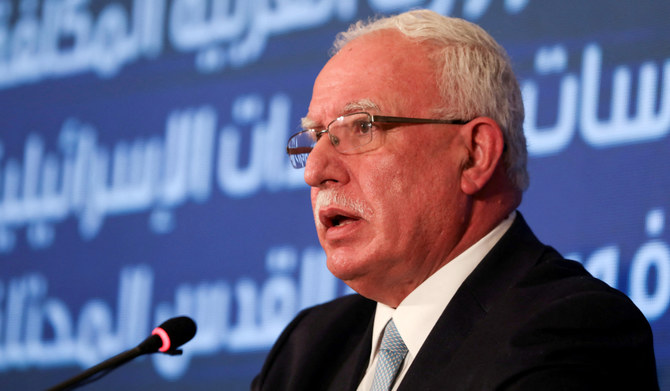

BARCELONA, Spain: Hours before Israel and Hamas agreed to extend their expiring cease-fire by two more days, the top Palestinian diplomat made a plea during a Monday meeting of European Union members and Arab nations for a definitive end to Israel’s retaliatory attacks on the Gaza Strip .
“We have to find how to apply the necessary pressure so that the Israeli government does not continue killing innocent people, so that we can continue counting cadavers,” Riad Al-Maliki said in Spanish during a news conference during the gathering of diplomats in Barcelona, Spain.
Al-Maliki warned that any resumption of the war by Israel would quickly lead to more deaths in a conflict that has killed more than 14,000 people, the vast majority of them Palestinians. He is the foreign minister for the internationally recognized Palestinian Authority, whose forces were driven out of Gaza by Hamas when it seized power in 2007.
Israel did not attend the meeting hosted by the Union for the Mediterranean and chaired by the EU’s foreign policy chief, Josep Borrell, and Jordanian Foreign Minister Ayman Safadi. Many of the 43 delegations were represented by their foreign ministers.
In recent years, the event has become largely a forum for cooperation between the EU and the Arab world. Monday’s gathering was supposed to focus on the role of the union 15 years after its foundation, but it has taken on new significance since the Oct. 7 Hamas attack that killed more than 1,200 Israelis and led to nearly 240 people being taken hostage and Israel’s ensuing war in the Gaza Strip.
While the meeting did not produce any major policy initiatives, it did provide a chance for European diplomats to hear directly from northern African and Middle Eastern nations who strongly support the Palestinian cause and fear the Israel-Hamas war could destabilize the region.
Borrell said he “regretted” the absence of Israel. He repeated his condemnation of the Hamas attack, while calling on Israel to permanently end its assault, which he said has claimed the lives of over 5,000 children.
“One horror cannot justify another horror,” Borrell said. “Peace between Israel and Palestine has become a strategic imperative for the entire Euro-Mediterranean community and beyond.”
Jordan’s Safadi, who told The Associated Press on the eve of the event that he hoped the talks would help “bridge a gap” between Arab and European countries, urged the officials attending the meeting to back a two-state solution that would recognize a Palestinian state.
But Safadi also acknowledged Monday after the meeting that despite a broad consensus for peace, there were still some differing viewpoints on how hard to push Israel to stop.
“Today, we came for a very open, very frank, very blunt conversation. We agreed and we disagreed. Some of our colleagues still call the killing of 15,000 Palestinians, the destruction of over 160,000 homes, the complete devastation of hospitals, the denial of food, water, fuel, medicine, is self-defense,” he said. “We call it blatant aggression.”
Safadi would not say which countries took the softer approach to Israel, but the Czech Republic, Austria, Croatia, and Hungary have insisted on Israel’s right to defend itself.
Saudi Arabia’s foreign minister, Prince Faisal bin Farhan Al Saud, was invited to the event.
“Continued escalation will produce no severe pain for any party,” Prince Faisal said. “The only sure result is more destruction, radicalization and further conflict at the expense of Palestinian lives, as well as regional security, including that of Israel.”
Borrell said he wanted the gathering to focus on managing the humanitarian crisis in Gaza once hostilities finally stop. The EU would want the United Nations to take a leading role in establishing how best to fill any security vacuum should Israeli forces defeat Hamas, according to a senior EU official who was not authorized to speak publicly and spoke on condition of anonymity.
A small pro-Palestinian group rallied before the gathering at the art nouveau building that once housed Barcelona’s Sant Pau Hospital.
Israel gave no reason for its decision not to attend the gathering. The EU is the world’s biggest provider of assistance to the Palestinians as well as Israel’s biggest trade partner. Spain is one of the EU countries that has called for Israel to cease its assault, while also condemning the Hamas attack.
Spanish Prime Minister Pedro Sánchez said during a trip to Israel, the Palestinian territories and Egypt last week with his Belgian counterpart that the time haf come for the international community and the EU to recognize a Palestinian state. His comment prompted Israel to summon the Belgian and Spanish ambassadors.
Lebanese Foreign Affairs Minister Abdallah Bou Habib said he was pleased that all the European nations agreed to back a two-state solution and do not want Israel to occupy Gaza.
“I’m glad that the Europeans are interested in solving the problem of problem that is 75 years old,” he told the AP. “And they all agreed that Israel should not stay in the Gaza Strip, and that it and the West Bank are one and should continue to be one.”


