

Pakistan ex-PM Khan’s accountability czar says attacked with ‘acidic liquid’ in UK 

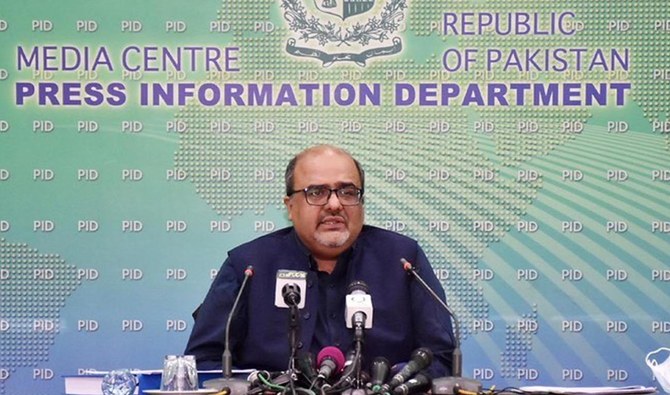
Shahzad Akbar, adviser on accountability and interior to former Pakistan Prime Minister Imran Khan, addresses reporters during a news conference in Islamabad, Pakistan, on May 27, 2020. (PID/File)
Short Url
Updated 27 November 2023
Follow

Pakistan ex-PM Khan’s accountability czar says attacked with ‘acidic liquid’ in UK 

  • Shahzad Akbar is a central figure in a £190 million land bribe case against ex-PM Khan and wife 
  • In May, Khan shifted responsibility on Akbar for the deal with property tycoon Malik Riaz Hussain 

ISLAMABAD: Shahzad Akbar, who was the accountability chief of former Pakistan prime minister Imran Khan, said on Monday he came under an attack by unknown assailants, who threw an “acidic liquid” on him at his home in the United Kingdom. 

Akbar served as a special assistant to the prime minister on accountability during the reign of Khan-led government in Pakistan. He left Pakistan shortly after Khan was ousted in a parliamentary no-trust vote in April 2022 and currently lives in exile in the UK. 

Sharing details of the attack on him, the former accountability czar said he received a few injuries, but his wife and children, who were with him at the time, remained safe.

“Last evening, I was attacked at my address in England (where I am living in exile with my family) by unknown assailant/s who threw acidic liquid at me,” Akbar said on X.

“Thankfully my wife and children are safe, however I got some injuries but nothing life-threatening.” 

Akbar is a central figure in a land bribe case against Khan and his wife, who are accused of receiving benefits from Pakistani property tycoon Malik Riaz Hussain by granting him a settlement of £190 million seized by the United Kingdom’s National Crime Agency as part of a deal relating to the transfer of ill-gotten money to Pakistan. 

The case involves the Al-Qadir Trust, owned by Khan and his third wife Bushra Bibi, which runs a university outside Islamabad that is devoted to spirituality and Islamic teachings. The project is inspired by Khan’s wife, who is a spiritual leader. 

In May, Khan shifted the responsibility on Akbar for the deal with Hussain, saying that he relied upon Akbar’s briefing that the amount was to be repatriated to Pakistan against the liability of respondents, Bahria Town, which is owned by Hussain. 

Speaking further of the attack, Akbar said he would neither be “intimidated,” nor “bow down” to the ones behind the attack on him. 

“Police and emergency services arrived instantly and house being protected now,” he said. “I will not be intimidated nor bow down to those who are doing this.” 


Pakistani president arrives in Iraq to deepen trade, energy cooperation

Updated 20 December 2025
Follow

Pakistani president arrives in Iraq to deepen trade, energy cooperation

  • Visit follows recent high-level contacts as Islamabad seeks to expand limited commercial ties with Baghdad
  • Talks are expected to cover investment, manpower and facilitation of Pakistani pilgrims visiting holy sites in Iraq

ISLAMABAD: President Asif Ali Zardari arrived in Iraq on Saturday on an official visit aimed at expanding cooperation in trade, energy and investment, as Pakistan seeks to deepen ties with Baghdad after years of limited engagement.

Pakistan and Iraq established diplomatic relations in 1947 and have traditionally maintained cordial ties, though commercial links remain modest, with officials and business groups identifying scope for cooperation in construction services, pharmaceuticals, manpower and agricultural exports.

“President Asif Ali Zardari arrived in Baghdad on a four-day official visit to Iraq,” his office said in a post on X. “He was received by Culture Minister Dr. Ahmed Fakkak Al-Badrani. During the visit, meetings with senior Iraqi leadership are expected to advance cooperation and further strengthen Pakistan-Iraq relations.”

Zardari’s visit follows a series of recent high-level contacts between the two countries, reflecting efforts to broaden bilateral engagement beyond traditional diplomatic ties and explore collaboration across economic, political and people-to-people domains.

According to Pakistan’s foreign office, the president is expected to hold meetings with Iraq’s senior leadership to discuss cooperation in various areas such as trade and investment, energy, technology, education and manpower.

He is also expected to discuss regional and international issues with Iraqi officials.

Earlier this month, Pakistan’s Interior Minister Mohsin Naqvi met his Iraqi counterpart, Abdul Ameer Al-Shammari, on the sidelines of meetings in Brussels, where both sides agreed to enhance cooperation on security and facilitate travel for Pakistani Shia pilgrims to Najaf and Karbala.

The two officials discussed measures to ensure the smoother movement of these pilgrims and their compliance with visa regulations.