

Two civilians killed, three soldiers injured in suicide bombing targeting army convoy

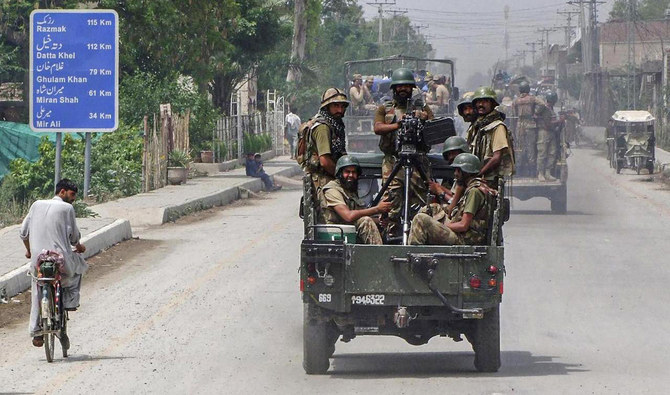
Pakistani soldiers drive toward North Waziristan from Bannu on June 20, 2014. (REUTERS/File)
Short Url
Updated 27 November 2023
Follow

Two civilians killed, three soldiers injured in suicide bombing targeting army convoy

  • Army says bomber had been identified as an Afghan national and had struck in Bakka Khel area in Bannu District
  • Bomber affiliated with group headed by Hafiz Gul Bahadur, militant leader who used to operate in North Waziristan

ISLAMABAD: The army said on Monday a suicide bomber had targeted a security forces convoy, killing two civilians and injuring seven civilians and three soldiers in northwest Pakistan.

The military said the bomber was affiliated with a militant group headed by militant commander Hafiz Gul Bahadur, who used to operate in Pakistan's North Waziristan border region. The faction is allied with the Tehreek-e-Taliban Pakistan (TTP), which carries out a majority of terror attacks in Pakistan. The army added that the bomber had been identified as an Afghan national, without giving evidence, and had struck in the Bakka Khel area in Bannu District.

“Resultantly, 2x innocent civilians embraced Shahadat, while 7x civilians and 3x soldiers got injured,” the military said. “Sanitization operation is being carried out to eliminate any other terrorists found in the area.”

The TTP, or Pakistani Taliban, are a separate group but allies of the Afghan Taliban, who seized power in Afghanistan in 2021 as the US and NATO troops were in the final stages of their pullout. Kabul denies it allows militants to harbor on its soil.

Islamabad last month announced it would expel over a million undocumented migrants, mostly Afghans, amid a row with Kabul over charges that it harbors anti-Pakistan militants. Since the announcement of the deportation drive on Oct. 3, Pakistani officials have variously said Afghan nationals have been found to be involved in a majority of recent terror attacks in the country,

On Nov. 8, Prime Minister Anwaar-ul-Haq Kakar said in an unusually harshly worded presser that the move to expel undocumented Afghans was a response to the unwillingness of the Taliban-led administration to act against militants using Afghanistan to carry out attacks in Pakistan.

"After non-cooperation by the Afghan interim government, Pakistan has decided to take matters into its own hands - and Pakistan's recent actions are neither unexpected or surprising," caretaker Prime Minister Anwar ul Haq Kakar told journalists.

Tens of thousands of Afghans, many of whom have lived in Pakistan for decades, have had to leave the country, and authorities are rounding up many more in raids across the country.


Pakistan forecasts inflation to remain in moderate 5.5-6.5 percent range

Updated 10 sec ago
Follow

Pakistan forecasts inflation to remain in moderate 5.5-6.5 percent range

  • Finance Division report says robust remittance inflows, steady performance of IT, service sectors to cushion external pressures
  • Consumer inflation in Pakistan has significantly reduced over the years when it surged to a record high of 38 percent in May 2023

ISLAMABAD: Inflation is expected to remain in the moderate range of 5.5 to 6.5 percent for December, the Finance Division said in its Monthly Economic Outlook report on Wednesday. 

Pakistan reported inflation at 6.1 percent on a year-on-year basis in November as compared to 6.2 percent in October. Pakistan’s inflation rate rose to a record high of 38 percent in May 2023 on account of surging food and fuel costs as Islamabad scrapped subsidies as part of a financial deal agreed with the International Monetary Fund (IMF). 

“Inflation is projected to remain moderate, in the range of 5.5-6.5 percent in December, primarily reflecting base effect,” the report said. 

The Finance Division’s report said Pakistan’s economic outlook remains “positive,” driven by sustained growth in industrial activity due to continued momentum in textiles, automobiles, cement and food processing sectors. 

“Robust remittance inflows and steady performance in IT and services exports are likely to cushion external pressures,” the report said. 

The report said Pakistan’s current account recorded a surplus of $100 million while it posted a deficit of $812 million during the July-November period.

It said remittances increased by 9.3 percent to $16.1 billion in November, led by inflows from Saudi Arabia (24.2 percent) and the UAE (20.8 percent), while the net foreign direct investment inflows were recorded at $927.4 million during the same July to November period. 

It said Pakistan’s fiscal consolidation is expected to continue supporting macroeconomic stability, with government efforts in expenditure management, enhanced tax collection and structural reforms contributing to sustainable growth. 

“Overall, Pakistan’s economy is projected to maintain its positive momentum in the coming months, driven by industrial growth, improved governance, digitalization, and prudent macroeconomic management,” the report said.