

Pakistan forecasts inflation to remain in moderate 5.5-6.5 percent range

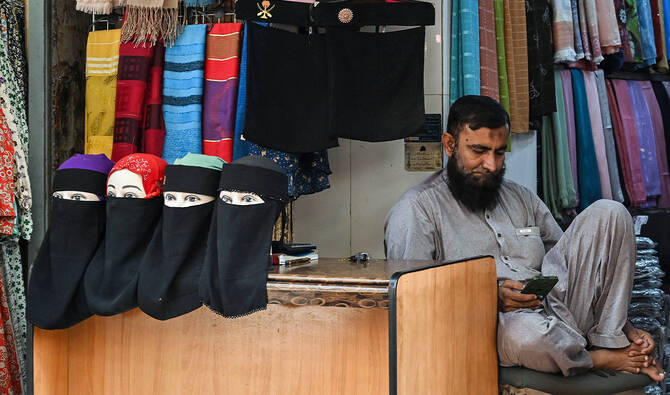
A shopkeeper waits for customers at a cloth market in Karachi, Pakistan, on November 24, 2025. (AFP/File)
Short Url
Updated 31 December 2025
Follow

Pakistan forecasts inflation to remain in moderate 5.5-6.5 percent range

  • Finance Division report says robust remittance inflows, steady performance of IT, service sectors to cushion external pressures
  • Consumer inflation in Pakistan has significantly reduced over the years when it surged to a record high of 38 percent in May 2023

ISLAMABAD: Inflation is expected to remain in the moderate range of 5.5 to 6.5 percent for December, the Finance Division said in its Monthly Economic Outlook report on Wednesday. 

Pakistan reported inflation at 6.1 percent on a year-on-year basis in November as compared to 6.2 percent in October. Pakistan’s inflation rate rose to a record high of 38 percent in May 2023 on account of surging food and fuel costs as Islamabad scrapped subsidies as part of a financial deal agreed with the International Monetary Fund (IMF). 

“Inflation is projected to remain moderate, in the range of 5.5-6.5 percent in December, primarily reflecting base effect,” the report said. 

The Finance Division’s report said Pakistan’s economic outlook remains “positive,” driven by sustained growth in industrial activity due to continued momentum in textiles, automobiles, cement and food processing sectors. 

“Robust remittance inflows and steady performance in IT and services exports are likely to cushion external pressures,” the report said. 

The report said Pakistan’s current account recorded a surplus of $100 million while it posted a deficit of $812 million during the July-November period.

It said remittances increased by 9.3 percent to $16.1 billion in November, led by inflows from Saudi Arabia (24.2 percent) and the UAE (20.8 percent), while the net foreign direct investment inflows were recorded at $927.4 million during the same July to November period. 

It said Pakistan’s fiscal consolidation is expected to continue supporting macroeconomic stability, with government efforts in expenditure management, enhanced tax collection and structural reforms contributing to sustainable growth. 

“Overall, Pakistan’s economy is projected to maintain its positive momentum in the coming months, driven by industrial growth, improved governance, digitalization, and prudent macroeconomic management,” the report said.


Pakistan military says 12 soldiers killed in border fighting as Kabul calls for dialogue

Updated 7 sec ago
Follow

Pakistan military says 12 soldiers killed in border fighting as Kabul calls for dialogue

  • Military says 274 Afghan fighters killed, over 400 injured in ongoing operation
  • Afghan authorities earlier said 55 Pakistani soldiers killed in retaliatory strikes

ISLAMABAD: Pakistan’s military said on Friday 12 soldiers had been killed in cross-border fighting with Afghan forces, as it detailed the scale of an ongoing border operation and accused the Kabul government of coordinating with militant groups targeting Pakistan.

The announcement followed days of escalating hostilities triggered by Pakistani airstrikes earlier this week on what Islamabad said were Tehreek-e-Taliban Pakistan (TTP) and Daesh militant camps inside Afghanistan. Since then, both governments have reported retaliatory operations and issued conflicting casualty figures, marking the most serious deterioration in relations between the neighbors in recent months.

The 2,600-kilometer (1,600-mile) shared frontier between the two nations, a key trade and transit corridor, has remained closed to trade and movement since October 2025 amid recurring tensions.

Lt. Gen. Ahmed Sharif Chaudhry, director general of Inter-Services Public Relations (ISPR), told a news conference in Rawalpindi that Pakistani forces had repelled coordinated attacks at 53 locations along the border and responded under what he described as Operation Ghazab lil-Haq.

“While safeguarding Pakistan’s honor and territorial integrity, 12 brave soldiers have embraced martyrdom in the operation so far, while 27 have been injured and one soldier is missing in action,” he said.

Chaudhry said Pakistan had destroyed 274 Taliban posts and positions and more than 400 fighters were injured, describing those figures as conservative estimates. He added that 73 posts were completely destroyed along the border and 18 had been captured.

He said Afghan Taliban forces had launched physical raids “in collusion and in support of an internationally declared terrorist organization” and accused the Taliban administration of acting in coordination with militant groups.

“The Afghan Taliban regime is the master proxy of these terrorist proxies which are operating from Afghanistan,” he said.

Kabul has repeatedly said it does not allow militants to operate in its territory. 

Chaudhry said Pakistan had targeted 22 locations across the border, including in Kabul, Kandahar, Paktia, Nangarhar, Khost and Paktika.

“All targets were selected with great care based on intelligence. They were military objectives, and utmost care was taken to avoid any civilian collateral damage,” he said.

He said the Taliban authorities faced a choice.

“Either they choose terrorists and terrorism or side with Pakistan,” he said.

KABUL CALLS FOR DIALOGUE 

Separately on Friday afternoon, Afghan Taliban spokesperson Zabihullah Mujahid called for talks to resolve the crisis.

“We have always emphasized peaceful resolution, and now too we want the issue to be resolved through dialogue,” he said.

In a detailed statement earlier in the day, Afghanistan’s Ministry of National Defense said it had carried out airstrikes inside Pakistan in response to what it described as Pakistani “aerial incursions” into Kabul, Kandahar and Paktia.

Afghan officials said 55 Pakistani soldiers were killed and that several posts were captured, claims denied by Islamabad.

None of the casualty figures or battlefield claims from either side could be independently verified.

Pakistan’s Information Minister Attaullah Tarar earlier said militants had attempted to launch drones inside Pakistani territory.

“Fitna al khawarij terrorists have attempted to launch small drones in Abbotabad, Swabi and Nowshera. Anti Drone Systems have brought down all the drones. No damage to life,” Tarar said.

“The incidents have again exposed direct linkages between Afghan Taliban Regime and Terrorism in Pakistan.”

Separately, Prime Minister Shehbaz Sharif on Friday visited General Headquarters (GHQ) in Rawalpindi, where he was briefed by the military leadership on the evolving situation. 

According to a statement from the Prime Minister’s Office, Sharif said there would be “zero tolerance” toward what he described as collusion between the Afghan Taliban regime and militant elements.

“Pakistan knows very well how to defend itself against any aggression,” the statement quoted him as saying, adding that the armed forces were ready to safeguard the country.
Regional concern

Cross-border violence has intensified in recent weeks, with Pakistan blaming a surge in suicide bombings and militant attacks on insurgents it says are based in Afghanistan. Kabul denies providing safe havens and says Pakistan’s security challenges are an internal matter.

The latest clashes mark the third major escalation between the neighbors in less than a year. Similar strikes last year triggered weeklong fighting before Qatar, Türkiye and other regional actors mediated a ceasefire in October.

Several countries, including China, Russia, Saudi Arabia and Iran, have expressed concern and urged restraint.

Operations on both sides were ongoing as of Friday evening.