KHAN YOUNIS: Hamas was expected to swap more of its hostages Saturday for prisoners held by Israel on the second day of a ceasefire that has allowed critical humanitarian aid into the Gaza Strip and given civilians their first respite after seven weeks of war.
On the first day of the four-day ceasefire, Hamas released 24 of the about 240 hostages taken during its Oct. 7 attack on Israel that triggered the war, and Israel freed 39 Palestinians from prison. Those freed from captivity in Gaza were 13 Israelis, 10 Thai nationals and citizen of the Philippines.
During the four days, Hamas is to release at least 50 Israeli hostages, and Israel 150 Palestinian prisoners.
Israel has said the truce can be extended an extra day for every additional 10 hostages freed — something United States President Joe Biden said he hoped would come to pass.
The start of the truce Friday morning brought the first quiet for 2.3 million Palestinians reeling and desperate from relentless Israeli bombardment that has killed thousands, driven three-quarters of the population from their homes and leveled residential areas. Rocketfire from Gaza militants into Israel went silent as well.
The United Nations said the pause enabled it to scale up the delivery of food, water, and medicine to the largest volume since the resumption of humanitarian aid convoys on Oct. 21. It was also able to deliver 129,000 liters (34,078 gallons) of fuel — just over 10 percent of the daily pre-war volume — as well as cooking gas, a first time since the war began.
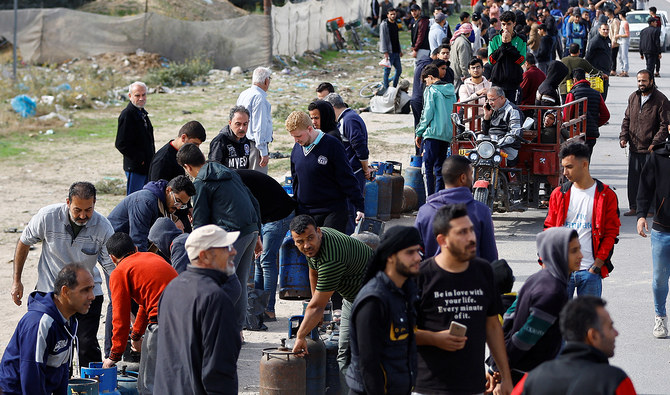
In the southern city of Khan Yunis on Saturday, a long line of people with gas cans and other containers waited outside a filling station hoping to get some of the newly delivered fuel.
For the first time in over a month, aid reached northern Gaza, the focus of Israel’s ground offensive. A UN convoy delivered flour to two facilities sheltering people displaced by fighting.
The UN said it and the Palestinian Red Crescent Society were also able to evacuate 40 patients and family members from a hospital in Gaza City, where much of the fighting has taken place, to a hospital in Khan Yunis.
The relief brought by the ceasefire has been tempered, however, for both sides — among Israelis by the fact that not all hostages will be freed and among Palestinians by the brevity of the pause. The short truce leaves Gaza mired in humanitarian crisis and under the threat that fighting could soon resume.
Israel has vowed to resume its massive offensive once the truce ends. That has clouded hopes that the deal could eventually help wind down the conflict, which has fueled a surge of violence in the occupied West Bank and stirred fears of a wider conflagration across the Middle East.
First hostages freed
After nightfall Friday, a line of ambulances emerged from Gaza through the Rafah Crossing into Egypt carrying the freed hostages. The freed Israelis included nine women and four children 9 and under.
The released hostages were taken to three Israeli hospitals for observation. The Schneider Children’s Medical Center said it was treating eight Israelis — four children and four women — and that all appeared to be in good physical condition. The center said they were also receiving psychological treatment, adding that “these are sensitive moments” for the families.
At a plaza dubbed “Hostages Square” in Tel Aviv, a crowd of Israelis celebrated at the news.
Yael Adar spotted her mother, 85-year-old Yaffa Adar, in a TV newscast of the release and was cheered to see her walking. “That was a huge concern, what would happen to her health during these almost two months,” she told Israel’s Channel 12.
But Yael’s 38-year-old son, Tamir Adar, remained in captivity. Both were kidnapped on Oct. 7 from Kibbutz Nir Oz. “Everyone needs to come back. It’s happiness locked up in grief.”
The hostages included multiple generations. Nine-year-old Ohad Munder-Zichri was freed along with his mother, Keren Munder, and grandmother, Ruti Munder. The fourth-grader was abducted during a holiday visit to his grandparents at the kibbutz where about 80 people — nearly a quarter of all residents of the small community — are believed to have been taken from.
The plight of the hostages has raised anger among some families that the government of Prime Minister Benjamin Netanyahu was not doing enough to bring them home.
Hours later, 24 Palestinian women and 15 teenage boys held in Israeli prisons in the occupied West Bank and east Jerusalem were freed. In the West Bank town of Beitunia, hundreds of Palestinians poured out of their homes to celebrate, honking horns and setting off fireworks that lit up the night sky.
The teenagers had been jailed for minor offenses like throwing stones. The women included several convicted of trying to stab Israeli soldiers, and others who had been arrested at checkpoints in the West Bank.
“As a Palestinian, my heart is broken for my brothers in Gaza, so I can’t really celebrate,” said Abdulqader Khatib, a UN worker whose 17-year-old son, Iyas, was freed. “But I am a father. And deep inside, I am very happy.”
Iyas had been taken into “administrative detention” in 2022 without charges or trial and based on secret evidence. Israel often holds detainees for months without charges. Most of those who are tried are put before military courts that almost never acquit defendants and often don’t follow due process, human rights groups say.
According to the Palestinian Prisoners’ Club, an advocacy group, Israel is currently holding 7,200 Palestinians, including about 2,000 arrested since the start of the war.
A longer peace?
The war erupted when several thousand Hamas militants stormed into southern Israel, killing some 1,200 people, mostly civilians, and taking scores of hostages, including babies, women and older adults, as well as soldiers.
Majed Al-Ansari, a spokesperson for the Foreign Ministry of Qatar, said the hope is that momentum from the deal will lead to an end to the violence. Qatar served as a mediator along with the US and Egypt.
But hours before it came into effect, Israeli Defense Minister Yoav Gallant told troops that their respite would be short and that the war would resume with intensity for at least two more months.
Netanyahu has also vowed to continue the war to destroy Hamas’ military capabilities, end its 16-year rule in Gaza and return all the hostages.
The Israeli offensive has killed more than 13,300 Palestinians, according to the Health Ministry in the Hamas-run Gaza government. Women and minors have consistently made up around two-thirds of the dead, though the latest number was not broken down. The figure does not include updated numbers from hospitals in the north, where communications have broken down.
The ministry says some 6,000 people have been reported missing, feared buried under rubble. The ministry does not differentiate between civilians and militants in its death tolls.
Israel says it has killed thousands of Hamas fighters, without presenting evidence for its count.


![]()

Gaza ceasefire enters second day with more hostages to be exchanged and critical supplies delivered
Short Url
https://arab.news/z36ps
Gaza ceasefire enters second day with more hostages to be exchanged and critical supplies delivered
- During the four-day truce, Hamas is to release at least 50 Israeli hostages, and Israel 150 Palestinian prisoners
- The UN said the pause enabled it to scale up the delivery of food, water, and medicine to the largest volume
Latest updates





© 2026 SAUDI RESEARCH & PUBLISHING COMPANY, All Rights Reserved And subject to Terms of Use Agreement.