Kim Jong Un reviews satellite photos of US bases in Hawaii, South Korea: state media

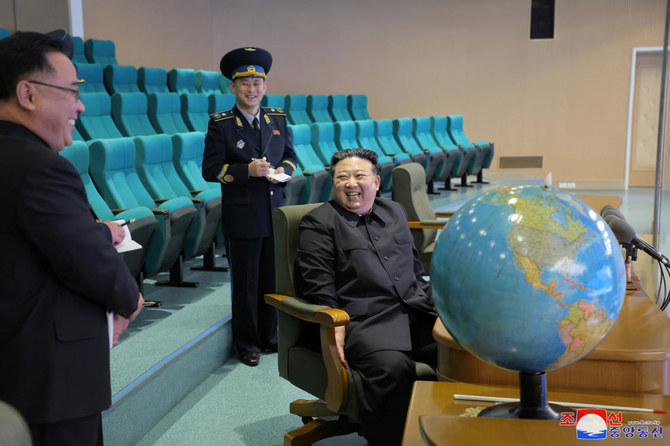
North Korea’s leader Kim Jong-un visits the Pyongyang General Control Center of the National Aerospace Technology Administration to inspect operational readiness of the reconnaissance satellites and view aerospace photographs. (Reuters)
Short Url
Updated 25 November 2023
Follow

Kim Jong Un reviews satellite photos of US bases in Hawaii, South Korea: state media

  • Pyongyang successfully put a military spy satellite into orbit earlier this week
  • Experts have said putting a working reconnaissance satellite into orbit would improve North Korea’s intelligence-gathering capabilities

SEOUL: North Korean state media said Saturday that leader Kim Jong Un has reviewed images taken by his country’s new spy satellite of “major target regions” including the US military base at Pearl Harbor, Hawaii and sites across South Korea.
Pyongyang successfully put a military spy satellite into orbit earlier this week, but South Korea said it was too early to determine if the satellite was functioning as the North claims.
Experts have said putting a working reconnaissance satellite into orbit would improve North Korea’s intelligence-gathering capabilities, particularly over South Korea, and provide crucial data in any military conflict.
Pyongyang previously claimed, within hours of the Tuesday launch, that Kim was shown photos of US military bases in Guam taken by the satellite, named “Malligyong-1.”
On Saturday, the North claimed Kim inspected images taken as the satellite passed over Hawaii at around 5 am, including those of “a naval base in the Pearl Harbor, the Hickam air-force base in Honolulu,” according to the North’s official Korean Central News Agency.
Kim also reviewed the satellite’s images of the South Korean port city of Busan, which Pyongyang said were taken at around 10 am on Saturday.
The photos included ones of the US nuclear-powered aircraft carrier USS Carl Vinson, Pyongyang claimed.
Carl Vinson had arrived at the Busan Naval Base on Tuesday, according to Seoul’s military.
In an earlier report on Saturday, KCNA said Kim had the day before reviewed the satellite’s images of “major target regions” in the South, including its capital and cities hosting US military bases.
The Friday images also included some areas of North Korea, it added.
Among the South Korean cities mentioned, Pyeongtaek — around 60 kilometers from Seoul — hosts Camp Humphreys, the largest overseas US military installation in the world.
Pyeongtaek is also home to the Osan Air Base, which houses Seoul’s Air Force Operations Command as well as a US Air Force base.
The North’s satellite launch has since prompted the two Koreas to suspend — the South only partially — a five-year-old military accord established to de-escalate tensions on the peninsula.
Separately, the top diplomats of South Korea, Japan and the United States on Friday “strongly condemned the launch for its destabilizing effect on the region” after a joint phone call, the US State Department said in a statement.
The launch “used ballistic missile technology in violation of multiple United Nations Security Council resolutions,” it said.
Seoul’s spy agency has said that Pyongyang, after two failed attempts to put a satellite in orbit earlier this year, received help from Moscow for this week’s successful launch.
North Korea’s National Aerospace Technology Administration would continue “additional fine-tuning” of the spy satellite’s functions on Saturday, KCNA said.


Iceland joins Eurovision boycott over Israel’s participation

Updated 5 sec ago
Follow

Iceland joins Eurovision boycott over Israel’s participation

  • Decision follows similar moves by Spain, the Netherlands, Ireland and Slovenia over the Gaza war
  • Iceland’s national broadcaster says it pulled out 'given the public debate' in the country
LONDON: Iceland’s national broadcaster said Wednesday it will boycott next year’s Eurovision Song Contest because of discord over Israel’s participation, joining four other countries in a walkout of the pan-continental music competition.
Broadcasters in Spain, the Netherlands, Ireland and Slovenia told contest organizer the European Broadcasting Union last week that they will not take part in the contest in Vienna in May after organizers declined to expel Israel over its conduct of the war against Hamas in Gaza.
The board of Iceland’s RÚV met Wednesday to make a decision.
At its conclusion the broadcaster said in a statement that “given the public debate in this country ... it is clear that neither joy nor peace will prevail regarding the participation of RÚV in Eurovision. It is therefore the conclusion of RÚV to notify the EBU today that RÚV will not take part in Eurovision next year.”
“The Song Contest and Eurovision have always had the aim of uniting the Icelandic nation but it is now clear that this aim cannot be achieved and it is on these program-related grounds that this decision is taken,” the broadcaster said.
Last week the general assembly of the EBU — a group of public broadcasters from 56 countries that runs Eurovision — met to discuss concerns about Israel’s participation. Members voted to adopt tougher contest voting rules in response to allegations that Israel manipulated the vote in favor of its competitor, but took no action to exclude any broadcaster from the competition.
The pullouts include some big names in the Eurovision world. Spain is one of the “Big Five” large-market countries that contribute the most to the contest. Ireland has won seven times, a record it shares with Sweden.
Iceland, a volcanic North Atlantic island nation with a population of 360,000, has never won but has the highest per capita viewing audience of any country.
The walkouts cast a cloud over the future of what’s meant to be a feel-good cultural party marked by friendly rivalry and disco beats, dealing a blow to fans, broadcasters and the contest’s finances.
The contest, which turns 70 in 2026, strives to put pop before politics, but has repeatedly been embroiled in world events. Russia was expelled in 2022 after its full-scale invasion of Ukraine.
It has been roiled by the war in Gaza for the past two years, stirring protests outside the venues and forcing organizers to clamp down on political flag-waving.
Opponents of Israel’s participation cite the war in Gaza, where more than 70,000 Palestinians have been killed, according to the territory’s Health Ministry, which operates under the Hamas-run government and whose detailed records are viewed as generally reliable by the international community.
Israel’s government has repeatedly defended its campaign as a response to the attack by Hamas-led militants on Oct. 7, 2023. The militants killed around 1,200 people — mostly civilians — in the attack and took 251 hostage.
A number of experts, including those commissioned by a UN body, have said that Israel’s offensive in Gaza amounts to genocide, a claim Israel has vigorously denied.
Wednesday marked the final day for national broadcasters to announce whether they planned to participate. More than two dozen countries have confirmed they will attend the contest in Vienna, and the EBU says a final list of competing nations will be published before Christmas.