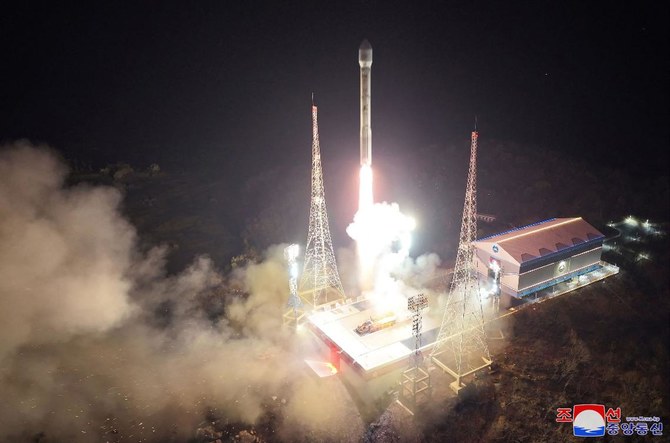

SEOUL: North Korea said on Thursday it would deploy stronger armed forces and new weapons on its border with the South, a day after Seoul suspended part of a 2018 military accord between the two Koreas in a protest over Pyongyang’s launch of a spy satellite.
North Korea’s defense ministry said in a statement carried by the KCNA news agency that it would restore all military measures it had halted under the deal with South Korea, which was designed to de-escalate tension along their shared border.
“From now on, our army will never be bound by the September 19 North-South Military Agreement,” the statement said. “We will withdraw the military steps, taken to prevent military tension and conflict in all spheres including ground, sea and air, and deploy more powerful armed forces and new-type military hardware in the region along the Military Demarcation Line.”
Tuesday’s satellite launch was the North’s third attempt this year after two failures and followed a rare trip by North Korean leader Kim Jong Un to Russia, during which President Vladimir Putin vowed to help Pyongyang build satellites.
South Korean officials said the latest launch most likely involved Russian technical assistance under a growing partnership that has seen Pyongyang supply Russia with millions of artillery shells.
Russia and North Korea have denied arms deals but have promised deeper cooperation, including on satellites.
South Korea on Wednesday suspended part of the inter-Korean deal in response to Pyongyang’s launch and said it would immediately step up surveillance along the heavily fortified border with the North.
North Korea accused South Korea of scrapping the deal, known as the Comprehensive Military Agreement (CMA), and said Seoul will be held “wholly accountable in case an irretrievable clash breaks out” between the two Koreas.
NORTH FIRES MISSILE
North Korea’s statement came hours after it fired a ballistic missile toward the sea off its east coast late on Wednesday. South Korea’s military said the launch appeared to have failed.
A US Department of State spokesperson said South Korea’s decision to suspend part of the CMA was a “prudent and restrained response,” citing North Korea’s “failure to adhere to the agreement.”
“The ROK suspension will restore surveillance and reconnaissance activities along the ROK side of the Military Demarcation Line, improving the ROK’s ability to monitor DPRK threats,” the official said, referring to South Korea and North Korea respectively by the initials of their official names.
South Korea resumed the use of crewed and uncrewed reconnaissance aircraft in the border area on Wednesday, Yonhap news agency reported.
The suspended North-South pact was signed at a 2018 summit between Kim Jong Un and then South Korean President Moon Jae-in, one of the most concrete measures to come from months of diplomacy that stalled out by 2019.
Moon Chung-in, a professor at Yonsei University who served as a special adviser to President Moon during the talks with Kim, said that although North Korea had not been following all elements of the agreement, the CMA’s demise could increase the risk of confrontation along the border.
“Accidental clashes can escalate into full-blown conflict, including nuclear strikes,” he said. “We have every reason to try to reduce risk and tension and instead the South is going in the opposite direction.”
Critics have said that the pact weakened Seoul’s ability to monitor North Korea, and that Pyongyang had violated the agreement.
“The CMA was a good agreement in theory, since risk reduction and confidence- and security-building measures are beneficial to both sides by reducing the risk of tactical clashes and inadvertent escalation,” said Bruce Klingner, a former CIA analyst now with the US-based Heritage Foundation.
However, with further measures stalled, the measure came at the cost of curtailing allied surveillance and military training and did not reduce the North Korean military threat, he said.
Although it has remained publicly noncommittal, Washington had been privately urging Seoul to maintain the CMA, Klingner said.
North Korea said on Tuesday it placed its first spy satellite in orbit, drawing international condemnation for violating UN resolutions that bar its use of technology applicable to ballistic missile programs.
South Korea has said the North Korean satellite was believed to have entered orbit, but it would take time to assess whether it was operating normally.