

Manila invites global Muslim investors to establish halal businesses in Philippines

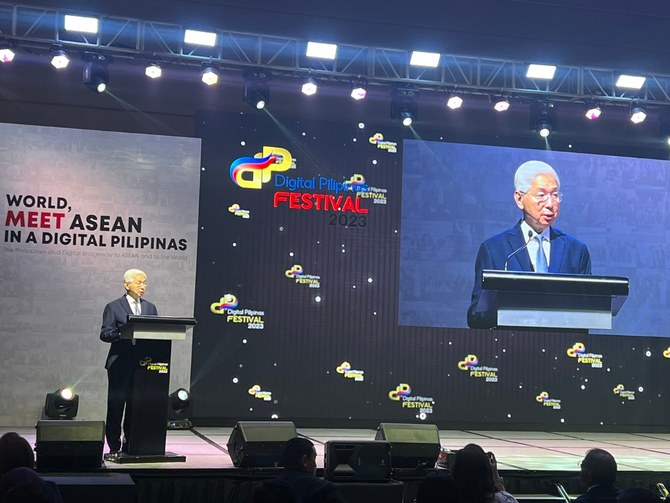
Department of Trade and Industry Secretary Alfredo E. Pascual speaks at the Philippine Halal Economy Festival in Manila on Nov. 22, 2023. (DTI)
Short Url
Updated 22 November 2023
Follow

Manila invites global Muslim investors to establish halal businesses in Philippines

  • Government wants to reach $4bn in trade, investment over next 5 years
  • New regulations, amended laws seek to facilitate foreign companies

MANILA: The Philippines is inviting global Muslim investors to establish halal businesses in the country, the Department of Trade and Industry said on Wednesday at the Philippine Halal Economy Festival in Manila.

The predominantly Catholic Philippines is aiming to position itself as an Asia-Pacific hub of the halal industry, seeking to tap into a global halal market estimated to be worth more than $7 trillion.

As Manila seeks to reach $4 billion in halal trade and investments over the next five years, Philippine lawmakers have also passed new regulations and amended older laws to facilitate foreign companies doing business in the country.

“These laws give more incentives to Muslim investors from around the world. We invite them to establish and operate their halal enterprises right here in the Philippines,” DTI Secretary Alfredo E. Pascual said on Wednesday.

One of those laws is the amended Foreign Investment Act, which allows qualified non-Philippine nationals to do business in the country or invest in a domestic company, Pascual added.

The Philippine congress also amended the Retail Trade Liberalization Act, which lowered the ceiling for capital required from foreign-led retailers to set up shop in the Philippines, allowing smaller foreign businesses to open in the country.

“These ventures can cater to our vibrant domestic market or the burgeoning community of local halal consumers, which holds immense promise and potential,” he said, adding that the government was also seeking to create 120,000 new jobs in the halal sector.

The Philippines is home to around 7 million Muslims, most of whom live on the island of Mindanao and the Sulu archipelago in the country’s south, and in the central-western province of Palawan.

Pascual was speaking at the Philippine Halal Economy Festival, part of the Invest Philippine Week that brings together domestic and international investors to engage with Filipino businesses and officials.

“At the end of this series of investment promotion activities, we hope to create new business partnerships and investments. We want to signal that new Philippines is open for business,” he said.


What is Trump’s ‘Board of Peace’?

Updated 6 sec ago
Follow

What is Trump’s ‘Board of Peace’?

  • The Board of Peace’s charter does not appear to limit its role to the occupied Palestinian territory of Gaza
  • Trump will be chairman but also “separately serve as inaugural representative of the United States of America”

BRUSSELS: US President Donald Trump’s government has asked countries to pay $1 billion for a permanent spot on his “Board of Peace” aimed at resolving conflicts, according to its charter seen by AFP.
The board was originally conceived to oversee the rebuilding of war-torn Gaza, but the charter does not appear to limit its role to the occupied Palestinian territory.
What exactly will it do? And who has been invited?

- To what end? -

The Board of Peace will be chaired by Trump, according to its founding charter.
It is “an international organization that seeks to promote stability, restore dependable and lawful governance, and secure enduring peace in areas affected or threatened by conflict,” reads the preamble of the charter sent to countries invited to participate.
It will “undertake such peace-building functions in accordance with international law,” it adds.

- Who’s boss? -

Trump will be chairman but also “separately serve as inaugural representative of the United States of America.”
“The Chairman shall have exclusive authority to create, modify, or dissolve subsidiary entities as necessary or appropriate to fulfill the Board of Peace’s mission,” the document states.
He will pick members of an Executive Board to be “leaders of global stature” to “serve two-year terms, subject to removal by the Chairman.”
He may also, “acting on behalf of the Board of Peace,” “adopt resolutions or other directives.”
The chairman can be replaced only in case of “voluntary resignation or as a result of incapacity.”

- Who can be a member? -

Member states have to be invited by the US president, and will be represented by their head of state or government.
Each member “shall serve a term of no more than three years,” the charter says.
But “the three-year membership term shall not apply to Member States that contribute more than USD $1,000,000,000 in cash funds to the Board of Peace within the first year of the Charter’s entry into force,” it adds.
The board will “convene voting meetings at least annually,” and “each member State shall have one vote.”
But while all decisions require “a majority of Member States present and voting,” they will also be “subject to the approval of the Chairman, who may also cast a vote in his capacity as Chairman in the event of a tie.”

- Who’s already in? -

The White House has said its members will include:
US President Donald Trump, chair
US Secretary of State Marco Rubio
Steve Witkoff, Trump’s special negotiator
Jared Kushner, Trump’s son-in-law
Tony Blair, former UK prime minister
Marc Rowan, billionaire US financier
Ajay Banga, World Bank president
Robert Gabriel, loyal Trump aide on the National Security Council

- Who’s been invited? -

The list of countries and leaders who say they have been invited include, but are not limited to:
Russia’s President Vladimir Putin
Canada’s Prime Minister Mark Carney
Egypt’s President Abdel Fattah El-Sisi
Argentina’s President Javier Milei
Jordan
Brazil
Paraguay
India
Pakistan
Germany
France
Italy
Hungary
Romania
Uzbekistan
Belarus
Greece
Morocco
Slovenia
Poland

- When does it start? -

The charter says it enters into force “upon expression of consent to be bound by three States.”