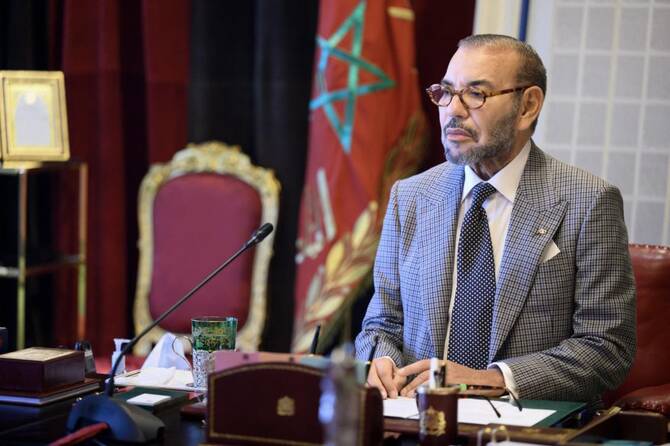
RABAT: Morocco’s King Mohammed VI has accepted US President Donald Trump’s invitation to join his “Board of Peace” as a founding member, the Moroccan foreign ministry said on Monday.
“Welcoming President Donald Trump’s commitment and vision to promoting peace,” the monarch “has graciously accepted this invitation,” the ministry said in a statement published by MAP news agency, adding the country would “ratify the charter establishing this board.”
The US-led initiative aims to “contribute to peace efforts in the Middle East and adopt a new approach to resolving conflicts around the world,” it said.
The board was originally conceived to oversee the rebuilding of Gaza, but its charter does not appear to limit its role to the Palestinian territory.
The board’s charter, seen by AFP, says that member countries — represented on the board by their head of state or government — would be allowed to join for three years or longer if they paid more than $1 billion within the first year.
The White House has asked various world leaders to sit on the board, chaired by Trump himself, including Russian President Vladimir Putin, Hungarian premier Viktor Orban and Canadian Prime Minister Mark Carney.
The initial reaction from two key allies, France and Canada, was lukewarm.
Others who have received invitations to join the new board, such as Putin, have not yet announced whether they will accept.


Morocco’s king accepts invitation to join Trump ‘peace board’: statement
https://arab.news/2qkkb
Morocco’s king accepts invitation to join Trump ‘peace board’: statement

- The board was originally conceived to oversee the rebuilding of Gaza, but its charter does not appear to limit its role to the Palestinian territory


Iraqi lawmakers to elect president Tuesday, PM appointment next
- Parliamentary speaker Haibat Al-Halbussi announced on Sunday that the new parliament will convene on Tuesday to elect a president
BAGHDAD: Iraq’s parliament will meet on Tuesday to elect the country’s new president, who will then appoint a prime minister expected to be Nouri Al-Maliki after he was endorsed by the largest Shiite bloc.
By convention, a Shiite Muslim holds the post of prime minister, the parliament speaker is Sunni and the largely ceremonial presidency goes to a Kurd.
Parliamentary speaker Haibat Al-Halbussi announced on Sunday that the new parliament will convene on Tuesday to elect a president, according to the official INA press agency.
The president will then have 15 days to appoint a prime minister, who is usually nominated by the largest Shiite bloc formed through post-election alliances.
On Saturday, the Coordination Framework alliance — whose Shiiite factions have varying links to Iran — endorsed former prime minister and powerbroker Al-Maliki as the country’s next premier.
The alliance, to which Al-Maliki belongs, spoke of his “political and administrative experience and his record in running the state.”
Kurdish parties have yet to agree on a presidential candidate, who must be endorsed by other blocs and win a two-thirds majority in parliament.
The presidency is usually held by the Patriotic Union of Kurdistan (PUK). This year, the rival Kurdistan Democratic Party (KDP) named its own candidate: Foreign Minister Fuad Hussein.
Although Maliki’s endorsement effectively guarantees him the post, forming a new government remains a daunting challenge that could drag on for months and still fail.
The designated premier has one month to form a government and present it to parliament for a vote of confidence.
The 75-year-old Maliki, a shrewd politician, is set to return to power at a time of seismic changes in the Middle East, as Tehran’s regional influence wanes and tensions with Washington rise.
Government formation in Iraq must balance internal political dynamics and power-sharing among major parties, all under the continued influence of Iraq’s two main allies: Iran and the United States.
A close Iran ally, Al-Maliki will be expected to address Washington’s longstanding demand that Baghdad dismantle Tehran-backed factions, many of which are designated terrorist groups by the US.
Last month, Iraqi officials and diplomats told AFP that Washington demanded the eventual government exclude Iran-backed armed groups, even though most of them hold seats in parliament, and have seen their political and financial clout increase.
But Iraq is struggling with weak economic growth and cannot risk punitive measures by the US, which has already sanctioned several Iraqi entities, accusing them of helping Tehran evade sanctions.


