Pakistan signs letter of intent with Saudi Arabia’s Al Bawani to unlock jobs for its nationals

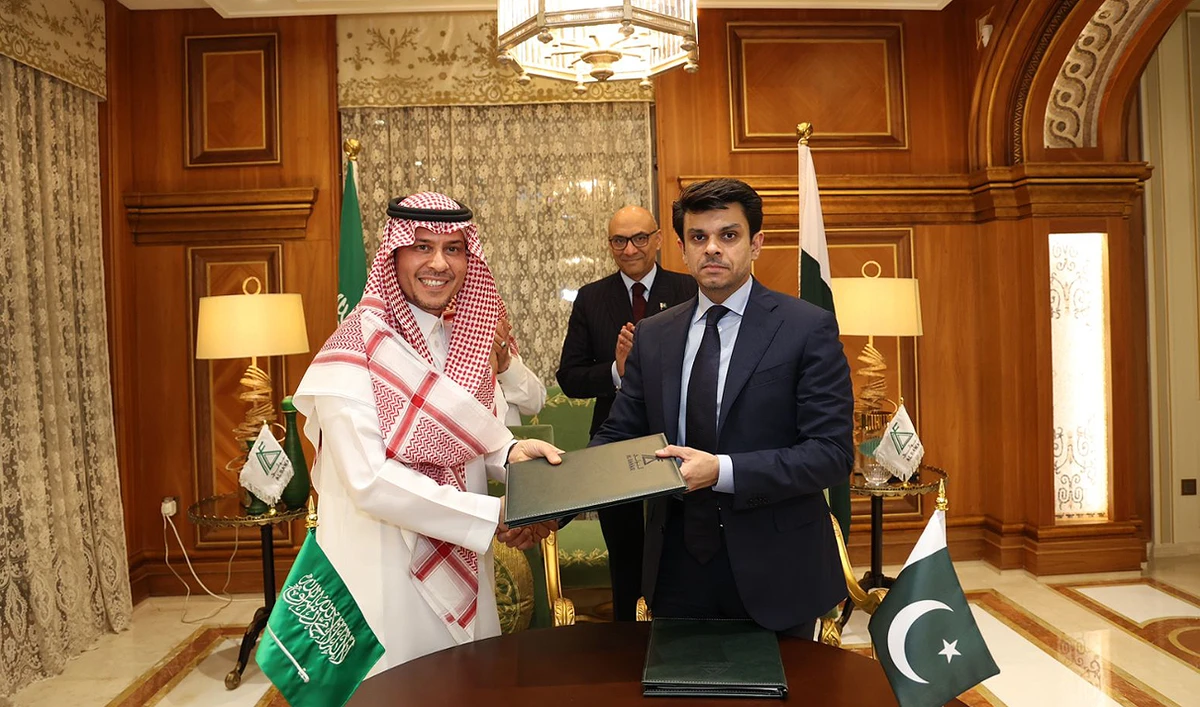
Special Assistant to the Prime Minister on Overseas Pakistanis and Human Resource Development, Jawad Sohrab Malik (right), with Engr. Fakher Al-Shawaf, Chairman of Saudi Arabia's Al Bawani Holdings, after signing letter of intent to unlock jobs for Pakistani nationals in Riyadh on November 22, 2023. (Photo courtesy: PID)
Short Url
Updated 22 November 2023
Follow

Pakistan signs letter of intent with Saudi Arabia’s Al Bawani to unlock jobs for its nationals

  • Al Bawani Holdings, a diversified Saudi conglomerate, is among top five general contracting entities in Saudi construction sector
  • Al Bawani Holdings chairman says company will establish a state of the art human resource training center in Pakistan

ISLAMABAD: Special Assistant to the Prime Minister (SAPM) on Overseas Pakistanis and Human Resource Development, Jawad Sohrab Malik, on Wednesday signed a letter of intent (LOI) with the Saudi-based global conglomerate, Al Bawani Holdings, to unlock jobs for Pakistani expats.
Malik is on a visit to Saudi Arabia to enhance cooperation on jobs and human resources. On Wednesday, the SAPM visited the headquarters of Al Bawani holdings in Riyadh where he met the company’s CEO and chairman, Engr. Fakher Al-Shawaf. 
Al Bawani Holdings, a diversified Saudi conglomerate, is among the top five general contracting entities in the Saudi construction sector.
The Kingdom is home to the largest number of Pakistani expats, over two million, and is the biggest contributor to remittance inflows to the South Asian nation.
“Expressing confidence in the capabilities of Pakistani workers, Malik conveyed to the company Chairman that Pakistani workforce is well-trained and possess the necessary skills and knowledge, making them exceptionally suitable for construction work in KSA,” the Ministry for Overseas Pakistanis said in a statement after the meeting.
“This acknowledgment of Pakistani workforce competence led to a significant development — the signing of a Letter of Intent (LOI) between the Overseas Employment Corporation (OEC) and Al Bawani.”
This LOI establishes a legal framework to “foster cooperation and coordination for mutual benefits, promising to unlock numerous job opportunities for Pakistani professionals and workers in the near future,” the ministry added.
Al Bawani Holdings also said it would establish a state of the art human resource training center in Pakistan, “to further train and equip Pakistani workforce with skills required as per international standards.”
On Tuesday, Malik met with the Saudi Minister for Human Resources and Social Development, Dr. Abdullah Nasser Abu Thnain, and Deputy Minister for Human Resources and Social Development, HE Adnan Abdullah Al-Nuaim, in Riyadh. During the meeting he invited Takamol, a Saudi initiative to develop human capital, to open more testing and training centers in Pakistan, and offered full cooperation to Takamol to work as an independent training and certification company in Pakistan.
“Further, [Saudi] TVTC (Technical and Vocational Training Corporation) can also collaborate for training initiatives in Pakistan,” the SAPM was quoted as saying in a statement on Tuesday.
“[Pakistan’s] NAVTEC (National Vocational and Technical Training Commission) and TVTC shall sign MOU very soon.”
The meeting came days after the Pakistan Overseas Employment Corporation (POEC) and NESMA & Partners, a leading contracting company in Saudi Arabia, signed an agreement to export manpower to the Kingdom.
The “landmark” agreement between the POEC and NESMA & Partners will allow the export of skilled Pakistani labor to Saudi Arabia, specifically for ongoing and upcoming projects of NESMA, which specializes in construction.


Pakistan, UK launch £10 million higher education partnership

Updated 5 sec ago
Follow

Pakistan, UK launch £10 million higher education partnership

  • Pak-UK Education Gateway second phase expands climate research, scholarships, university exchanges
  • First phase was launched in 2018 and delivered 165 partnerships, 2,000 joint studies and £5 million in grants

ISLAMABAD: Pakistan’s Higher Education Commission (HEC) and the British Council have launched the £10 million second phase of the Pak-UK Education Gateway, the HEC said on Monday, a joint initiative aimed at deepening collaboration between universities in both countries on research, mobility and higher-education reform.

The program, funded equally by the HEC and the British Council, builds on a partnership launched in 2018 and seeks to strengthen institutional ties between Pakistani and British universities, focusing on shared challenges including climate change, skills development and economic growth.

Education cooperation has become an increasingly important pillar of broader Pakistan-UK relations, as both countries look to expand academic mobility, research collaboration and international recognition of qualifications at a time when higher-education systems face pressure to respond to climate risks, labor-market shifts and funding constraints.

“This £10 million partnership is set to deepen collaboration between UK and Pakistani universities on critical issues like Climate Change and Mobility. A true system-to-system commitment,” the HEC said in an X post. 

According to the British Council and HEC, the first phase of the Pak-UK Education Gateway supported 165 institutional partnerships, generated around 2,000 joint research papers and awarded £5 million in research grants. Officials say the second phase aims to build on that foundation as part of a longer-term effort to internationalize Pakistan’s higher-education sector.

“Education is the building block of growth and prosperity. Our work on education in Pakistan supports people throughout their lives: from helping reform education policy at the school level, to our strong partnership in higher education,” British High Commissioner Jane Marriott said in a statement.

“This next phase builds on our already strong relationship, and will unlock opportunities to help both our higher education sectors thrive.”

Opportunities under the second phase include increased funding for scholarships, joint research grants and faculty exchanges, alongside a Start-Up Challenge Fund to support Pakistan-UK university collaborations pursuing commercial opportunities and access to new markets.

The program will also focus on leadership and governance reforms within Pakistan’s higher-education system, including quality assurance, improved campus accessibility for people with disabilities, and greater participation of women in senior leadership roles. It further aims to expand opportunities for Pakistani students to study UK-accredited courses without leaving their home cities, alongside a commitment to mutual recognition of qualifications.

Pakistan’s Minister for Federal Education and Professional Training Khalid Maqbool Siddiqui said the initiative had already delivered concrete results since its launch in 2018, calling education “the bridge that connects people, cultures, and futures.”

Acting HEC Chairperson Nadeem Mahbub described the Gateway as a system-to-system partnership rather than a stand-alone program, noting that it had benefited institutions and students in both countries.