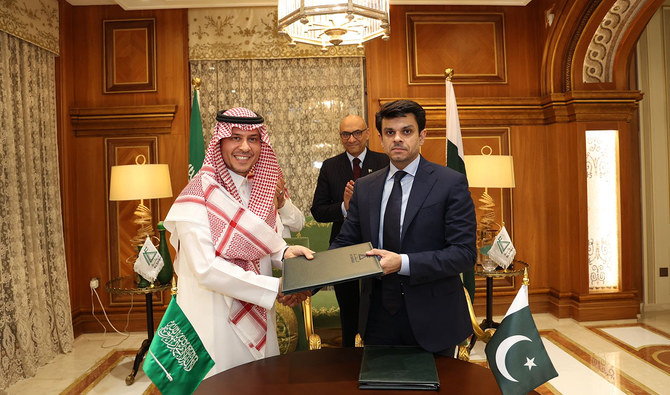
ISLAMABAD: Special Assistant to the Prime Minister (SAPM) on Overseas Pakistanis and Human Resource Development, Jawad Sohrab Malik, on Wednesday signed a letter of intent (LOI) with the Saudi-based global conglomerate, Al Bawani Holdings, to unlock jobs for Pakistani expats.
Malik is on a visit to Saudi Arabia to enhance cooperation on jobs and human resources. On Wednesday, the SAPM visited the headquarters of Al Bawani holdings in Riyadh where he met the company’s CEO and chairman, Engr. Fakher Al-Shawaf.
Al Bawani Holdings, a diversified Saudi conglomerate, is among the top five general contracting entities in the Saudi construction sector.
The Kingdom is home to the largest number of Pakistani expats, over two million, and is the biggest contributor to remittance inflows to the South Asian nation.
“Expressing confidence in the capabilities of Pakistani workers, Malik conveyed to the company Chairman that Pakistani workforce is well-trained and possess the necessary skills and knowledge, making them exceptionally suitable for construction work in KSA,” the Ministry for Overseas Pakistanis said in a statement after the meeting.
“This acknowledgment of Pakistani workforce competence led to a significant development — the signing of a Letter of Intent (LOI) between the Overseas Employment Corporation (OEC) and Al Bawani.”
This LOI establishes a legal framework to “foster cooperation and coordination for mutual benefits, promising to unlock numerous job opportunities for Pakistani professionals and workers in the near future,” the ministry added.
Al Bawani Holdings also said it would establish a state of the art human resource training center in Pakistan, “to further train and equip Pakistani workforce with skills required as per international standards.”
On Tuesday, Malik met with the Saudi Minister for Human Resources and Social Development, Dr. Abdullah Nasser Abu Thnain, and Deputy Minister for Human Resources and Social Development, HE Adnan Abdullah Al-Nuaim, in Riyadh. During the meeting he invited Takamol, a Saudi initiative to develop human capital, to open more testing and training centers in Pakistan, and offered full cooperation to Takamol to work as an independent training and certification company in Pakistan.
“Further, [Saudi] TVTC (Technical and Vocational Training Corporation) can also collaborate for training initiatives in Pakistan,” the SAPM was quoted as saying in a statement on Tuesday.
“[Pakistan’s] NAVTEC (National Vocational and Technical Training Commission) and TVTC shall sign MOU very soon.”
The meeting came days after the Pakistan Overseas Employment Corporation (POEC) and NESMA & Partners, a leading contracting company in Saudi Arabia, signed an agreement to export manpower to the Kingdom.
The “landmark” agreement between the POEC and NESMA & Partners will allow the export of skilled Pakistani labor to Saudi Arabia, specifically for ongoing and upcoming projects of NESMA, which specializes in construction.


Pakistan signs letter of intent with Saudi Arabia’s Al Bawani to unlock jobs for its nationals
https://arab.news/vdr4y
Pakistan signs letter of intent with Saudi Arabia’s Al Bawani to unlock jobs for its nationals

- Al Bawani Holdings, a diversified Saudi conglomerate, is among top five general contracting entities in Saudi construction sector
- Al Bawani Holdings chairman says company will establish a state of the art human resource training center in Pakistan

Pakistani student launches ‘Urdu ChatGPT’ AI model
- Developer says “Qalb” is largest large language model built exclusively for Urdu
- Project highlights push to localize artificial intelligence for non-English users
ISLAMABAD: A Pakistani student studying in the United States has launched an artificial intelligence model designed exclusively for the Urdu language, a development its creator says could help bridge longstanding gaps in access to advanced digital tools for millions of speakers worldwide.
The project, called Qalb, is positioned as an Urdu-first large language model at a time when most generative AI systems are primarily trained on English and other widely used global languages. Supporters of language-specific models argue they can improve accuracy, cultural relevance and accessibility for users in education, business and public services.
Urdu is spoken by more than 230 million people globally, including in Pakistan, India and diaspora communities, but remains under-represented in advanced AI systems. Efforts to localize artificial intelligence have increasingly been seen as critical for widening participation in digital economies, particularly in developing countries.
“Qalb is now recognized as the world’s largest Large Language Model created exclusively for the Urdu language,” Taimoor Hassan, the project’s developer, was quoted this month in a report in state-run news agency APP.
“Trained on a massive dataset of 1.97 billion tokens and benchmarked across seven-plus international evaluation frameworks, Qalb outperforms existing Urdu-focused AI models on key real-world performance indicators, setting a new standard for natural language processing in Pakistan,” Hassan said.
“This is a development model and in the next phase we would soon launch App for mobile and web so that people could use and benefit from Qalb ChatGPT.”
Hassan completed his undergraduate degree in computer science at FAAST University’s Peshawar campus and is currently studying for a master’s degree in computer science and software engineering at Auburn University in the United States. According to APP, he is a serial entrepreneur who has previously launched and exited multiple startups and has represented Pakistan at international technology forums.
“I had the opportunity to contribute in a small way to a much bigger mission for the country,” Hassan said.
“Together with my undergraduate roommates and teammates, Jawad Ahmed and Muhammad Awais, we are committed to continuously fine-tuning localized models for niche industries, which we believe can become a major breakthrough for Pakistan.”
Both collaborators are also graduates of FAAST University Peshawar Campus and are currently studying in Germany, APP reported.
The team behind Qalb said the model is intended to support local businesses, startups, educational platforms and voice-based digital services, arguing that meaningful innovation is no longer limited to large technology firms.
“Technology is no longer locked behind big budgets or big teams. With the right mindset, even a small group can build products that educate, automate, and serve millions,” Hassan told APP.