

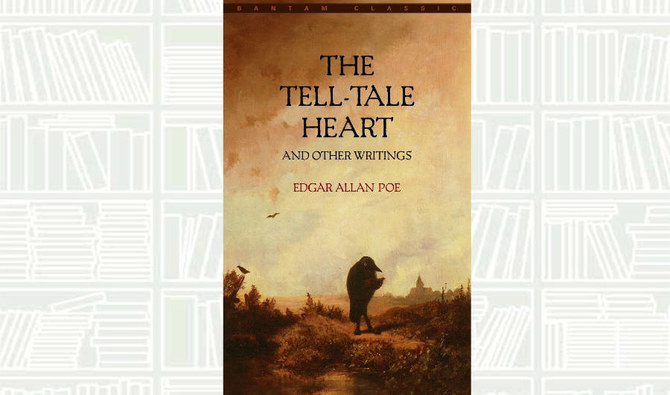
What We Are Reading Today: ‘The Tell-Tale Heart’

Photo/Supplied
Short Url
Updated 22 November 2023
Follow

What We Are Reading Today: ‘The Tell-Tale Heart’

  • The narrator is unreliable and tries to convince the reader of his sanity while simultaneously revealing his increasing madness through his actions and erratic behavior

Author: Edgar Allan Poe

“The Tell-Tale Heart” is a famous short story by Edgar Allan Poe, the American writer known for his macabre and gothic storytelling.

It was first published in 1843 and is one of Poe’s best-known and most widely-studied works.

The short story is narrated by an unnamed character driven to madness by his obsession with an old man’s “vulture eye.” The eye is repeatedly also described as “pale blue,” emphasizing its unsettling nature.

After he commits a heinous act of murder against the old man, the narrator becomes tormented by guilt and becomes haunted by the sound of the old man’s beating heart.

His increasing fixation on the sound symbolizes his guilt and is a manifestation of his disturbed state of mind. The sound grows louder and more intense as the story progresses, heightening the suspense.

The narrator is unreliable and tries to convince the reader of his sanity while simultaneously revealing his increasing madness through his actions and erratic behavior.

The story explores themes of guilt, madness, and the psychological effects of crime. It showcases Poe’s mastery at creating a suspenseful and chilling atmosphere and his ability to delve into the inner workings of the human mind.

“The Tell-Tale Heart” is considered a prime example of gothic fiction, characterized by its exploration of the dark and mysterious aspects of the human psyche. It showcases Poe's signature style with its vivid descriptions, immersive atmosphere, and exploration of psychological torment.

Poe’s other stories that remain famous to this day include “The Masque of the Red Death,” “The Pit and The Pendulum,” “The Cask of Amontillado,” and “The Raven.”


What We Are Reading Today: ‘Ghost Music’

Photo/Supplied
Updated 1 min 15 sec ago
Follow

What We Are Reading Today: ‘Ghost Music’

  • Written with spare yet evocative prose, “Ghost Music” carries themes of grief, identity crisis, the expectations one has for oneself, as well as familial expectations and bonds, loneliness and isolation

Author: An Yu

Reading “Ghost Music” by An Yu was like being in a fever dream because of the introspective and dreamlike telling of the story.

We follow Song Yan, a gifted pianist living in Beijing who abandoned her concert career to become a wife. Her days are shaped by absence as her husband becomes increasingly distant, often away for work, and unmoved by her desire to have a child.

What might have been a stable life reveals itself as something far more precarious, built on compromises that now feel irreversible to her.

Song moves through her marriage and her city with a growing sense of dislocation, aware that whatever choices she makes next will leave a permanent mark.

The story takes a turn into the surreal when she begins to dream repeatedly of a doorless room inhabited by a talking mushroom. These dreams are never fully explained, and that might be the point.

Like much of the book, they function as emotional shorthand, giving form to feelings of entrapment, grief and unspoken longing. The mushroom lingers over the story like a reminder of what has been suppressed rather than resolved.

At one point, in a line that crystallizes the novels emotional core, she reflects that “loss came in all shapes and forms, but it never occurred to me until now that you could lose the things you never had.”

Written with spare yet evocative prose, “Ghost Music” carries themes of grief, identity crisis, the expectations one has for oneself, as well as familial expectations and bonds, loneliness and isolation.

Readers familiar with Yu’s earlier novel, “Braised Pork,” will recognize her fascination with complex women whose inner creative lives exist in tension with social and familial demands. In “Ghost Music,” that tension is rendered with clarity and eerie gloom.

I would love to read the novel again, especially because the writing was beautiful and I often found myself taking pause to study the author’s creative techniques.