


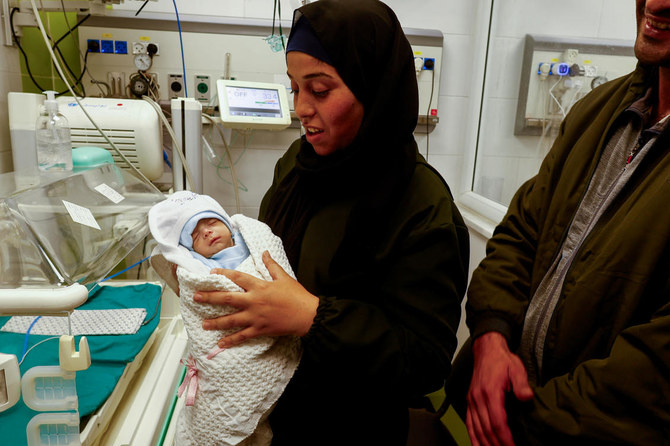


RAFAH, Gaza Strip: At first, the young mother couldn’t find her newborn son, Anas, among the 31 tiny babies who had just arrived in southern Gaza after being evacuated from Gaza City’s devastated Al Shifa Hospital. She hadn’t seen him for 45 days.
“I was losing hope to see my baby alive,” said Warda Sbeta in an interview with Reuters TV on Tuesday.
She and her husband frantically checked the list of names provided by the head of the neonatal unit where the babies were being cared for, at a hospital in Rafah, and there it was, Anas’s name in black and white.
“I felt alive again, grateful to God that we now have our baby safely in our care,” said Sbeta, speaking at the hospital as she watched over her sleeping son, whom she had dressed in a light blue sleepsuit and matching hat.
Sbeta smiled as she held him in her hands and her husband helped her to wrap him in a white swaddling blanket with pink ribbons and a hood. Once he was bundled up, she cradled him against her chest.
Sbeta, 32, has seven older children and the family, whose home was in Gaza City before the war, are now living in a school in Khan Younis, southern Gaza, that has become a shelter for hundreds of people displaced from the north of the strip.
Sbeta was offered the option of being evacuated to Egypt with Anas so he could receive further medical care, but she did not want to leave her husband and her other children.
“I can’t leave them with only their father. He won’t be able to look after them. So I was obliged to refuse this offer,” she said.
Anas was one of only three out of the 31 premature babies rescued from Al Shifa who stayed behind in Gaza. Of the other two, one was unidentified, according to doctors at the Rafah hospital. They did not give information about the third baby.
When doctors at Al Shifa first raised the alarm nine days ago about the premature babies in their care, 39 of the infants were alive, but eight died because of the dire conditions before the evacuation to Rafah and Egypt could be organized.
A World Health Organization official said on Tuesday that two of the eight had died the night before the evacuation.
’IS HE ALIVE?’
Out of the 31 who were transported to Rafah on Sunday, 28 were evacuated to Egypt on Monday. UNICEF spokesman James Elder said on Tuesday that 20 of them were unaccompanied and eight were with their mothers. There were seven mothers as two of the infants were twins.
Elder said some of the 20 unaccompanied babies were orphans, while for others there was no information about their families. “It all underlines the horrific situation for families in Gaza,” he said.
For Anas, the safety of Egypt was out of reach, but the separation from his family was over.
Sbeta said that Anas was being treated at Al Shifa when war broke out on Oct. 7, the day when Hamas militants rampaged through southern Israel, killing 1,200 Israelis and kidnapping 240, according to Israeli figures.
Israel responded with a military assault on Gaza that has killed some 13,000 Palestinians, according to health officials in the Hamas-controlled enclave, and has made three quarters of the population homeless, according to UN data.
Like hundreds of thousands of others in the northern Gaza Strip, Sbeta and the rest of the family fled their home for southern Gaza, while Anas stayed behind at Al Shifa as the hospital gradually ran out of power, water, food and medicines.
“They called us from Al Shifa to come and take the baby but it was hard for us to return. The route out of Gaza City was open, but the way back was closed,” she said.
The anguish of separation worsened when Israeli forces last week entered Al Shifa, which Israel says has been used by Hamas as a base for its operations — an assertion denied by Hamas — and the family lost communication with the hospital.
“We completely lost any news about the baby. We were not able to know anything about him. Is he alive? Is he dead? Is someone giving him milk?” said Sbeta.
With communications patchy at the shelter in Khan Younis, the parents were struggling to get any solid information, until other displaced people living in the school told them they had heard the babies were being moved south.
The parents rushed to Nasser Hospital in Khan Younis, but were told they had to go to the maternity hospital in Rafah, where they were finally reunited with Anas.
On Tuesday, he was well enough to leave the hospital. His parents were taking him to the school in Khan Younis, their wartime refuge, to start a new life with his seven brothers and sisters.


