

Red Cross president meets with Hamas chief on Gaza war humanitarian issues

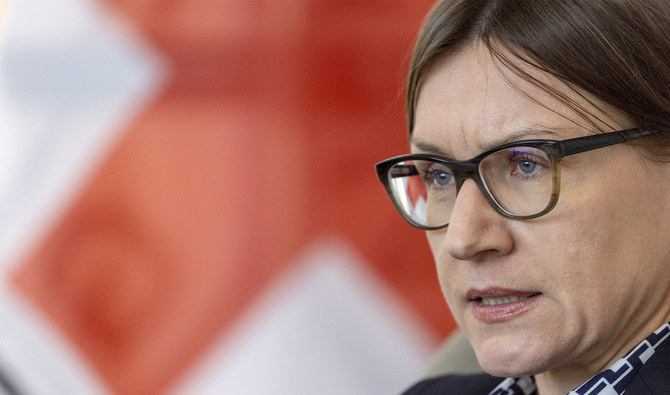
International Committee of the Red Cross (ICRC) President Mirjana Spoljaric Egger attends a briefing in Geneva, Switzerland, on December 14, 2022. (REUTERS/File)
Short Url
Updated 21 November 2023
Follow

Red Cross president meets with Hamas chief on Gaza war humanitarian issues

  • The announcement comes amid efforts to get 240 hostages released from Hamas custody
  • ICRC says it has been calling for the alleviation of humanitarian situation in the Gaza strip

GENEVA: The Red Cross said Monday that its president had traveled to Qatar to meet with Hamas chief Ismail Haniyeh “to advance humanitarian issues related to the armed conflict in Israel and Gaza.”

“President Mirjana Spoljaric met with (Ismail) Haniyeh, Chair of Hamas’ Political Bureau, and separately with authorities of the state of Qatar,” the International Committee of the Red Cross said in a statement.

The announcement came as negotiators worked to seal a deal for the release of some of the 240 hostages the Islamist militants took during their unprecedented October 7 attacks on Israel.

Israeli authorities say the attack left around 1,200 people dead, mainly civilians.

Israel’s withering air and ground campaign have meanwhile killed more than 13,300 people in Gaza, also mainly civilians and including thousands of children, according to Hamas authorities.

The ICRC stressed that Spoljaric’s visit was part of efforts to hold “direct discussions with all sides to improve respect for international humanitarian law.”

It pointed out that she has also met “multiple times in recent weeks with families of hostages held in Gaza, as well as senior Israeli and Palestinian leaders.”

The Geneva-based organization stressed that it was continuing “to appeal for the urgent protection of all victims in the conflict, and for the alleviation of the catastrophic humanitarian situation in the Gaza strip.”

“ICRC staff in Gaza have been delivering life-saving assistance, and an ICRC surgical team continues to perform operations,” it said, adding that it was “calling for sustained, safe humanitarian access so it can increase its work.”

The organization stressed that it had “persistently called for the immediate release of hostages.”

“The ICRC is insisting that our teams be allowed to visit the hostages to check on their welfare and deliver medications, and for the hostages to be able to communicate with their families,” it said.

“Agreements must be reached that allow the ICRC to safely carry out this work. The ICRC cannot force its way in to where hostages are held, nor do we know their location,” it added.

The ICRC, which has already helped facilitate the release of four hostages on two separate occasions, emphasised that it “does not take part in negotiations leading to the release of hostages.”

But it added that “as a neutral humanitarian intermediary, we remain ready to facilitate any future release that the parties to the conflict agree to.”


Security, economic and political partnerships in the spotlight at first Jordan-EU Summit

Updated 11 sec ago
Follow

Security, economic and political partnerships in the spotlight at first Jordan-EU Summit

  • Event reflects international confidence in Jordan as a reliable partner in efforts to address security threats, advance peace initiatives, and expand cooperation, analysts say
  • Timing is significant, expert says, given the region faces overlapping crises and threats that place security and defense cooperation at the heart of Jordanian-European relations

AMMAN: The inaugural Jordan-EU Summit underlined the depth of the country’s strategic partnership with Europe, officials and experts said, and confirmed the pivotal role Jordan plays in regional security, political stability and economic cooperation.

Analysts told the Jordan News Agency that Thursday’s summit took place at a sensitive moment for the region, but reflected international confidence in Jordan as a reliable partner in efforts to address cross-border security threats, advance peace initiatives, and expand cooperation in trade, investment and development.

Bashir Al-Dajeh, an expert in security and strategy, said the timing of the summit was significant, given the region is facing overlapping crises and transnational threats that place security and defense cooperation at the heart of Jordanian-European relations.

Jordan’s strategic location positions it on the front lines of efforts to tackle illegal migration, organized crime, drug and arms smuggling and cross-border terrorism, he added. The country has hosted more than 3.5 million refugees over the past decade without compromising its security infrastructure, he noted.

Jordan’s effective border controls were helping to curb irregular migration to Europe and disrupting the plans of extremist groups and trafficking networks, Al-Dajeh said, which was directly benefiting regional and European security.

Khaled Abu Hassan, a member of the Jordanian parliament, said the country’s foreign policy under King Abdullah had reinforced its influence, in the region and internationally, particularly its firm stance in support of the Palestinian cause and a two-state solution to the conflict with Israel.

He said the summit reaffirmed Jordan’s political influence in the shaping of regional balances and advancement of efforts to achieve a just and comprehensive peace. The timing of the meeting also demonstrated the resilience of the nation in managing multiple regional and domestic challenges.

Abu Hassan also highlighted the economic aspects of the summit, including the announcement of a Jordan-EU economic conference in April, as a sign of the international recognition of Jordan’s political and economic role.

Economist Mufleh Aql said the high-level summit reflected a shared desire for a broadening of cooperation to encompass politics, trade, security and renewable energy, and Jordan was well-placed to benefit from access to the EU’s large markets, technology and investment opportunities.

The country could benefit from increased exports, technology transfers and financing for major infrastructure projects in sectors such as water, transport and energy, he added, and in return offer the EU skilled human capital amid labor shortages in Europe.

EU support for Jordan’s positions on issues such as Jerusalem, regional stability, energy and migration further strengthens the partnership, Aql said. Jordan also already benefits from EU grants, concessional loans and exports of agricultural, pharmaceutical and chemical products to European markets, he noted.