

Pakistan says Makkah Route Initiative to be expanded to Karachi this year

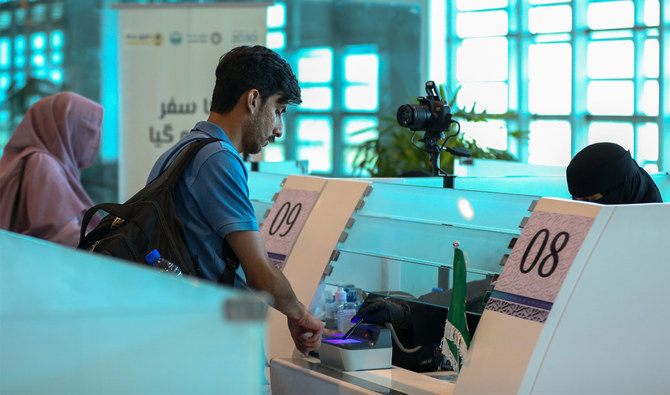
Saudi official facilitates Pakistani Hajj pilgrim during biometrics at the immigration counter at the Islamabad International Airport on May 29, 2023. (Photo courtesy: Twitter/MakkahRoute)
Short Url
Updated 21 November 2023
Follow

Pakistan says Makkah Route Initiative to be expanded to Karachi this year

  • The initiative allows pilgrims to undergo immigration requirements to enter Saudi Arabia at airports in Pakistan
  • Minister Aneeq Ahmed calls it the government’s responsibility to make adequate arrangements for Hajj pilgrimage

ISLAMABAD: Pakistan’s interim religious affairs minister Aneeq Ahmed said on Monday the government wanted to provide maximum facilities to Hajj pilgrims, adding that the Makkah Route Initiative, which was previously confined to Islamabad, would also be extended to the southern Karachi port city in the coming year.

This initiative allows pilgrims performing Hajj under the government scheme the convenience of undergoing all immigration requirements to enter Saudi Arabia from their home countries’ airports.

Ahmed made the announcement while addressing the inaugural ceremony of the bankers’ training for the Hajj portal for next year’s pilgrimage.

The government announced the Hajj Policy 2024 on Thursday and plans to start receiving applications from aspiring pilgrims from Nov. 27 to Dec. 12.

“The Road to Makkah program, a facility offered by the Saudi government to Hujaj [pilgrims], was earlier limited to Islamabad only but this year it will be extended to Karachi airport as well,” the Associated Press of Pakistan (APP) news agency quoted the minister as saying on the occasion.

He also informed the participants that the government aimed to expand the facility to other major airports across Pakistan, further facilitating pilgrims from all regions.

Ahmed stated it was the government’s responsibility to make adequate arrangements for Hajj, adding that its cost had been reduced to PKR 1,075,000 next year from PKR 1,175,000 in 2023.

He informed attendees that the government was negotiating with airlines to reduce airfare. “In the event of a reduction in air ticket prices, the corresponding amount would be transferred into the accounts of Hujaj-e-Karam,” he added.

The government will also introduce a smartphone app for pilgrims that would assist them from the moment they file the Hajj applications until their return to the country. Additionally, Pakistan has managed to secure tent space in the Old Mina area and will provide a commuting facility through a dedicated fleet of buses.

The ministry will provide QR code-marked suitcases along with other Hajj articles, including headscarves adorned with the country’s flag, to be distributed to female pilgrims.


Pakistan’s Mahnoor Omer named among TIME’s ‘Women of the Year’ for 2026

Updated 01 March 2026
Follow

Pakistan’s Mahnoor Omer named among TIME’s ‘Women of the Year’ for 2026

  • Omer moved a Pakistani court against the so-called ‘period tax’ in Sept. 2025 which has since sparked a national debate
  • Taxes on sanitary pads in Pakistan can add up to 40 percent to retail price, UNICEF says only around 12 percent women use such products

ISLAMABAD: Pakistani women’s rights activist Mahnoor Omer, who fought against taxes on menstrual products, has been named among the TIME magazine’s ‘Women of the Year’ for 2026.

Omer’s efforts have been recognized alongside 16 activists, artists, athletes and businesswomen in the TIME’s Women of the Year 2026 list, including Olympic gold medalist Sydney McLaughlin-Levrone and Oscar-nominated filmmaker Chloe Zhao.

Dissatisfied with the efforts to educate Pakistani girls about sexual violence, Omer founded the Noor Foundation at the age of 14 and held her own workshops with village girls about everything from climate change to menstruation, according to the TIME magazine.

Two years later, a conversation with a domestic worker about the price of pads made her realize that not everyone could afford these essentials. She moved a court against the so-called “period tax” in Sept. 2025 and the case has sparked a national debate on the subject, considered a taboo by many in Pakistan, since its first hearing late last year.

“A decade and one law degree after her interest in activism was sparked, Omer, now 25, is putting her passion and expertise to work in the name of gender equity,” TIME wrote about Omer on its website.

Taxes imposed on sanitary products in Pakistan can add up to 40 percent to the retail price. UNICEF estimates just 12 percent of women in the country use commercially produced pads or tampons. The alternative, using cloth, risks health impacts including rashes and infections, and can make it impossible for girls to attend school while menstruating.

Omer’s suit, which awaits the government response, has sparked a national discussion. She says she spoke about menstruation to her father and male cousins, who thanked her for standing up for their daughters.
The 25-year-old, who is currently enrolled in a master’s degree in gender, peace, and security at the London School of Economics, sees this case as just the first of many.

“I’m not free until every woman is free,” she was quoted as saying by TIME. “I want to leave no stones unturned in terms of what I can do with the next few decades, as a lawyer for the women in my country and gender minorities in general.”