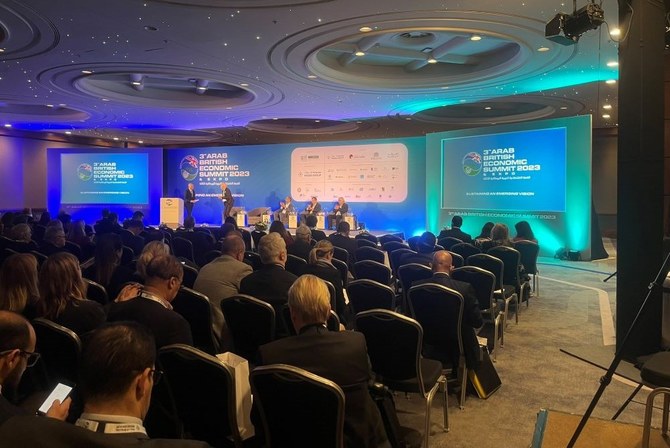

LONDON: A special “innovation chapter” will need to be part of a UK-Gulf Cooperation Council trade deal to ensure artificial intelligence developments do not throw up barriers to commerce, Britain’s chief negotiator at the Department of Business and Trade said on Monday.
Speaking at the Arab-British Economic Summit in London — organized by the Arab-British Chamber of Commerce, with Arab News as a media partner — Tom Wintle said the pace of change in the technology sector is something his team is worried about “quite a lot” as it comes to thrashing out a deal with his GCC equivalents.
He told an audience of government officials, senior executives, thought leaders and decision-makers that the fifth round of talks on a free trade agreement were recently concluded in Riyadh, but he was unable to set out a clear timeframe for when a deal would be reached.
Wintle assured the audience that both sides are working “flat out” to secure an agreement to boost the already £61 billion ($76.05 billion) in trade between the UK and GCC.
Reflecting on the impact of the growth of the global AI sector on the talks, he said: “How we try and capture innovation has been one of the UK’s key considerations.”
Wintle explained that recent FTAs involving the UK often featured an innovation chapter, something he wants replicated in the GCC agreement.
“Our hope would be, and what we’d wish to do with our GCC colleagues, is … for something like AI we may have a commitment to regulators meeting often, exploring, exchanging, so as these regulations that we can’t know now what they’ll look like in five, 10 years hence, you have the experts talking, learning from each other, sharing best practice, so as new regulations come in they’re ideally designed in such a way of enhancing trade rather than potentially throwing up future barriers,” he said.
Reflecting on the negotiations, which began in August 2022, Wintle said he is mindful that e-commerce must play a key role in any agreement.
“What we’ve heard a lot from businesses, and what we’re looking to achieve, is to lock in legal certainty on electronic transactions so businesses can make greater use of things like e-contracts, e-signatures, paperless trading, which our data and analysis shows can cut costs by up to 87 percent, which is crucial particularly for SMEs (small and medium enterprises),” he said.
Wintle flagged greater cooperation in digital identities, online identification and electronic invoicing as areas that will benefit trade between the GCC and the UK.
Speaking about the progress of the talks, he echoed previous statements by the British government that it is “about the deal, not the date,” adding: “Certainly I can vouch that both sides are working flat out, but it’s about getting the right agreement.
“It’s reaching that modern, progressive and ambitious agreement that really delivers for businesses.”
The event, held under the theme “Sustaining an Emerging Vision,” saw sessions on a range of topics, including water, food and health provisions, and the evolution of banking, finance and insurance.
At the opening session, business figures and government officials hailed expanding economic ties between the Arab world and the UK, but warned that the looming threat of an escalation in the Gaza conflict threatens to undermine years of economic progress.
In his opening remarks, Sameer Abdulla Nass, president of the Union of Arab Chambers, warned that “prosperity can’t exist without stability.”
He called on businesspeople, both British and Arab, to “influence their governments” and push for peace in Gaza.
Hosted by TV anchor Rebecca McLaughlin, the opening session also featured Baroness Symons of Vernham Dean; Bandar Ali Reda, ABCC secretary-general and CEO; and Mohamed Al-Khadar Al-Ahmed, CEO of Khalifa Economic Zones Abu Dhabi.
Also in attendance were Arab League Secretary-General Ahmed Aboul Gheit; Lord Ahmad of Wimbledon, UK minister of state for the Middle East; and Oliver Christian, British trade commissioner for the Middle East and Pakistan at the Department of Business and Trade.
Symons opened her remarks by hailing the myriad opportunities for expanded Arab-UK trade in finance, technology, energy, medicine and agriculture.
She urged both sides to “confront the greatest challenge of our time” — climate change — at the upcoming UN Climate Change Conference in the UAE.
Investments between the Arab world and the UK are “guided by strategies implemented by visionary leaders who are absolutely determined to address the core needs of their citizens,” Symons said.
She added that friendship between the two sides is “absolutely pivotal,” hailing the “dynamism” shown by the Arab world, and lauding the “strategic” role played by Arab embassies and ambassadors in the UK.
Ali Reda said the size and scope of the summit’s third edition demonstrates the strength of relations and history between the Arab world and the UK.
Lord Ahmed, who recently returned from the Manama Dialogue in Bahrain — which gathers national leaders, ministers and policymakers from around the world to discuss the most pressing regional security issues and share policy responses — said: “As we join here this morning, in the spirit of friendship, in the spirit of collaboration, it would be remiss of me, indeed for any of us, not to begin by reflecting on what’s happening right now across Israel, Gaza, and sadly in the West Bank. The intensity of what’s happening is reflected on the level of engagement.”
He added: “In bridging that particular gap, we need to move forward. The suffering (in Gaza) has gone on for far too long. No one, unless you’re directly impacted, can comprehend the pain and suffering.
“It’s important at this time that our conversations are frank and candid, and when we have differing perspectives, (remember) that ultimately, the goal that we all want to see is peace in the Middle East.
“If we don’t address that central, pivotal issue, we won’t see progress and we’ll be back here again.”