

New clashes in Myanmar’s Rakhine state displace 26,000: UN

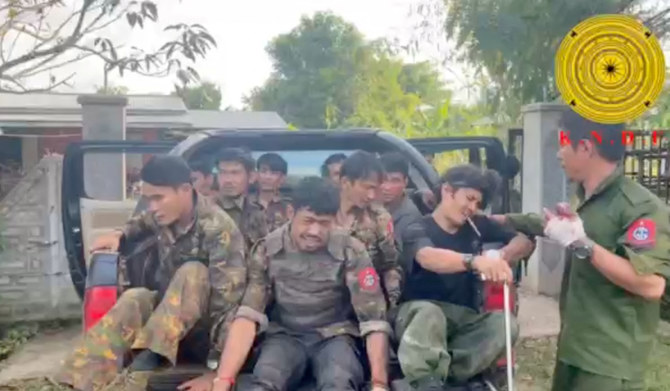
Myanmar military soldiers who have surrendered to the Karenni Nationalities Defense Force ride in the back of a vehicle in Loikaw, Myanmar, in this still image taken from video released November 15, 2023. (REUTERS)
Short Url
Updated 18 November 2023
Follow

New clashes in Myanmar’s Rakhine state displace 26,000: UN

  • The military took control of the town later in the day, and on Friday local media cited residents saying that around 50 people had been detained and an unknown number were feared dead

YANGON, Myanmar: Renewed fighting this week between Myanmar’s military and an ethnic minority armed group has displaced more than 26,000 people in western Rakhine state, the United Nations said on Friday.
Ongoing clashes between the Arakan Army (AA) and the military “have resulted in the displacement of 26,175 people” across Rakhine, the United Nations Office for the Coordination of Humanitarian Affairs said in an update.
AA fighters launched attacks on security forces in Rakhine and neighboring Chin state on Monday, ending a shaky cease-fire and opening another front as the military battles opponents in the north and east.
UNOCHA said at least 11 people had been killed in military shelling of AA positions since Monday.
On Thursday junta troops shelled the town of Pauktaw, 16 miles (25 kilometers) west of state capital Sittwe, and shot at it from helicopters after AA fighters briefly seized the police station, residents told AFP.
The military took control of the town later in the day, and on Friday local media cited residents saying that around 50 people had been detained and an unknown number were feared dead.
UNOCHA said 19,000 people had been displaced from Pauktaw.
“Virtually all” roads and waterways connecting Rakhine townships have been blocked, UNOCHA said, adding most humanitarian activities in affected townships had been suspended.
It added more than 100 people had reportedly been detained by junta authorities since the renewed clashes.
For years the AA has fought a war for the autonomy of the state’s ethnic Rakhine population in their home near the border with Bangladesh.

Since last month AA fighters, in alliance with two other armed ethnic minority groups, have been battling the junta across a swathe of northern Shan state near the border with China.
The alliance, which includes the Myanmar National Democratic Alliance Army (MNDAA) and the Ta’ang National Liberation Army (TNLA) has seized towns and blocked vital trade routes to Myanmar’s northern neighbor.
The offensive has galvanized other opponents of the military, with clashes spreading to Myanmar’s western and eastern borders in what analysts say is the biggest military challenge to the junta since it seized power in 2021.
On Friday anti-coup fighters in eastern Kayah state said they had torched a courthouse in the state capital Loikaw amid clashes with security forces in and around the city.
UN Secretary-General Antonio Guterres said Wednesday he was “deeply concerned” about the widening conflict.


South Korea will boost medical school admissions to tackle physician shortage

Updated 9 sec ago
Follow

South Korea will boost medical school admissions to tackle physician shortage

  • Jeong said all of the additional students will be trained through regional physician programs

SEOUL: South Korea plans to increase medical school admissions by more than 3,340 students from 2027 to 2031 to address concerns about physician shortages in one of the fastest-aging countries in the world, the government said Tuesday.

The decision was announced months after officials defused a prolonged doctors’ strike by backing away from a more ambitious increase pursued by Seoul’s former conservative government. Even the scaled-down plan drew criticism from the country’s doctors’ lobby, which said the move was “devoid of rational judgment.”

Kwak Soon-hun, a senior Health Ministry official, said that the president of the Korean Medical Association attended the healthcare policy meeting but left early to boycott the vote confirming the size of the admission increases.

The KMA president, Kim Taek-woo, later said the increases would overwhelm medical schools when combined with students returning from strikes or mandatory military service, and warned that the government would be “fully responsible for all confusion that emerges in the medical sector going forward.” The group didn’t immediately signal plans for further walkouts.

Health Minister Jeong Eun Kyeong said the annual medical school admissions cap will increase from the current 3,058 to 3,548 in 2027, with further hikes planned in subsequent years to reach 3,871 by 2031. This represents an average increase of 668 students per year over the five-year period, far smaller than the 2,000-per-year hike initially proposed by the government of former President Yoon Suk Yeol, which sparked the months long strike by thousands of doctors.

Jeong said all of the additional students will be trained through regional physician programs, which aim to increase the number of doctors in small towns and rural areas that have been hit hardest by demographic pressures. The specific admissions quota for each medical school will be finalized in April.